 Add to Chrome
 Add to Firefox
 Add to Edge
Position: Deployed Reinforcement Learning should be Continual
Jun 01, 2026
Reinforcement Learning (RL) has received increasing attention and adoption in real-world use cases. Most of these systems follow a train-then-fix paradigm, where trained agents do not learn while interacting with the world until performance degrades and retraining becomes necessary. In this position paper, we argue that deploying an agent that is incapable of optimality, but receives an evaluative reward signal, is inherently a continual RL problem. We identify four sources of non-stationarity after deployment that necessitate never-ending learning, and highlight why the best deployed agents never stop adapting. We analyze successful examples of continual RL in the real world, and present the community with the advantages and measures to move away from the current train-then-fix paradigm.

Tuning for the Unknown: Revisiting Evaluation Strategies for Lifelong RL
Apr 02, 2024
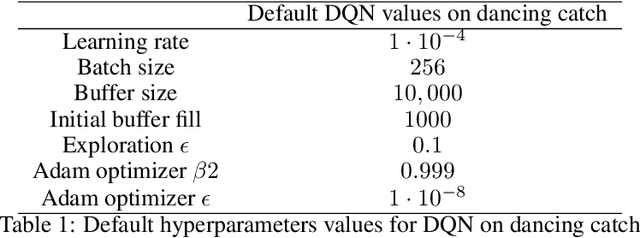


In continual or lifelong reinforcement learning access to the environment should be limited. If we aspire to design algorithms that can run for long-periods of time, continually adapting to new, unexpected situations then we must be willing to deploy our agents without tuning their hyperparameters over the agent's entire lifetime. The standard practice in deep RL -- and even continual RL -- is to assume unfettered access to deployment environment for the full lifetime of the agent. This paper explores the notion that progress in lifelong RL research has been held back by inappropriate empirical methodologies. In this paper we propose a new approach for tuning and evaluating lifelong RL agents where only one percent of the experiment data can be used for hyperparameter tuning. We then conduct an empirical study of DQN and Soft Actor Critic across a variety of continuing and non-stationary domains. We find both methods generally perform poorly when restricted to one-percent tuning, whereas several algorithmic mitigations designed to maintain network plasticity perform surprising well. In addition, we find that properties designed to measure the network's ability to learn continually indeed correlate with performance under one-percent tuning.