 Add to Chrome
 Add to Firefox
 Add to Edge
Classical State Preparation for Variational Quantum Algorithms via Reinforcement Learning
May 22, 2026
Variational Quantum Algorithms (VQAs) potentially offer a pathway to practical quantum advantage, but their optimization is heavily hindered by barren plateaus and numerous local minima. While classically simulable Clifford circuits can warm-start VQAs to accelerate convergence, existing heuristic-based initialization methods struggle to scale within vast combinatorial search spaces. To overcome this bottleneck, we propose CRiSP (a Clifford Reinforcement Learning agent for State Preparation), a framework that formulates discrete prefix selection as a sequential decision-making problem. CRiSP utilizes Neural-Guided Monte Carlo Tree Search, driven by a Transformer-based policy trained via self-play, to insert learned Clifford gates before fixed parameterized rotations. This enables the construction of high-quality initial states entirely through polynomial-time classical stabilizer simulation without altering the underlying circuit architecture. By integrating a curriculum learning strategy that progressively expands the search horizon, the agent efficiently scales to deep circuits. Evaluated on QAOA benchmarks of up to $22$ qubits and $1{,}370$ parameters, CRiSP outperforms state-of-the-art Clifford initialization methods by a mean of $3.17\times$ (max $45.02\times$) in average energy accuracy and $2.44\times$ (max $16.01\times$) in best-achieved energy accuracy. Assessments on VQE tasks further demonstrate the framework's robustness and generalizability.

Benchmarking variational quantum circuits with permutation symmetry
Nov 23, 2022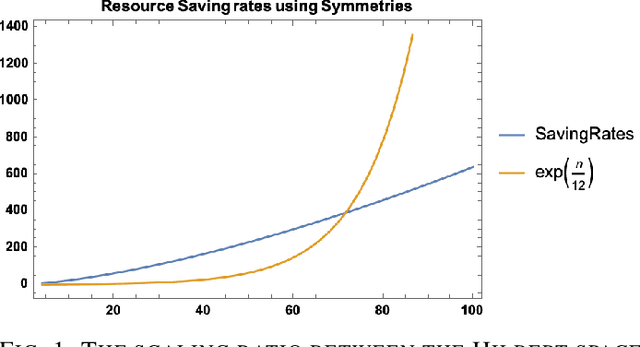
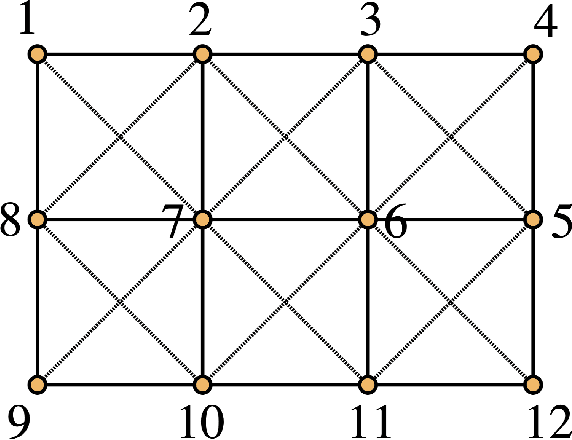
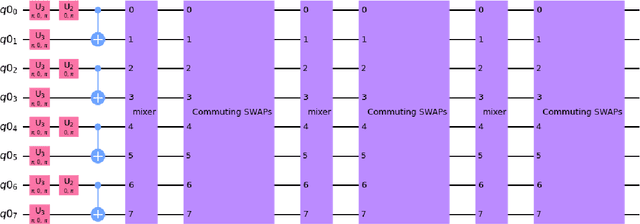
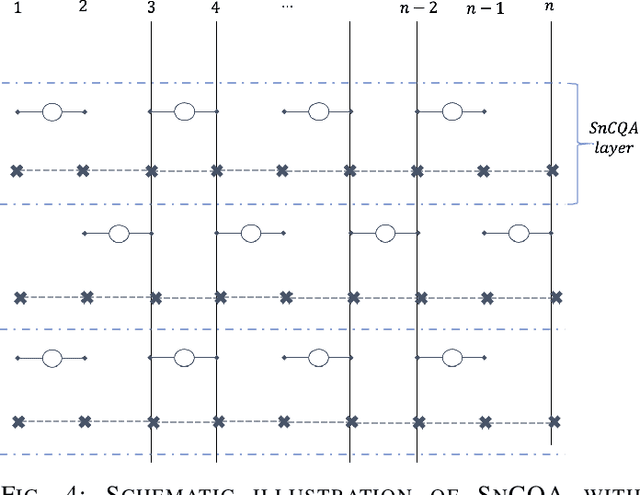
We propose SnCQA, a set of hardware-efficient variational circuits of equivariant quantum convolutional circuits respective to permutation symmetries and spatial lattice symmetries with the number of qubits $n$. By exploiting permutation symmetries of the system, such as lattice Hamiltonians common to many quantum many-body and quantum chemistry problems, Our quantum neural networks are suitable for solving machine learning problems where permutation symmetries are present, which could lead to significant savings of computational costs. Aside from its theoretical novelty, we find our simulations perform well in practical instances of learning ground states in quantum computational chemistry, where we could achieve comparable performances to traditional methods with few tens of parameters. Compared to other traditional variational quantum circuits, such as the pure hardware-efficient ansatz (pHEA), we show that SnCQA is more scalable, accurate, and noise resilient (with $20\times$ better performance on $3 \times 4$ square lattice and $200\% - 1000\%$ resource savings in various lattice sizes and key criterions such as the number of layers, parameters, and times to converge in our cases), suggesting a potentially favorable experiment on near-time quantum devices.