 Add to Chrome
 Add to Firefox
 Add to Edge
EM-NeSy: Expectation Maximization for Neurosymbolic Learning
Jun 12, 2026
Neurosymbolic (NeSy) models integrate neural networks and symbolic reasoning for robust and interpretable AI. State-of-the-art NeSy models require that the symbolic component is expressed in a differentiable way, often complicating the use of approximate inference. We propose EM-NeSy which casts probabilistic NeSy learning as an instance of the Expectation-Maximization (EM) algorithm. In the expectation step, we compute the posterior over the neurally predicted symbols conditioned on the label via probabilistic inference. In the maximization step, we update the neural parameters based on this posterior using gradient descent only through the neural component. This formulation unlocks the full potential of the EM algorithm for NeSy learning. It allows NeSy to extend naturally to approximate reasoning without any additional modifications or differentiability requirements of the symbolic component. Furthermore, it recovers the standard end-to-end gradient-based NeSy setting under exact inference. Our experimental results demonstrate the scalability and computational efficiency of EM-NeSy.

The Standard Interpretable Model: A general theory of interpretable machine learning to deductively design interpretable methods using Lagrangian mechanics
Jun 10, 2026As Artificial Intelligence models grow in complexity, interpretability has become an indispensable tool for understanding, debugging, and controlling their computations. However, interpretability lacks general theories to deductively design interpretable methods. This gap between theories and methods results in a fragmented literature and inconsistent evaluation protocols. To fill this gap, we introduce the Standard Interpretable Model (SIM), a general theory grounded in Lagrangian mechanics that enables the deductive design of interpretable methods. Specifically, the SIM summarises, in a set of premises, what interpretability is for a target user. From these premises, the SIM systematically derives interpretability symmetries and corresponding constraints, which shape the landscape of a Lagrangian whose minima correspond to optimal interpretable models. To reach the minima, one can either update the parameter values of an opaque model to make it more interpretable or compile constraints into an interpretable architecture. We empirically show that the SIM identifies and solves limitations of existing methods (including traditional, concept-based, and mechanistic interpretability), highlights underexplored research directions, and informs the design of core programming interfaces. Beyond being a research method, the deductive nature of the SIM offers pedagogical grounding for interpretability curricula and may shift the scientific community's perspective of a discipline that has long been fragmented.
DeepLog: A Software Framework for Modular Neurosymbolic AI
May 11, 2026DeepLog is an operational neurosymbolic framework that unifies logic and deep learning within standard PyTorch workflows. While existing neurosymbolic systems focus on a particular paradigm and semantics, DeepLog serves as a universal backend that can emulate many systems in the neurosymbolic alphabet soup. By treating diverse neurosymbolic languages as high-level specifications, the DeepLog software automatically compiles them into optimized arithmetic circuits. This design lowers the barrier for machine learning practitioners by treating logic as composable modules, while providing neurosymbolic developers with a shared, high-performance basis for prototyping new integration strategies. The code is available here: https://github.com/ML-KULeuven/deeplog
Interpretability in Deep Time Series Models Demands Semantic Alignment
Feb 02, 2026Deep time series models continue to improve predictive performance, yet their deployment remains limited by their black-box nature. In response, existing interpretability approaches in the field keep focusing on explaining the internal model computations, without addressing whether they align or not with how a human would reason about the studied phenomenon. Instead, we state interpretability in deep time series models should pursue semantic alignment: predictions should be expressed in terms of variables that are meaningful to the end user, mediated by spatial and temporal mechanisms that admit user-dependent constraints. In this paper, we formalize this requirement and require that, once established, semantic alignment must be preserved under temporal evolution: a constraint with no analog in static settings. Provided with this definition, we outline a blueprint for semantically aligned deep time series models, identify properties that support trust, and discuss implications for model design.
Actionable Interpretability Must Be Defined in Terms of Symmetries
Jan 19, 2026This paper argues that interpretability research in Artificial Intelligence is fundamentally ill-posed as existing definitions of interpretability are not *actionable*: they fail to provide formal principles from which concrete modelling and inferential rules can be derived. We posit that for a definition of interpretability to be actionable, it must be given in terms of *symmetries*. We hypothesise that four symmetries suffice to (i) motivate core interpretability properties, (ii) characterize the class of interpretable models, and (iii) derive a unified formulation of interpretable inference (e.g., alignment, interventions, and counterfactuals) as a form of Bayesian inversion.
DeepProofLog: Efficient Proving in Deep Stochastic Logic Programs
Nov 11, 2025Neurosymbolic (NeSy) AI aims to combine the strengths of neural architectures and symbolic reasoning to improve the accuracy, interpretability, and generalization capability of AI models. While logic inference on top of subsymbolic modules has been shown to effectively guarantee these properties, this often comes at the cost of reduced scalability, which can severely limit the usability of NeSy models. This paper introduces DeepProofLog (DPrL), a novel NeSy system based on stochastic logic programs, which addresses the scalability limitations of previous methods. DPrL parameterizes all derivation steps with neural networks, allowing efficient neural guidance over the proving system. Additionally, we establish a formal mapping between the resolution process of our deep stochastic logic programs and Markov Decision Processes, enabling the application of dynamic programming and reinforcement learning techniques for efficient inference and learning. This theoretical connection improves scalability for complex proof spaces and large knowledge bases. Our experiments on standard NeSy benchmarks and knowledge graph reasoning tasks demonstrate that DPrL outperforms existing state-of-the-art NeSy systems, advancing scalability to larger and more complex settings than previously possible.
DeepGraphLog for Layered Neurosymbolic AI
Sep 09, 2025Neurosymbolic AI (NeSy) aims to integrate the statistical strengths of neural networks with the interpretability and structure of symbolic reasoning. However, current NeSy frameworks like DeepProbLog enforce a fixed flow where symbolic reasoning always follows neural processing. This restricts their ability to model complex dependencies, especially in irregular data structures such as graphs. In this work, we introduce DeepGraphLog, a novel NeSy framework that extends ProbLog with Graph Neural Predicates. DeepGraphLog enables multi-layer neural-symbolic reasoning, allowing neural and symbolic components to be layered in arbitrary order. In contrast to DeepProbLog, which cannot handle symbolic reasoning via neural methods, DeepGraphLog treats symbolic representations as graphs, enabling them to be processed by Graph Neural Networks (GNNs). We showcase the capabilities of DeepGraphLog on tasks in planning, knowledge graph completion with distant supervision, and GNN expressivity. Our results demonstrate that DeepGraphLog effectively captures complex relational dependencies, overcoming key limitations of existing NeSy systems. By broadening the applicability of neurosymbolic AI to graph-structured domains, DeepGraphLog offers a more expressive and flexible framework for neural-symbolic integration.
Valid Text-to-SQL Generation with Unification-based DeepStochLog
Mar 17, 2025Large language models have been used to translate natural language questions to SQL queries. Without hard constraints on syntax and database schema, they occasionally produce invalid queries that are not executable. These failures limit the usage of these systems in real-life scenarios. We propose a neurosymbolic framework that imposes SQL syntax and schema constraints with unification-based definite clause grammars and thus guarantees the generation of valid queries. Our framework also builds a bi-directional interface to language models to leverage their natural language understanding abilities. The evaluation results on a subset of SQL grammars show that all our output queries are valid. This work is the first step towards extending language models with unification-based grammars. We demonstrate this extension enhances the validity, execution accuracy, and ground truth alignment of the underlying language model by a large margin. Our code is available at https://github.com/ML-KULeuven/deepstochlog-lm.
Neural Interpretable Reasoning
Feb 17, 2025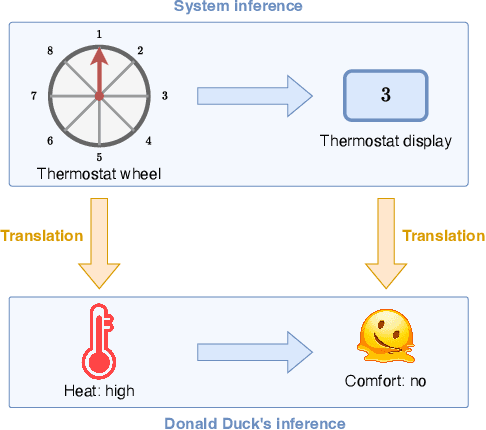
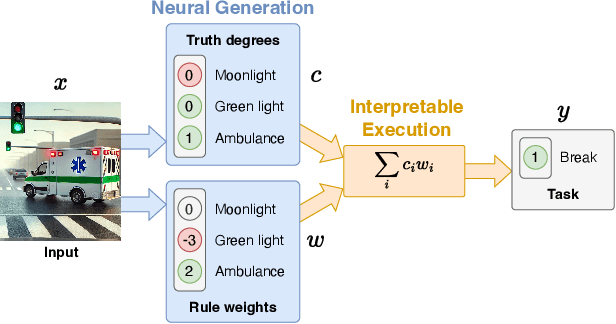
We formalize a novel modeling framework for achieving interpretability in deep learning, anchored in the principle of inference equivariance. While the direct verification of interpretability scales exponentially with the number of variables of the system, we show that this complexity can be mitigated by treating interpretability as a Markovian property and employing neural re-parametrization techniques. Building on these insights, we propose a new modeling paradigm -- neural generation and interpretable execution -- that enables scalable verification of equivariance. This paradigm provides a general approach for designing Neural Interpretable Reasoners that are not only expressive but also transparent.
Relational Neurosymbolic Markov Models
Dec 17, 2024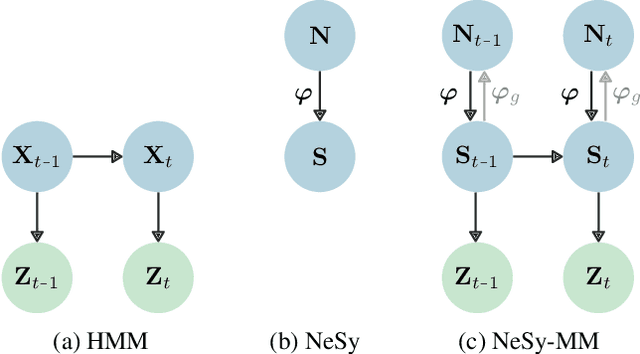
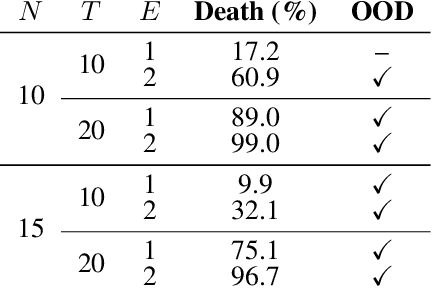


Sequential problems are ubiquitous in AI, such as in reinforcement learning or natural language processing. State-of-the-art deep sequential models, like transformers, excel in these settings but fail to guarantee the satisfaction of constraints necessary for trustworthy deployment. In contrast, neurosymbolic AI (NeSy) provides a sound formalism to enforce constraints in deep probabilistic models but scales exponentially on sequential problems. To overcome these limitations, we introduce relational neurosymbolic Markov models (NeSy-MMs), a new class of end-to-end differentiable sequential models that integrate and provably satisfy relational logical constraints. We propose a strategy for inference and learning that scales on sequential settings, and that combines approximate Bayesian inference, automated reasoning, and gradient estimation. Our experiments show that NeSy-MMs can solve problems beyond the current state-of-the-art in neurosymbolic AI and still provide strong guarantees with respect to desired properties. Moreover, we show that our models are more interpretable and that constraints can be adapted at test time to out-of-distribution scenarios.