 Add to Chrome
 Add to Firefox
 Add to Edge
$\mathbfλ$-VAE: Variance Equalization for Posterior Collapse
Jul 06, 2026
Variational Autoencoders (VAEs) frequently suffer from posterior collapse, a failure mode in which the approximate posterior converges to the prior, rendering the latent code uninformative. Despite extensive research, a unified account of why collapse occurs has remained an open question. We identify and formalize two logically independent but coupled causes. \emph{Gradient imbalance} occurs when the decoder's reconstruction signal vanishes faster than the $\mathbb{KL}$ regularization pressure as the posterior widens. \emph{Information gap} occurs when the stochastic sampling step discards a substantial fraction of the encoder's computed representation, attenuating decoder sensitivity and making collapse inexpensive. Both causes share the same collapse trajectory, and we show that the information gap is algebraically equivalent to mismatch between the aggregate posterior and the prior, unifying two pathologies. Subsequently, we introduce $λ$-VAE, which resolves both causes through a single modification to the reparameterization step: the sampling noise is scaled by per-dimension exponent, while the $\mathbb{KL}$ penalty retains the original posterior variance. This asymmetry shifts the stable training attractor away from the degenerate collapsed state, driving all latent dimensions toward the same equilibrium -- a mechanism we term \emph{variance equalization}. A closed-form optimal exponent per dimension follows from a net information gain objective, with a single hyperparameter controlling the reconstruction-generation tradeoff. We validate on standard benchmarks (Binary MNIST, Binary Omniglot, CIFAR-10, CelebA-64), showing consistent reductions in collapsed dimensions, information capacity gains of up to $2.8\times$ nats, and reconstruction quality improvements of up to $+0.33$ BPD.

Localized Trajectories for 2D and 3D Action Recognition
Apr 10, 2019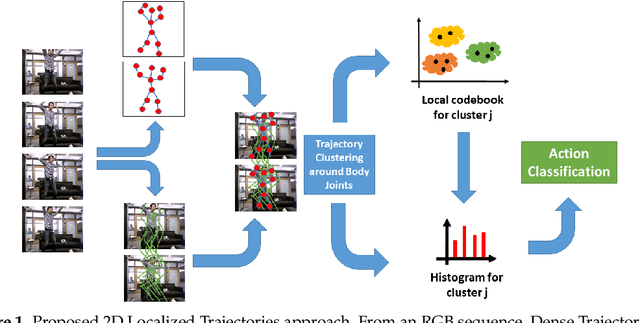
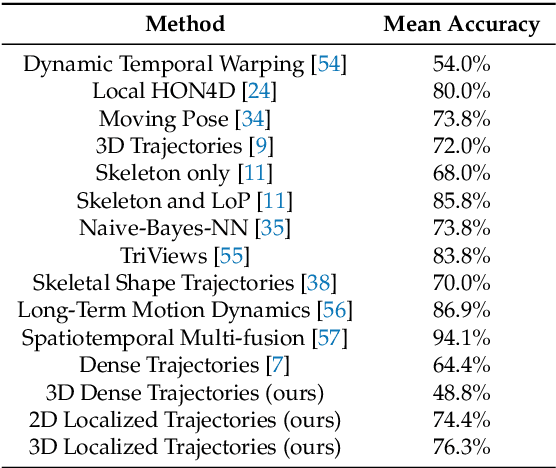
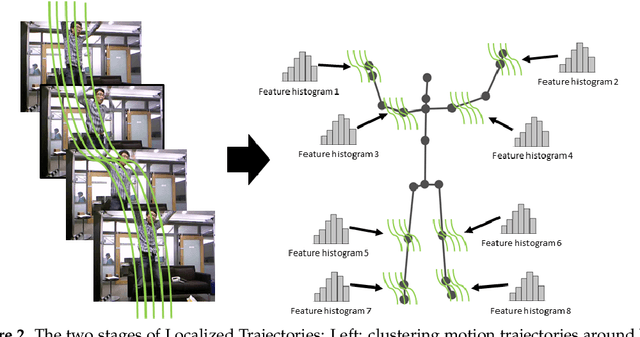
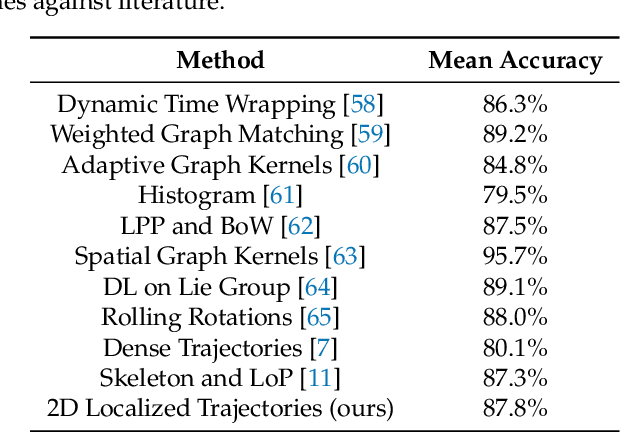
The Dense Trajectories concept is one of the most successful approaches in action recognition, suitable for scenarios involving a significant amount of motion. However, due to noise and background motion, many generated trajectories are irrelevant to the actual human activity and can potentially lead to performance degradation. In this paper, we propose Localized Trajectories as an improved version of Dense Trajectories where motion trajectories are clustered around human body joints provided by RGB-D cameras and then encoded by local Bag-of-Words. As a result, the Localized Trajectories concept provides a more discriminative representation of actions as compared to Dense Trajectories. Moreover, we generalize Localized Trajectories to 3D by using the modalities offered by RGB-D cameras. One of the main advantages of using RGB-D data to generate trajectories is that they include radial displacements that are perpendicular to the image plane. Extensive experiments and analysis are carried out on five different datasets.