 Add to Chrome
 Add to Firefox
 Add to Edge
A Unified Framework for Comprehensive Cardiac CT Segmentation and Phenotyping: Human-in-the-Loop Data Annotation, Vision Foundation Model Development, Multicenter Evaluation and Clinical Validation
Jul 13, 2026
Comprehensive quantification of cardiac structures from computed tomography (CT) remains limited not by data availability but by the scalability of measurements, which makes routine use impractical. Here we present a unified framework for comprehensive cardiac CT segmentation and phenotyping that combines a human-in-the-loop annotation pipeline, a cardiac CT augmentation technique, and a self-supervised foundation model pre-trained on 60,000 unlabeled cardiac CT scans. Using this approach, we assembled the largest and most comprehensive expert-annotated cardiac CT segmentation dataset to date, comprising 1598 cases and 14 distinct cardiac structures (1000 for training, 598 for the external test set). Across five external datasets, the framework segmented all structures more accurately and comprehensively than existing open-source tools. Self-supervised pre-training improved labeling efficiency, with the most significant gains observed during external evaluation in the low-data regime. Benchmarking across convolutional, transformer, and state-space architectures showed comparable performance, indicating that data quality and pre-training, rather than architecture, drove accuracy. The framework was scaled to population-level phenotyping, with segmented anatomy that carries functionally relevant information about ventricular function and disease severity beyond demographic variables. By openly releasing the largest dataset with human labels, code, model weights, a CT augmentation library, and software, this work provides a reproducible foundation for opportunistic cardiac phenotyping from routinely acquired CT scans.

From Claims to Evidence: A Unified Framework and Critical Analysis of CNN vs. Transformer vs. Mamba in Medical Image Segmentation
Mar 03, 2025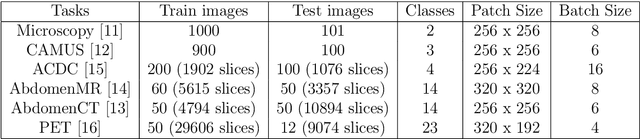
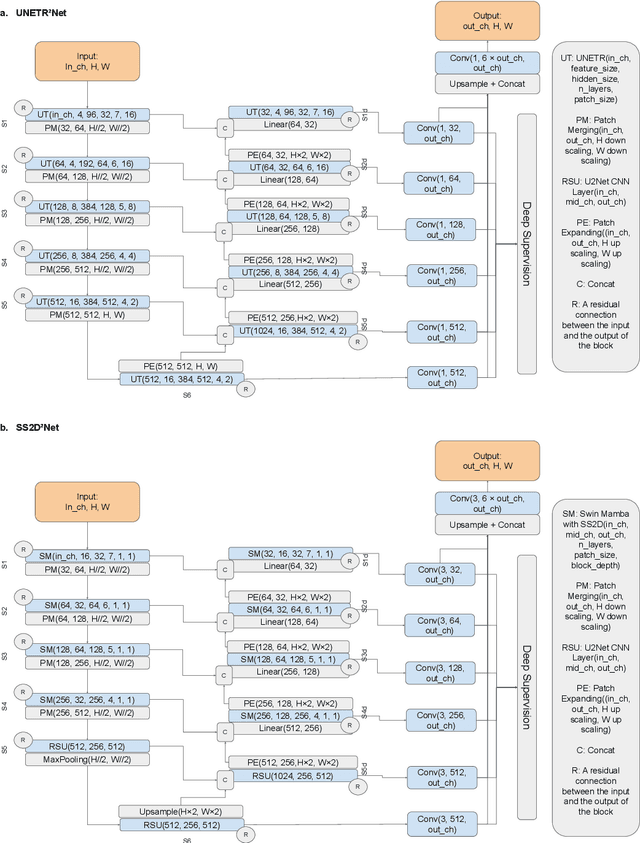
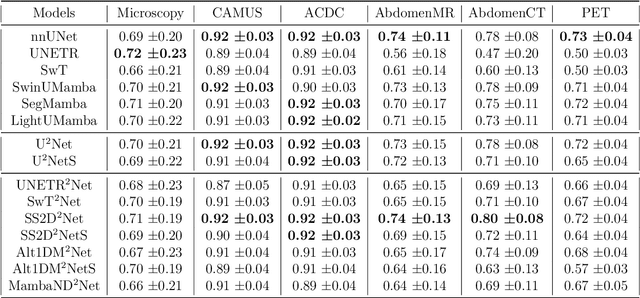
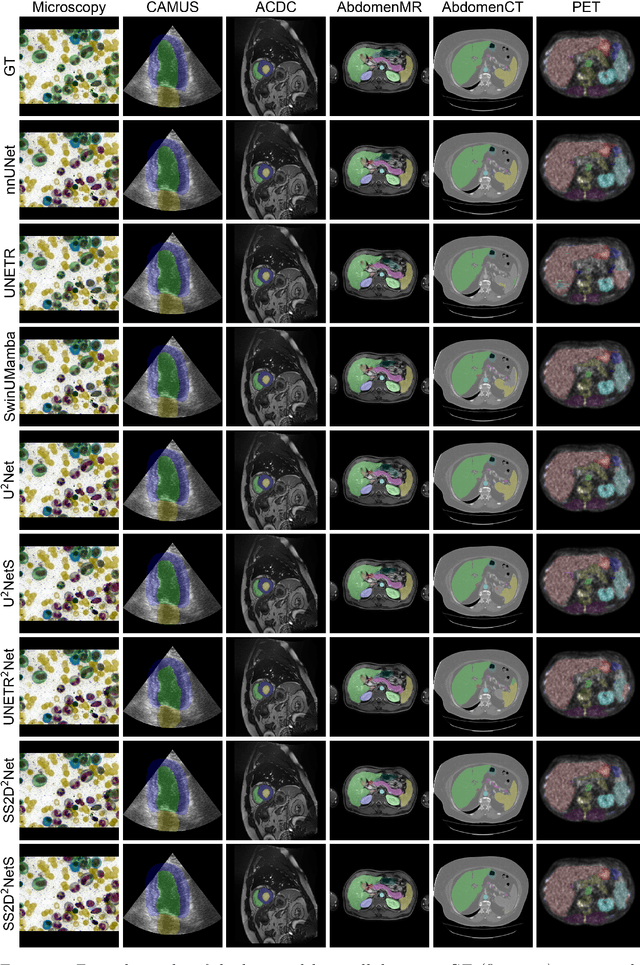
While numerous architectures for medical image segmentation have been proposed, achieving competitive performance with state-of-the-art models networks such as nnUNet, still leave room for further innovation. In this work, we introduce nnUZoo, an open source benchmarking framework built upon nnUNet, which incorporates various deep learning architectures, including CNNs, Transformers, and Mamba-based models. Using this framework, we provide a fair comparison to demystify performance claims across different medical image segmentation tasks. Additionally, in an effort to enrich the benchmarking, we explored five new architectures based on Mamba and Transformers, collectively named X2Net, and integrated them into nnUZoo for further evaluation. The proposed models combine the features of conventional U2Net, nnUNet, CNN, Transformer, and Mamba layers and architectures, called X2Net (UNETR2Net (UNETR), SwT2Net (SwinTransformer), SS2D2Net (SwinUMamba), Alt1DM2Net (LightUMamba), and MambaND2Net (MambaND)). We extensively evaluate the performance of different models on six diverse medical image segmentation datasets, including microscopy, ultrasound, CT, MRI, and PET, covering various body parts, organs, and labels. We compare their performance, in terms of dice score and computational efficiency, against their baseline models, U2Net, and nnUNet. CNN models like nnUNet and U2Net demonstrated both speed and accuracy, making them effective choices for medical image segmentation tasks. Transformer-based models, while promising for certain imaging modalities, exhibited high computational costs. Proposed Mamba-based X2Net architecture (SS2D2Net) achieved competitive accuracy with no significantly difference from nnUNet and U2Net, while using fewer parameters. However, they required significantly longer training time, highlighting a trade-off between model efficiency and computational cost.