 Add to Chrome
 Add to Firefox
 Add to Edge
Perceptually Aligning Representations of Music via Noise-Augmented Autoencoders
Nov 10, 2025
We argue that training autoencoders to reconstruct inputs from noised versions of their encodings, when combined with perceptual losses, yields encodings that are structured according to a perceptual hierarchy. We demonstrate the emergence of this hierarchical structure by showing that, after training an audio autoencoder in this manner, perceptually salient information is captured in coarser representation structures than with conventional training. Furthermore, we show that such perceptual hierarchies improve latent diffusion decoding in the context of estimating surprisal in music pitches and predicting EEG-brain responses to music listening. Pretrained weights are available on github.com/CPJKU/pa-audioic.

Estimating Musical Surprisal in Audio
Jan 13, 2025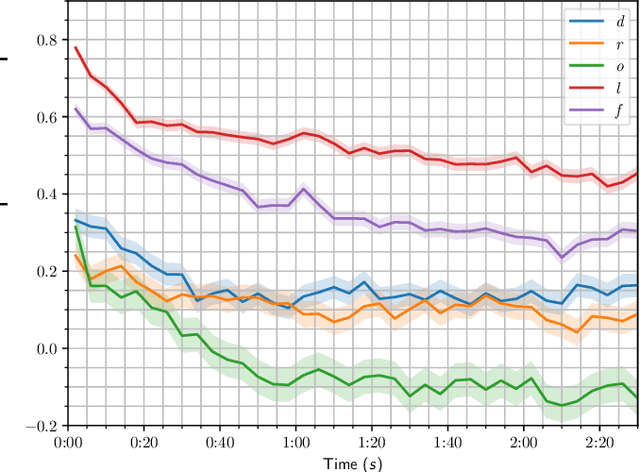
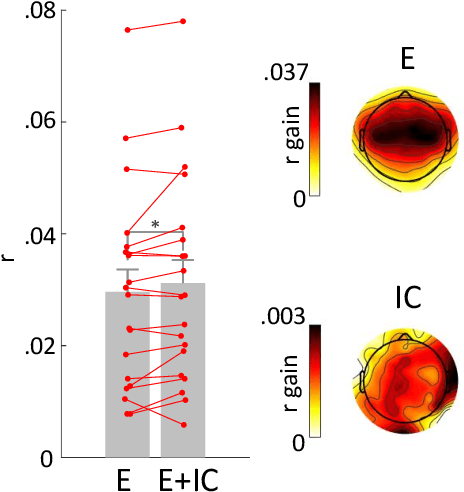
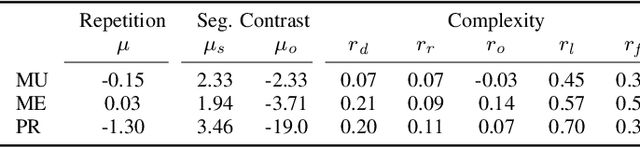
In modeling musical surprisal expectancy with computational methods, it has been proposed to use the information content (IC) of one-step predictions from an autoregressive model as a proxy for surprisal in symbolic music. With an appropriately chosen model, the IC of musical events has been shown to correlate with human perception of surprise and complexity aspects, including tonal and rhythmic complexity. This work investigates whether an analogous methodology can be applied to music audio. We train an autoregressive Transformer model to predict compressed latent audio representations of a pretrained autoencoder network. We verify learning effects by estimating the decrease in IC with repetitions. We investigate the mean IC of musical segment types (e.g., A or B) and find that segment types appearing later in a piece have a higher IC than earlier ones on average. We investigate the IC's relation to audio and musical features and find it correlated with timbral variations and loudness and, to a lesser extent, dissonance, rhythmic complexity, and onset density related to audio and musical features. Finally, we investigate if the IC can predict EEG responses to songs and thus model humans' surprisal in music. We provide code for our method on github.com/sonycslparis/audioic.