 Add to Chrome
 Add to Firefox
 Add to Edge
Enhancing LLMs through human feedback: a journey towards self-improvement
Jul 13, 2026
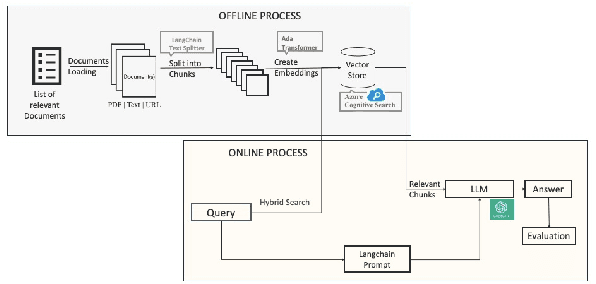
In the rapidly evolving landscape of information retrieval systems, the ability to adapt and improve through user feedback is paramount. This study introduces a novel methodology for refining the performance of a primary Retrieval Augmented Generation (RAG) system by strategically integrating an auxiliary feedback RAG system. By systematically harnessing human-generated feedback, the approach aims to enhance the accuracy, relevance, and overall quality of responses, driving the system towards self-improvement. Central to this methodology is a human-in-the-loop implementation, where user feedback is continuously collected, classified, and integrated into the inference workflow, enabling the system to learn and evolve iteratively. To validate the effectiveness of this approach, the study employs rigorous testing against three diverse benchmark datasets focused on general and custom domain knowledge, utilizing a LLM-as-a-Judge evaluation strategy. This comprehensive framework not only underscores the transformative potential of feedback-driven enhancements in RAG systems but also sets a precedent for future research in adaptive information retrieval technologies, marking a significant step in the journey towards autonomous refinement and optimization through user engagement.

Self-Improving Customer Review Response Generation Based on LLMs
May 06, 2024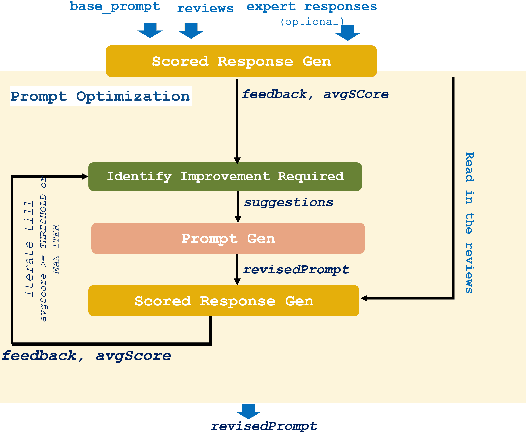

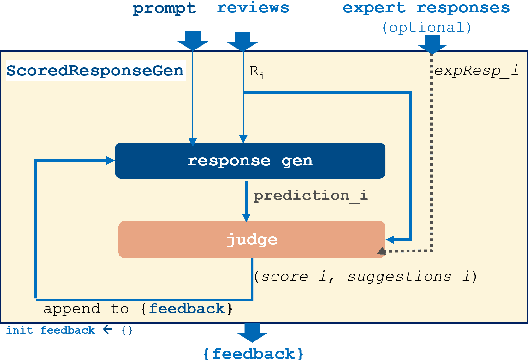
Previous studies have demonstrated that proactive interaction with user reviews has a positive impact on the perception of app users and encourages them to submit revised ratings. Nevertheless, developers encounter challenges in managing a high volume of reviews, particularly in the case of popular apps with a substantial influx of daily reviews. Consequently, there is a demand for automated solutions aimed at streamlining the process of responding to user reviews. To address this, we have developed a new system for generating automatic responses by leveraging user-contributed documents with the help of retrieval-augmented generation (RAG) and advanced Large Language Models (LLMs). Our solution, named SCRABLE, represents an adaptive customer review response automation that enhances itself with self-optimizing prompts and a judging mechanism based on LLMs. Additionally, we introduce an automatic scoring mechanism that mimics the role of a human evaluator to assess the quality of responses generated in customer review domains. Extensive experiments and analyses conducted on real-world datasets reveal that our method is effective in producing high-quality responses, yielding improvement of more than 8.5% compared to the baseline. Further validation through manual examination of the generated responses underscores the efficacy our proposed system.