 Add to Chrome
 Add to Firefox
 Add to Edge
Comparing Dynamical Models Through Diffeomorphic Vector Field Alignment
Dec 21, 2025
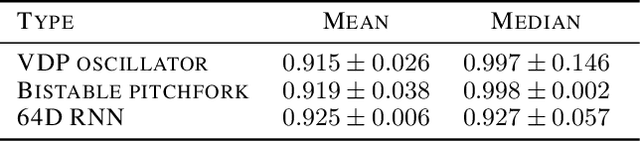
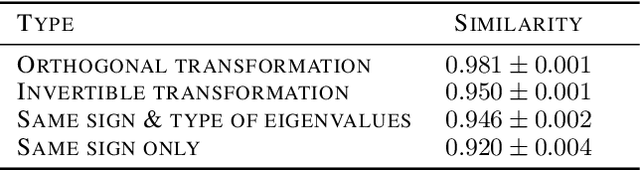
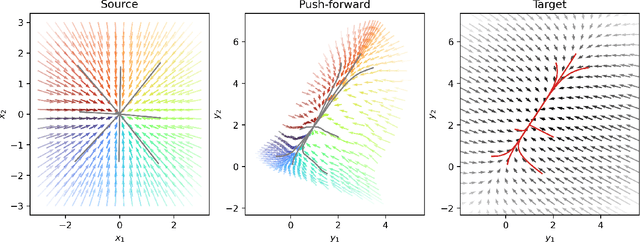
Dynamical systems models such as recurrent neural networks (RNNs) are increasingly popular in theoretical neuroscience for hypothesis-generation and data analysis. Evaluating the dynamics in such models is key to understanding their learned generative mechanisms. However, such evaluation is impeded by two major challenges: First, comparison of learned dynamics across models is difficult because there is no enforced equivalence of their coordinate systems. Second, identification of mechanistically important low-dimensional motifs (e.g., limit sets) is intractable in high-dimensional nonlinear models such as RNNs. Here, we propose a comprehensive framework to address these two issues, termed Diffeomorphic vector field alignment FOR learned Models (DFORM). DFORM learns a nonlinear coordinate transformation between the state spaces of two dynamical systems, which aligns their trajectories in a maximally one-to-one manner. In so doing, DFORM enables an assessment of whether two models exhibit topological equivalence, i.e., similar mechanisms despite differences in coordinate systems. A byproduct of this method is a means to locate dynamical motifs on low-dimensional manifolds embedded within higher-dimensional systems. We verified DFORM's ability to identify linear and nonlinear coordinate transformations using canonical topologically equivalent systems, RNNs, and systems related by nonlinear flows. DFORM was also shown to provide a quantification of similarity between topologically distinct systems. We then demonstrated that DFORM can locate important dynamical motifs including invariant manifolds and saddle limit sets within high-dimensional models. Finally, using a set of RNN models trained on human functional MRI (fMRI) recordings, we illustrated that DFORM can identify limit cycles from high-dimensional data-driven models, which agreed well with prior numerical analysis.

Synergistic pathways of modulation enable robust task packing within neural dynamics
Aug 02, 2024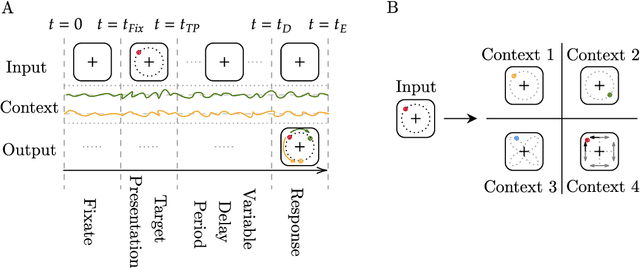
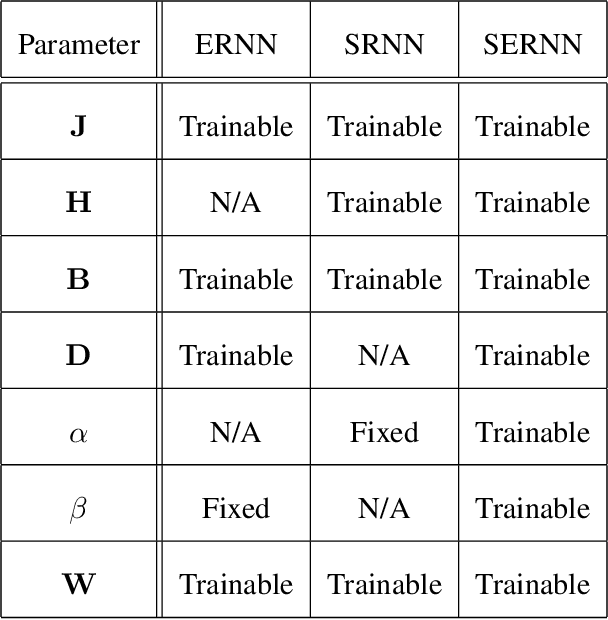
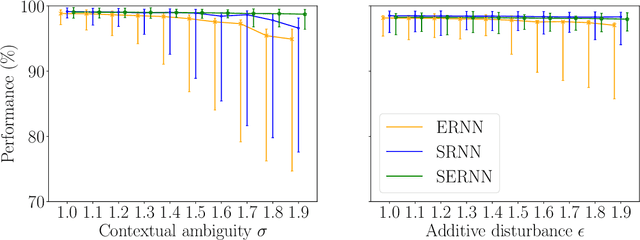
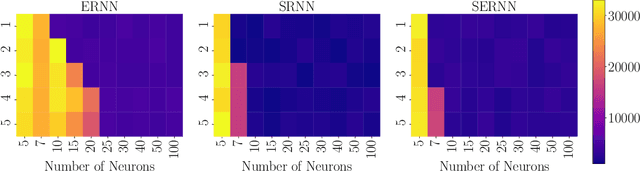
Understanding how brain networks learn and manage multiple tasks simultaneously is of interest in both neuroscience and artificial intelligence. In this regard, a recent research thread in theoretical neuroscience has focused on how recurrent neural network models and their internal dynamics enact multi-task learning. To manage different tasks requires a mechanism to convey information about task identity or context into the model, which from a biological perspective may involve mechanisms of neuromodulation. In this study, we use recurrent network models to probe the distinctions between two forms of contextual modulation of neural dynamics, at the level of neuronal excitability and at the level of synaptic strength. We characterize these mechanisms in terms of their functional outcomes, focusing on their robustness to context ambiguity and, relatedly, their efficiency with respect to packing multiple tasks into finite size networks. We also demonstrate distinction between these mechanisms at the level of the neuronal dynamics they induce. Together, these characterizations indicate complementarity and synergy in how these mechanisms act, potentially over multiple time-scales, toward enhancing robustness of multi-task learning.
DFORM: Diffeomorphic vector field alignment for assessing dynamics across learned models
Feb 15, 2024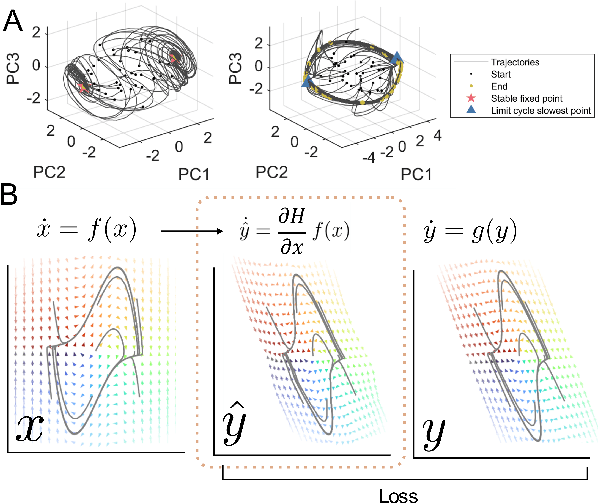
Dynamical system models such as Recurrent Neural Networks (RNNs) have become increasingly popular as hypothesis-generating tools in scientific research. Evaluating the dynamics in such networks is key to understanding their learned generative mechanisms. However, comparison of learned dynamics across models is challenging due to their inherent nonlinearity and because a priori there is no enforced equivalence of their coordinate systems. Here, we propose the DFORM (Diffeomorphic vector field alignment for comparing dynamics across learned models) framework. DFORM learns a nonlinear coordinate transformation which provides a continuous, maximally one-to-one mapping between the trajectories of learned models, thus approximating a diffeomorphism between them. The mismatch between DFORM-transformed vector fields defines the orbital similarity between two models, thus providing a generalization of the concepts of smooth orbital and topological equivalence. As an example, we apply DFORM to models trained on a canonical neuroscience task, showing that learned dynamics may be functionally similar, despite overt differences in attractor landscapes.