 Add to Chrome
 Add to Firefox
 Add to Edge
Generating from Discrete Distributions Using Diffusions: Insights from Random Constraint Satisfaction Problems
Mar 21, 2026
Generating data from discrete distributions is important for a number of application domains including text, tabular data, and genomic data. Several groups have recently used random $k$-satisfiability ($k$-SAT) as a synthetic benchmark for new generative techniques. In this paper, we show that fundamental insights from the theory of random constraint satisfaction problems have observable implications (sometime contradicting intuition) on the behavior of generative techniques on such benchmarks. More precisely, we study the problem of generating a uniformly random solution of a given (random) $k$-SAT or $k$-XORSAT formula. Among other findings, we observe that: $(i)$~Continuous diffusions outperform masked discrete diffusions; $(ii)$~Learned diffusions can match the theoretical `ideal' accuracy; $(iii)$~Smart ordering of the variables can significantly improve accuracy, although not following popular heuristics.

Towards a statistical theory of data selection under weak supervision
Sep 25, 2023
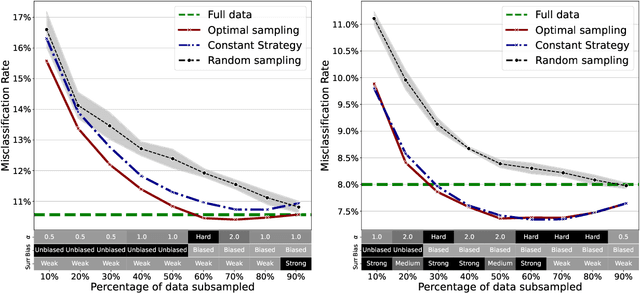
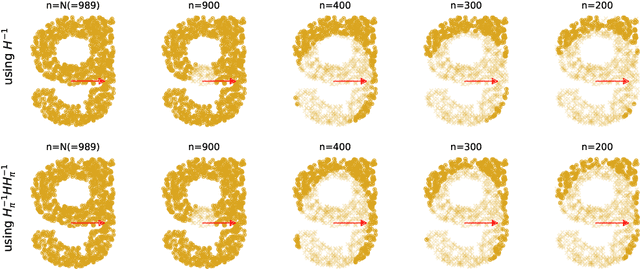

Given a sample of size $N$, it is often useful to select a subsample of smaller size $n<N$ to be used for statistical estimation or learning. Such a data selection step is useful to reduce the requirements of data labeling and the computational complexity of learning. We assume to be given $N$ unlabeled samples $\{{\boldsymbol x}_i\}_{i\le N}$, and to be given access to a `surrogate model' that can predict labels $y_i$ better than random guessing. Our goal is to select a subset of the samples, to be denoted by $\{{\boldsymbol x}_i\}_{i\in G}$, of size $|G|=n<N$. We then acquire labels for this set and we use them to train a model via regularized empirical risk minimization. By using a mixture of numerical experiments on real and synthetic data, and mathematical derivations under low- and high- dimensional asymptotics, we show that: $(i)$~Data selection can be very effective, in particular beating training on the full sample in some cases; $(ii)$~Certain popular choices in data selection methods (e.g. unbiased reweighted subsampling, or influence function-based subsampling) can be substantially suboptimal.