 Add to Chrome
 Add to Firefox
 Add to Edge
A Survey on Data-Driven Models for Soil Moisture Regression and Classification
Jun 16, 2026
Soil Moisture (SM) modelling constitutes a complex spatiotemporal learning problem characterised by nonlinear environmental interactions, heterogeneous data sources, and limited ground observations. Physics-based approaches, such as water balance models, rely on explicit hydrological equations and high-quality inputs, but their computational cost and scalability limitations restrict large-scale deployment. Data-driven artificial intelligence (AI) methods have emerged as flexible alternatives, enabling the extraction of empirical relationships between soil moisture and environmental variables with reduced modelling assumptions. This work presents a structured survey of AI-based models for soil moisture estimation and classification. Existing approaches are organized into five categories: (a) statistical time-series models, (b) geostatistical methods (c) classical machine learning (ML) models, (d) Deep Learning (DL) models and (e) Probabilistic/Bayesian methods. These models leverage historical soil moisture records, meteorological variables, vegetation indices, topography, soil characteristics, and geolocation data to perform regression or classification tasks.

Visual Area Coverage with Attitude-Dependent Camera Footprints by Particle Harvesting
Sep 15, 2019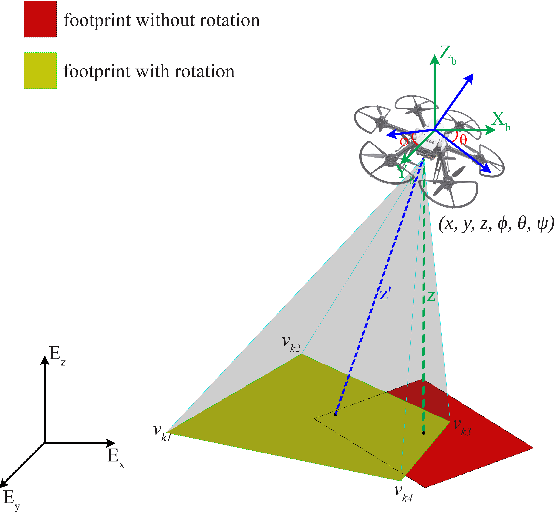
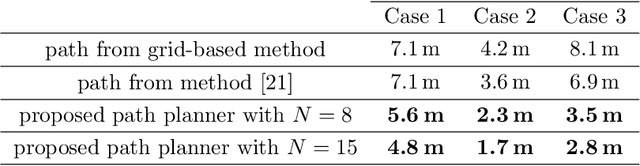
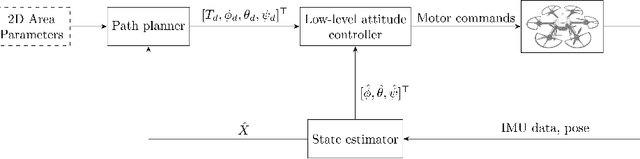
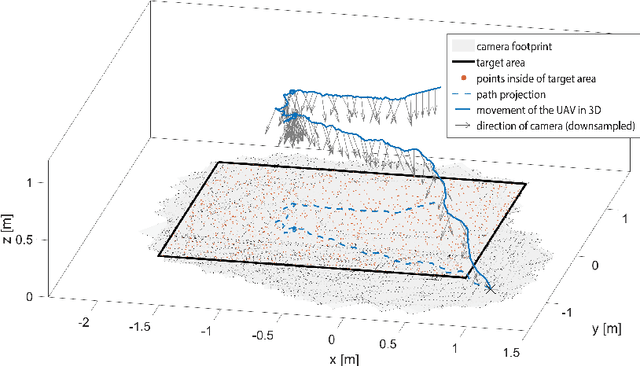
In aerial visual area coverage missions, the camera footprint changes over time based on the camera position and orientation -- a fact that complicates the whole process of coverage and path planning. This article proposes a solution to the problem of visual coverage by filling the target area with a set of randomly distributed particles and harvesting them by camera footprints. This way, high coverage is obtained at a low computational cost. In this approach, the path planner considers six degrees of freedom (DoF) for the camera movement and commands thrust and attitude references to a lower layer controller, while maximizing the covered area and coverage quality. The proposed method requires a priori information of the boundaries of the target area and can handle areas of very complex and highly non-convex geometry. The effectiveness of the approach is demonstrated in multiple simulations in terms of computational efficiency and coverage.