 Add to Chrome
 Add to Firefox
 Add to Edge
Better Learning-Augmented Spanning Tree Algorithms via Metric Forest Completion
Feb 27, 2026
We present improved learning-augmented algorithms for finding an approximate minimum spanning tree (MST) for points in an arbitrary metric space. Our work follows a recent framework called metric forest completion (MFC), where the learned input is a forest that must be given additional edges to form a full spanning tree. Veldt et al. (2025) showed that optimally completing the forest takes $Ω(n^2)$ time, but designed a 2.62-approximation for MFC with subquadratic complexity. The same method is a $(2γ+ 1)$-approximation for the original MST problem, where $γ\geq 1$ is a quality parameter for the initial forest. We introduce a generalized method that interpolates between this prior algorithm and an optimal $Ω(n^2)$-time MFC algorithm. Our approach considers only edges incident to a growing number of strategically chosen ``representative'' points. One corollary of our analysis is to improve the approximation factor of the previous algorithm from 2.62 for MFC and $(2γ+1)$ for metric MST to 2 and $2γ$ respectively. We prove this is tight for worst-case instances, but we still obtain better instance-specific approximations using our generalized method. We complement our theoretical results with a thorough experimental evaluation.

Approximate Tree Completion and Learning-Augmented Algorithms for Metric Minimum Spanning Trees
Feb 18, 2025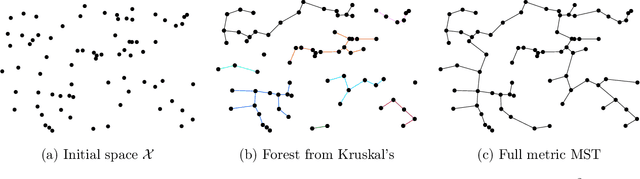
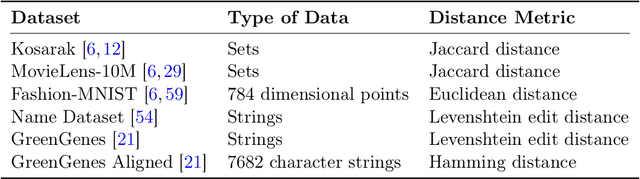
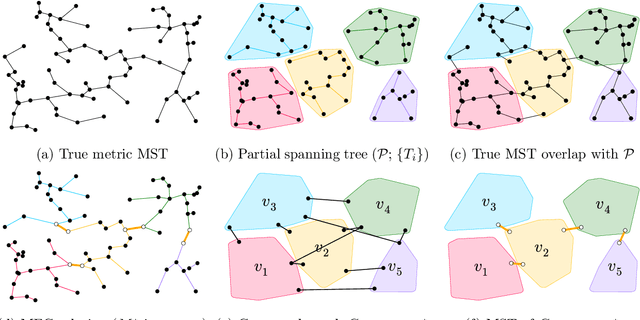
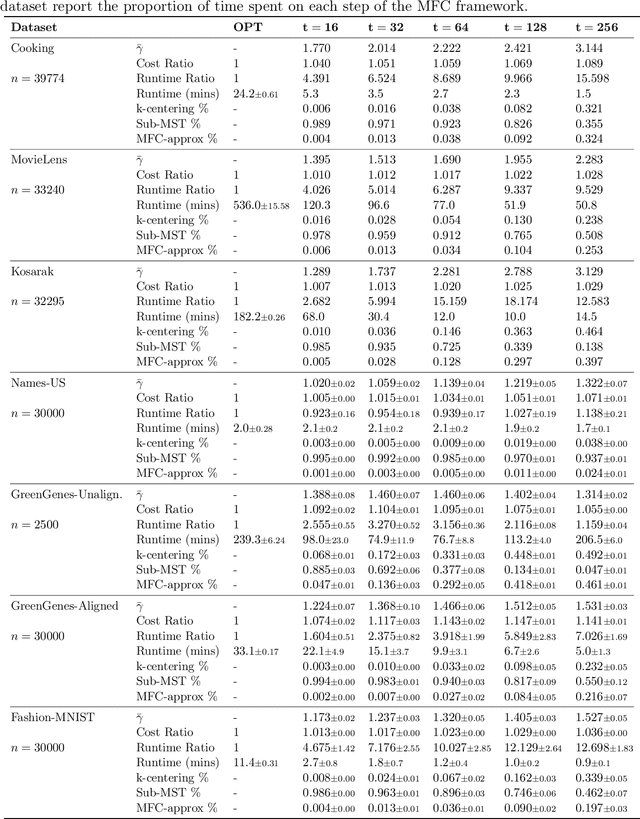
Finding a minimum spanning tree (MST) for $n$ points in an arbitrary metric space is a fundamental primitive for hierarchical clustering and many other ML tasks, but this takes $\Omega(n^2)$ time to even approximate. We introduce a framework for metric MSTs that first (1) finds a forest of disconnected components using practical heuristics, and then (2) finds a small weight set of edges to connect disjoint components of the forest into a spanning tree. We prove that optimally solving the second step still takes $\Omega(n^2)$ time, but we provide a subquadratic 2.62-approximation algorithm. In the spirit of learning-augmented algorithms, we then show that if the forest found in step (1) overlaps with an optimal MST, we can approximate the original MST problem in subquadratic time, where the approximation factor depends on a measure of overlap. In practice, we find nearly optimal spanning trees for a wide range of metrics, while being orders of magnitude faster than exact algorithms.
Scaling Graph Clustering with Distributed Sketches
Jul 24, 2020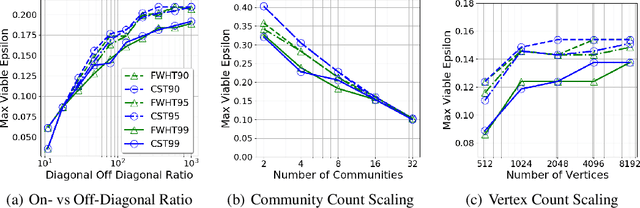
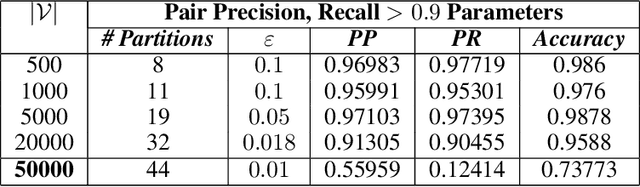
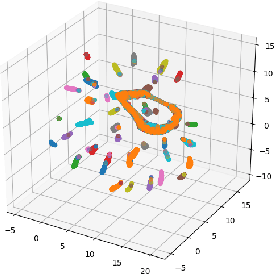
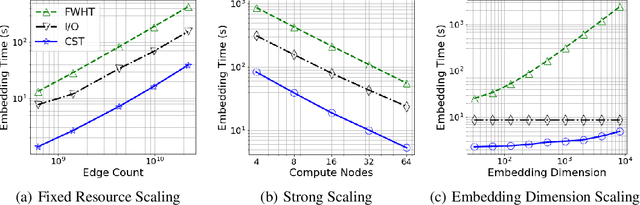
The unsupervised learning of community structure, in particular the partitioning vertices into clusters or communities, is a canonical and well-studied problem in exploratory graph analysis. However, like most graph analyses the introduction of immense scale presents challenges to traditional methods. Spectral clustering in distributed memory, for example, requires hundreds of expensive bulk-synchronous communication rounds to compute an embedding of vertices to a few eigenvectors of a graph associated matrix. Furthermore, the whole computation may need to be repeated if the underlying graph changes some low percentage of edge updates. We present a method inspired by spectral clustering where we instead use matrix sketches derived from random dimension-reducing projections. We show that our method produces embeddings that yield performant clustering results given a fully-dynamic stochastic block model stream using both the fast Johnson-Lindenstrauss and CountSketch transforms. We also discuss the effects of stochastic block model parameters upon the required dimensionality of the subsequent embeddings, and show how random projections could significantly improve the performance of graph clustering in distributed memory.
An Ensemble Framework for Detecting Community Changes in Dynamic Networks
Jul 24, 2017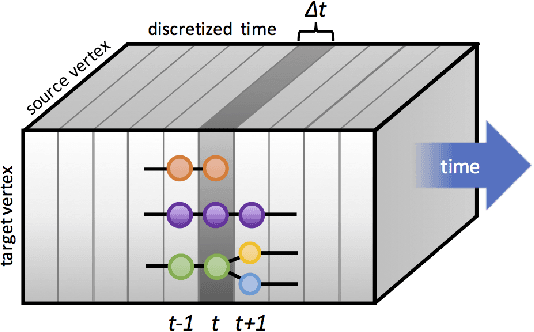
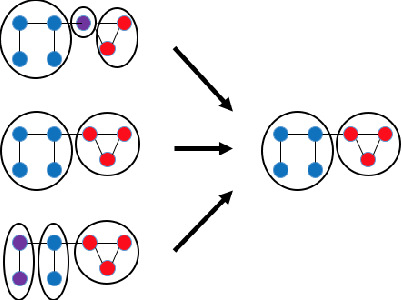
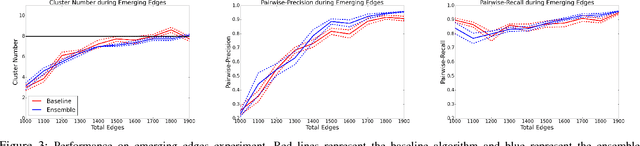
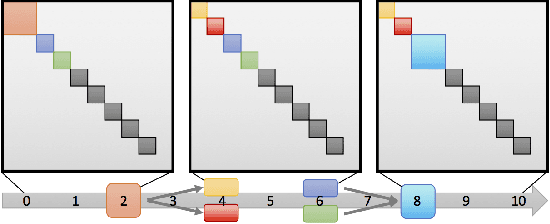
Dynamic networks, especially those representing social networks, undergo constant evolution of their community structure over time. Nodes can migrate between different communities, communities can split into multiple new communities, communities can merge together, etc. In order to represent dynamic networks with evolving communities it is essential to use a dynamic model rather than a static one. Here we use a dynamic stochastic block model where the underlying block model is different at different times. In order to represent the structural changes expressed by this dynamic model the network will be split into discrete time segments and a clustering algorithm will assign block memberships for each segment. In this paper we show that using an ensemble of clustering assignments accommodates for the variance in scalable clustering algorithms and produces superior results in terms of pairwise-precision and pairwise-recall. We also demonstrate that the dynamic clustering produced by the ensemble can be visualized as a flowchart which encapsulates the community evolution succinctly.