 Add to Chrome
 Add to Firefox
 Add to Edge
Resource-Efficient Gesture Recognition through Convexified Attention
Feb 13, 2026
Wearable e-textile interfaces require gesture recognition capabilities but face severe constraints in power consumption, computational capacity, and form factor that make traditional deep learning impractical. While lightweight architectures like MobileNet improve efficiency, they still demand thousands of parameters, limiting deployment on textile-integrated platforms. We introduce a convexified attention mechanism for wearable applications that dynamically weights features while preserving convexity through nonexpansive simplex projection and convex loss functions. Unlike conventional attention mechanisms using non-convex softmax operations, our approach employs Euclidean projection onto the probability simplex combined with multi-class hinge loss, ensuring global convergence guarantees. Implemented on a textile-based capacitive sensor with four connection points, our approach achieves 100.00\% accuracy on tap gestures and 100.00\% on swipe gestures -- consistent across 10-fold cross-validation and held-out test evaluation -- while requiring only 120--360 parameters, a 97\% reduction compared to conventional approaches. With sub-millisecond inference times (290--296$μ$s) and minimal storage requirements ($<$7KB), our method enables gesture interfaces directly within e-textiles without external processing. Our evaluation, conducted in controlled laboratory conditions with a single-user dataset, demonstrates feasibility for basic gesture interactions. Real-world deployment would require validation across multiple users, environmental conditions, and more complex gesture vocabularies. These results demonstrate how convex optimization can enable efficient on-device machine learning for textile interfaces.

Recognizing Complex Gestures on Minimalistic Knitted Sensors: Toward Real-World Interactive Systems
Mar 18, 2023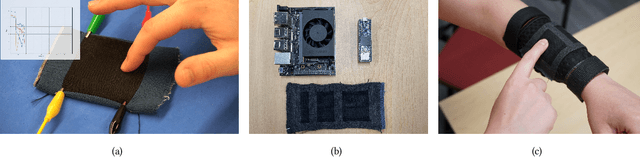
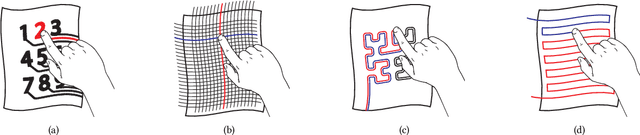


Developments in touch-sensitive textiles have enabled many novel interactive techniques and applications. Our digitally-knitted capacitive active sensors can be manufactured at scale with little human intervention. Their sensitive areas are created from a single conductive yarn, and they require only few connections to external hardware. This technique increases their robustness and usability, while shifting the complexity of enabling interactivity from the hardware to computational models. This work advances the capabilities of such sensors by creating the foundation for an interactive gesture recognition system. It uses a novel sensor design, and a neural network-based recognition model to classify 12 relatively complex, single touch point gesture classes with 89.8% accuracy, unfolding many possibilities for future applications. We also demonstrate the system's applicability and robustness to real-world conditions through its performance while being worn and the impact of washing and drying on the sensor's resistance.