 Add to Chrome
 Add to Firefox
 Add to Edge
Resource-Efficient Gesture Recognition through Convexified Attention
Feb 13, 2026
Wearable e-textile interfaces require gesture recognition capabilities but face severe constraints in power consumption, computational capacity, and form factor that make traditional deep learning impractical. While lightweight architectures like MobileNet improve efficiency, they still demand thousands of parameters, limiting deployment on textile-integrated platforms. We introduce a convexified attention mechanism for wearable applications that dynamically weights features while preserving convexity through nonexpansive simplex projection and convex loss functions. Unlike conventional attention mechanisms using non-convex softmax operations, our approach employs Euclidean projection onto the probability simplex combined with multi-class hinge loss, ensuring global convergence guarantees. Implemented on a textile-based capacitive sensor with four connection points, our approach achieves 100.00\% accuracy on tap gestures and 100.00\% on swipe gestures -- consistent across 10-fold cross-validation and held-out test evaluation -- while requiring only 120--360 parameters, a 97\% reduction compared to conventional approaches. With sub-millisecond inference times (290--296$μ$s) and minimal storage requirements ($<$7KB), our method enables gesture interfaces directly within e-textiles without external processing. Our evaluation, conducted in controlled laboratory conditions with a single-user dataset, demonstrates feasibility for basic gesture interactions. Real-world deployment would require validation across multiple users, environmental conditions, and more complex gesture vocabularies. These results demonstrate how convex optimization can enable efficient on-device machine learning for textile interfaces.

Recognizing Complex Gestures on Minimalistic Knitted Sensors: Toward Real-World Interactive Systems
Mar 18, 2023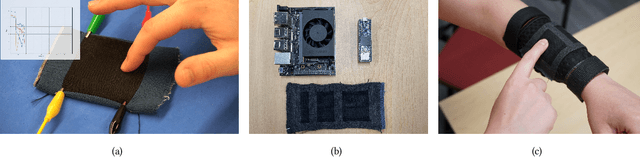
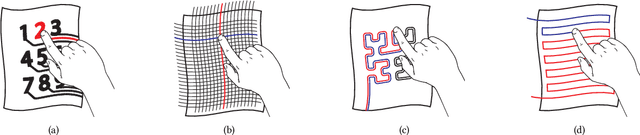


Developments in touch-sensitive textiles have enabled many novel interactive techniques and applications. Our digitally-knitted capacitive active sensors can be manufactured at scale with little human intervention. Their sensitive areas are created from a single conductive yarn, and they require only few connections to external hardware. This technique increases their robustness and usability, while shifting the complexity of enabling interactivity from the hardware to computational models. This work advances the capabilities of such sensors by creating the foundation for an interactive gesture recognition system. It uses a novel sensor design, and a neural network-based recognition model to classify 12 relatively complex, single touch point gesture classes with 89.8% accuracy, unfolding many possibilities for future applications. We also demonstrate the system's applicability and robustness to real-world conditions through its performance while being worn and the impact of washing and drying on the sensor's resistance.
Sparse Super-Regular Networks
Jan 04, 2022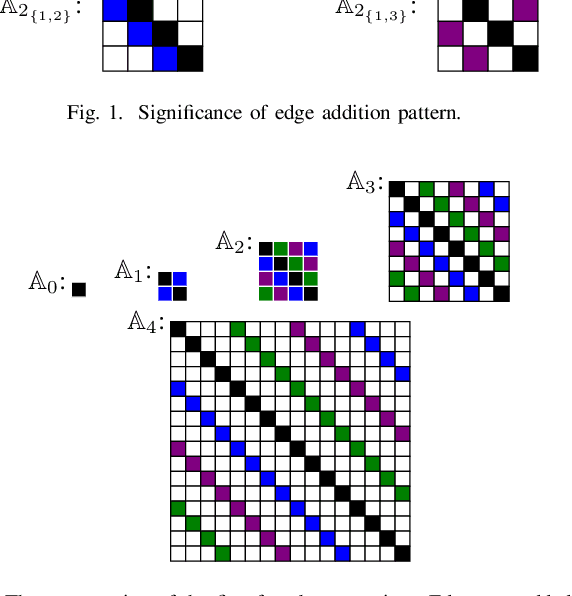


It has been argued by Thom and Palm that sparsely-connected neural networks (SCNs) show improved performance over fully-connected networks (FCNs). Super-regular networks (SRNs) are neural networks composed of a set of stacked sparse layers of (epsilon, delta)-super-regular pairs, and randomly permuted node order. Using the Blow-up Lemma, we prove that as a result of the individual super-regularity of each pair of layers, SRNs guarantee a number of properties that make them suitable replacements for FCNs for many tasks. These guarantees include edge uniformity across all large-enough subsets, minimum node in- and out-degree, input-output sensitivity, and the ability to embed pre-trained constructs. Indeed, SRNs have the capacity to act like FCNs, and eliminate the need for costly regularization schemes like Dropout. We show that SRNs perform similarly to X-Nets via readily reproducible experiments, and offer far greater guarantees and control over network structure.
Secure SURF with Fully Homomorphic Encryption
Jul 19, 2017
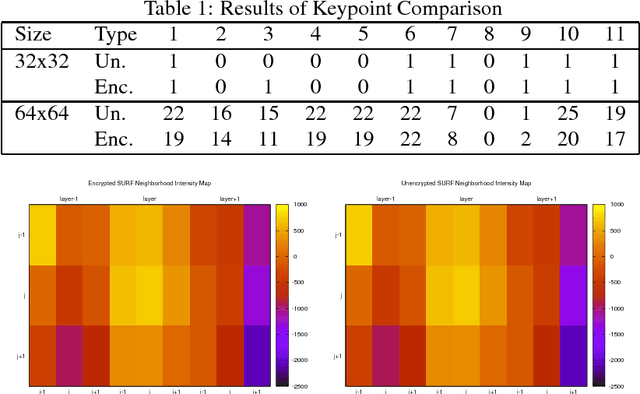
Cloud computing is an important part of today's world because offloading computations is a method to reduce costs. In this paper, we investigate computing the Speeded Up Robust Features (SURF) using Fully Homomorphic Encryption (FHE). Performing SURF in FHE enables a method to offload the computations while maintaining security and privacy of the original data. In support of this research, we developed a framework to compute SURF via a rational number based compatible with FHE. Although floating point (R) to rational numbers (Q) conversion introduces error, our research provides tight bounds on the magnitude of error in terms of parameters of FHE. We empirically verified the proposed method against a set of images at different sizes and showed that our framework accurately computes most of the SURF keypoints in FHE.
Neural Networks with Manifold Learning for Diabetic Retinopathy Detection
Dec 12, 2016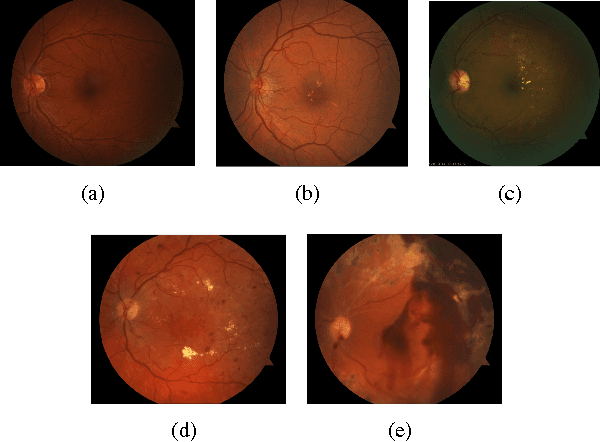
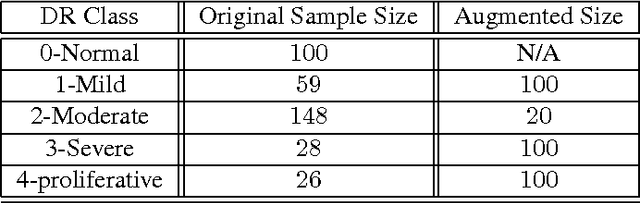

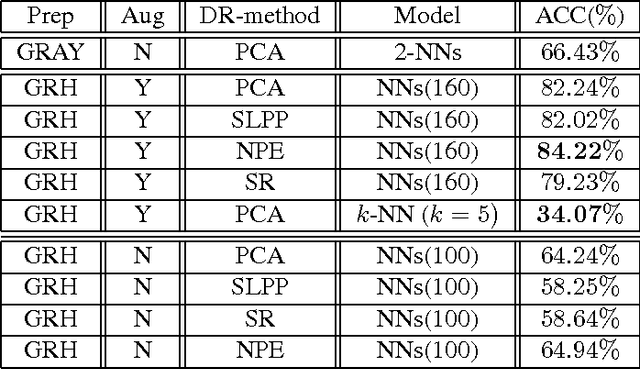
Widespread outreach programs using remote retinal imaging have proven to decrease the risk from diabetic retinopathy, the leading cause of blindness in the US. However, this process still requires manual verification of image quality and grading of images for level of disease by a trained human grader and will continue to be limited by the lack of such scarce resources. Computer-aided diagnosis of retinal images have recently gained increasing attention in the machine learning community. In this paper, we introduce a set of neural networks for diabetic retinopathy classification of fundus retinal images. We evaluate the efficiency of the proposed classifiers in combination with preprocessing and augmentation steps on a sample dataset. Our experimental results show that neural networks in combination with preprocessing on the images can boost the classification accuracy on this dataset. Moreover the proposed models are scalable and can be used in large scale datasets for diabetic retinopathy detection. The models introduced in this paper can be used to facilitate the diagnosis and speed up the detection process.
Item Popularity Prediction in E-commerce Using Image Quality Feature Vectors
May 12, 2016

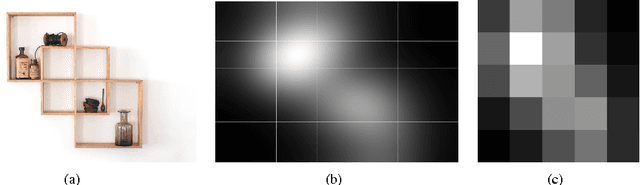
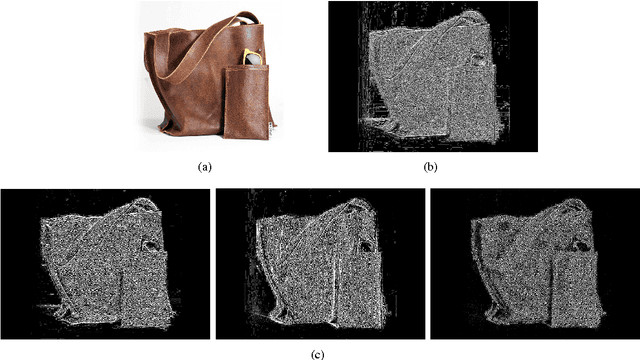
Online retail is a visual experience- Shoppers often use images as first order information to decide if an item matches their personal style. Image characteristics such as color, simplicity, scene composition, texture, style, aesthetics and overall quality play a crucial role in making a purchase decision, clicking on or liking a product listing. In this paper we use a set of image features that indicate quality to predict product listing popularity on a major e-commerce website, Etsy. We first define listing popularity through search clicks, favoriting and purchase activity. Next, we infer listing quality from the pixel-level information of listed images as quality features. We then compare our findings to text-only models for popularity prediction. Our initial results indicate that a combined image and text modeling of product listings outperforms text-only models in popularity prediction.