 Add to Chrome
 Add to Firefox
 Add to Edge
Probabilistic Dreaming for World Models
Mar 05, 2026
"Dreaming" enables agents to learn from imagined experiences, enabling more robust and sample-efficient learning of world models. In this work, we consider innovations to the state-of-the-art Dreamer model using probabilistic methods that enable: (1) the parallel exploration of many latent states; and (2) maintaining distinct hypotheses for mutually exclusive futures while retaining the desirable gradient properties of continuous latents. Evaluating on the MPE SimpleTag domain, our method outperforms standard Dreamer with a 4.5% score improvement and 28% lower variance in episode returns. We also discuss limitations and directions for future work, including how optimal hyperparameters (e.g. particle count K) scale with environmental complexity, and methods to capture epistemic uncertainty in world models.

On Ensemble Learning
Mar 07, 2021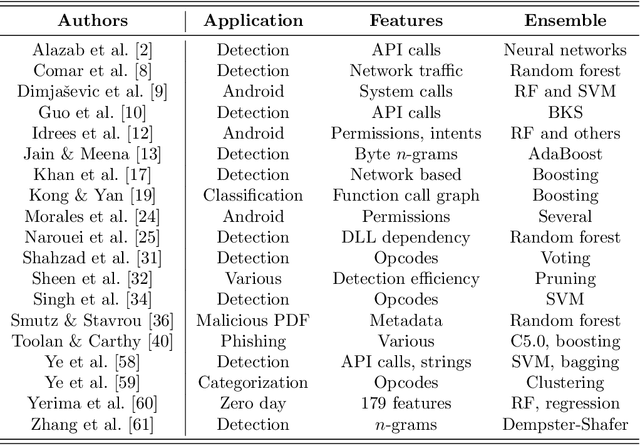
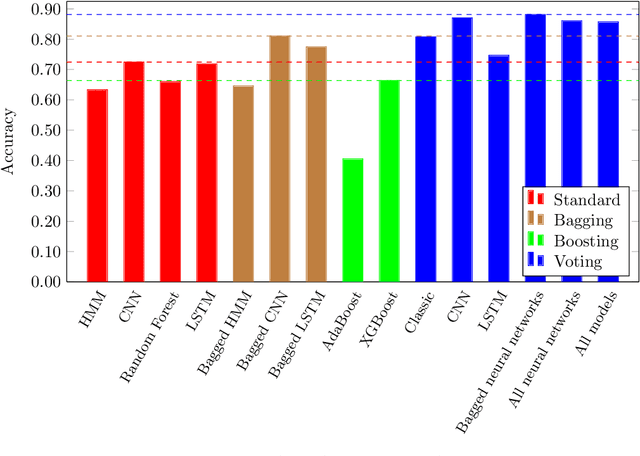
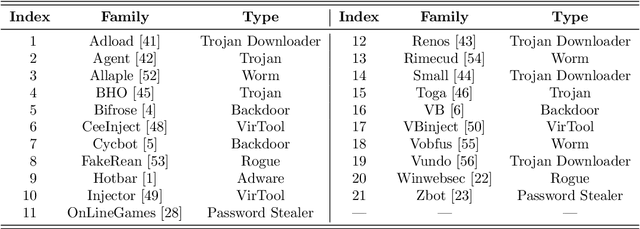
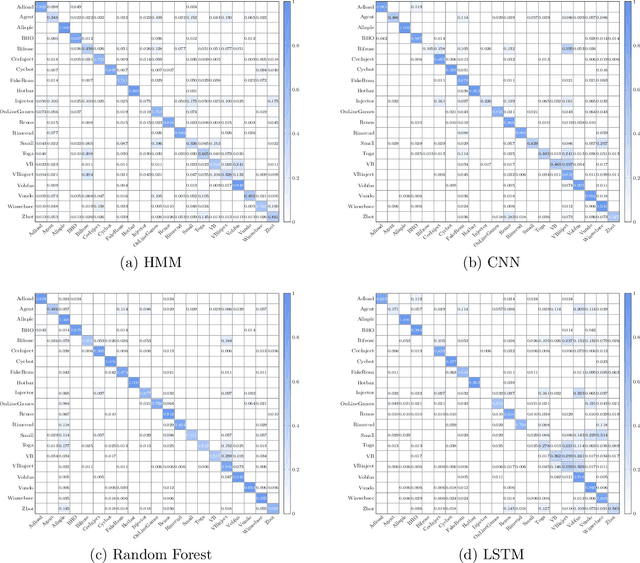
In this paper, we consider ensemble classifiers, that is, machine learning based classifiers that utilize a combination of scoring functions. We provide a framework for categorizing such classifiers, and we outline several ensemble techniques, discussing how each fits into our framework. From this general introduction, we then pivot to the topic of ensemble learning within the context of malware analysis. We present a brief survey of some of the ensemble techniques that have been used in malware (and related) research. We conclude with an extensive set of experiments, where we apply ensemble techniques to a large and challenging malware dataset. While many of these ensemble techniques have appeared in the malware literature, previously there has been no way to directly compare results such as these, as different datasets and different measures of success are typically used. Our common framework and empirical results are an effort to bring some sense of order to the chaos that is evident in the evolving field of ensemble learning -- both within the narrow confines of the malware analysis problem, and in the larger realm of machine learning in general.