 Add to Chrome
 Add to Firefox
 Add to Edge
Nonlinear Methods for Analyzing Pose in Behavioral Research
Apr 01, 2026
Advances in markerless pose estimation have made it possible to capture detailed human movement in naturalistic settings using standard video, enabling new forms of behavioral analysis at scale. However, the high dimensionality, noise, and temporal complexity of pose data raise significant challenges for extracting meaningful patterns of coordination and behavioral change. This paper presents a general-purpose analysis pipeline for human pose data, designed to support both linear and nonlinear characterizations of movement across diverse experimental contexts. The pipeline combines principled preprocessing, dimensionality reduction, and recurrence-based time series analysis to quantify the temporal structure of movement dynamics. To illustrate the pipeline's flexibility, we present three case studies spanning facial and full-body movement, 2D and 3D data, and individual versus multi-agent behavior. Together, these examples demonstrate how the same analytic workflow can be adapted to extract theoretically meaningful insights from complex pose time series.

Facial Movement Dynamics Reveal Workload During Complex Multitasking
Mar 18, 2026Real-time cognitive workload monitoring is crucial in safety-critical environments, yet established measures are intrusive, expensive, or lack temporal resolution. We tested whether facial movement dynamics from a standard webcam could provide a low-cost alternative. Seventy-two participants completed a multitasking simulation (OpenMATB) under varied load while facial keypoints were tracked via OpenPose. Linear kinematics (velocity, acceleration, displacement) and recurrence quantification features were extracted. Increasing load altered dynamics across timescales: movement magnitudes rose, temporal organisation fragmented then reorganised into complex patterns, and eye-head coordination weakened. Random forest classifiers trained on pose kinematics outperformed task performance metrics (85% vs. 55% accuracy) but generalised poorly across participants (43% vs. 33% chance). Participant-specific models reached 50% accuracy with minimal calibration (2 minutes per condition), improving continuously to 73% without plateau. Facial movement dynamics sensitively track workload with brief calibration, enabling adaptive interfaces using commodity cameras, though individual differences limit cross-participant generalisation.
Curating Stopwords in Marathi: A TF-IDF Approach for Improved Text Analysis and Information Retrieval
Jun 16, 2024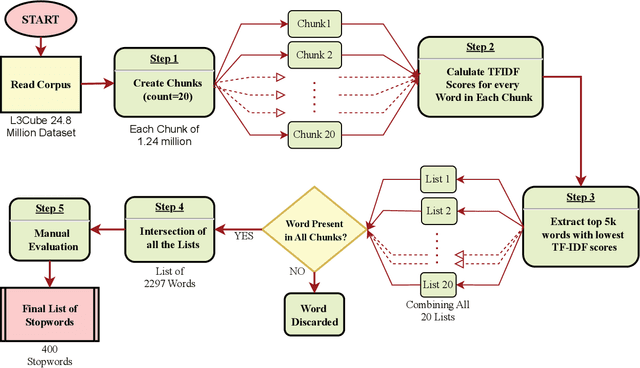
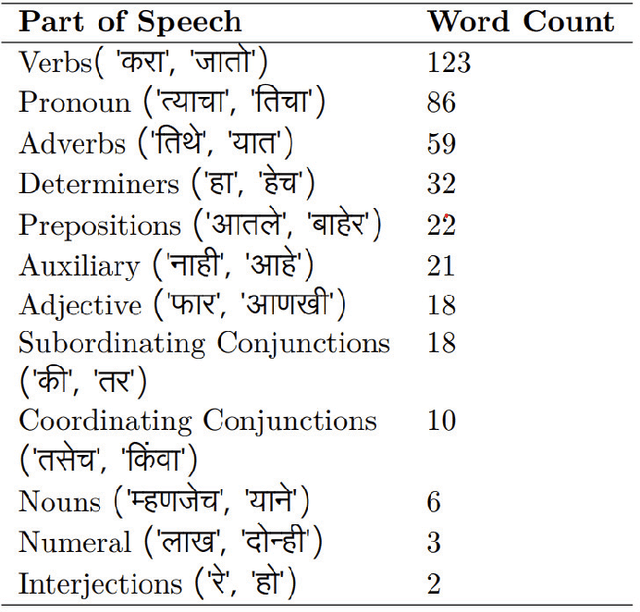
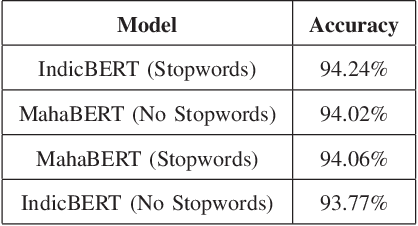
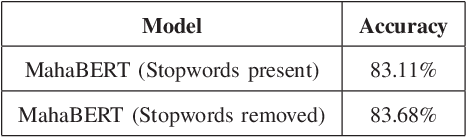
Stopwords are commonly used words in a language that are often considered to be of little value in determining the meaning or significance of a document. These words occur frequently in most texts and don't provide much useful information for tasks like sentiment analysis and text classification. English, which is a high-resource language, takes advantage of the availability of stopwords, whereas low-resource Indian languages like Marathi are very limited, standardized, and can be used in available packages, but the number of available words in those packages is low. Our work targets the curation of stopwords in the Marathi language using the MahaCorpus, with 24.8 million sentences. We make use of the TF-IDF approach coupled with human evaluation to curate a strong stopword list of 400 words. We apply the stop word removal to the text classification task and show its efficacy. The work also presents a simple recipe for stopword curation in a low-resource language. The stopwords are integrated into the mahaNLP library and publicly available on https://github.com/l3cube-pune/MarathiNLP .