 Add to Chrome
 Add to Firefox
 Add to Edge
Online identification of nonlinear time-varying systems with uncertain information
Jan 15, 2026
Digital twins (DTs), serving as the core enablers for real-time monitoring and predictive maintenance of complex cyber-physical systems, impose critical requirements on their virtual models: high predictive accuracy, strong interpretability, and online adaptive capability. However, existing techniques struggle to meet these demands simultaneously: Bayesian methods excel in uncertainty quantification but lack model interpretability, while interpretable symbolic identification methods (e.g., SINDy) are constrained by their offline, batch-processing nature, which make real-time updates challenging. To bridge this semantic and computational gap, this paper proposes a novel Bayesian Regression-based Symbolic Learning (BRSL) framework. The framework formulates online symbolic discovery as a unified probabilistic state-space model. By incorporating sparse horseshoe priors, model selection is transformed into a Bayesian inference task, enabling simultaneous system identification and uncertainty quantification. Furthermore, we derive an online recursive algorithm with a forgetting factor and establish precise recursive conditions that guarantee the well-posedness of the posterior distribution. These conditions also function as real-time monitors for data utility, enhancing algorithmic robustness. Additionally, a rigorous convergence analysis is provided, demonstrating the convergence of parameter estimates under persistent excitation conditions. Case studies validate the effectiveness of the proposed framework in achieving interpretable, probabilistic prediction and online learning.

Deep Recurrent Stochastic Configuration Networks for Modelling Nonlinear Dynamic Systems
Oct 28, 2024Deep learning techniques have shown promise in many domain applications. This paper proposes a novel deep reservoir computing framework, termed deep recurrent stochastic configuration network (DeepRSCN) for modelling nonlinear dynamic systems. DeepRSCNs are incrementally constructed, with all reservoir nodes directly linked to the final output. The random parameters are assigned in the light of a supervisory mechanism, ensuring the universal approximation property of the built model. The output weights are updated online using the projection algorithm to handle the unknown dynamics. Given a set of training samples, DeepRSCNs can quickly generate learning representations, which consist of random basis functions with cascaded input and readout weights. Experimental results over a time series prediction, a nonlinear system identification problem, and two industrial data predictive analyses demonstrate that the proposed DeepRSCN outperforms the single-layer network in terms of modelling efficiency, learning capability, and generalization performance.
Self-Organizing Recurrent Stochastic Configuration Networks for Nonstationary Data Modelling
Oct 14, 2024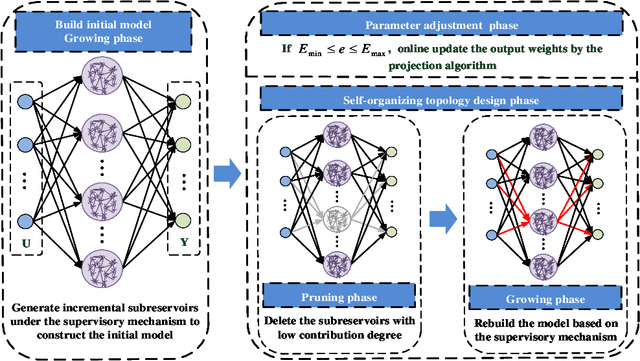
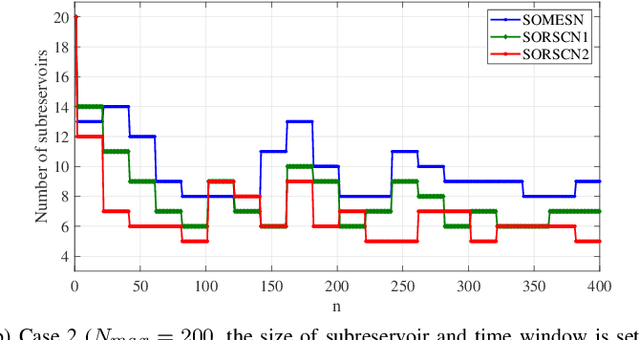
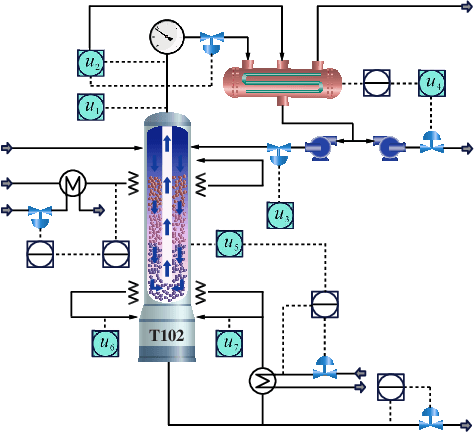
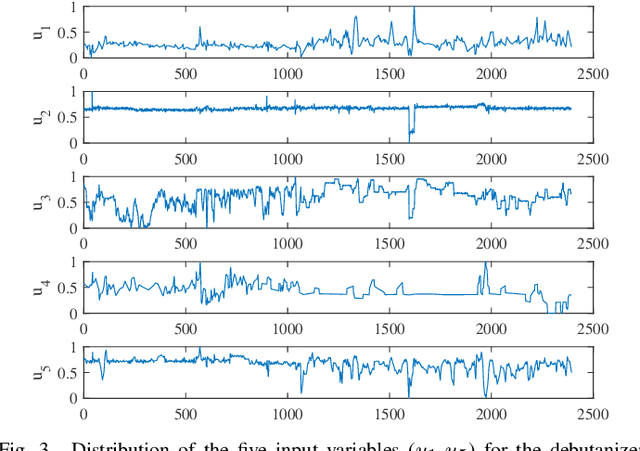
Recurrent stochastic configuration networks (RSCNs) are a class of randomized learner models that have shown promise in modelling nonlinear dynamics. In many fields, however, the data generated by industry systems often exhibits nonstationary characteristics, leading to the built model performing well on the training data but struggling with the newly arriving data. This paper aims at developing a self-organizing version of RSCNs, termed as SORSCNs, to enhance the continuous learning ability of the network for modelling nonstationary data. SORSCNs can autonomously adjust the network parameters and reservoir structure according to the data streams acquired in real-time. The output weights are updated online using the projection algorithm, while the network structure is dynamically adjusted in the light of the recurrent stochastic configuration algorithm and an improved sensitivity analysis. Comprehensive comparisons among the echo state network (ESN), online self-learning stochastic configuration network (OSL-SCN), self-organizing modular ESN (SOMESN), RSCN, and SORSCN are carried out. Experimental results clearly demonstrate that the proposed SORSCNs outperform other models with sound generalization, indicating great potential in modelling nonlinear systems with nonstationary dynamics.
Recurrent Stochastic Configuration Networks for Temporal Data Analytics
Jun 21, 2024Temporal data modelling techniques with neural networks are useful in many domain applications, including time-series forecasting and control engineering. This paper aims at developing a recurrent version of stochastic configuration networks (RSCNs) for problem solving, where we have no underlying assumption on the dynamic orders of the input variables. Given a collection of historical data, we first build an initial RSCN model in the light of a supervisory mechanism, followed by an online update of the output weights by using a projection algorithm. Some theoretical results are established, including the echo state property, the universal approximation property of RSCNs for both the offline and online learnings, and the convergence of the output weights. The proposed RSCN model is remarkably distinguished from the well-known echo state networks (ESNs) in terms of the way of assigning the input random weight matrix and a special structure of the random feedback matrix. A comprehensive comparison study among the long short-term memory (LSTM) network, the original ESN, and several state-of-the-art ESN methods such as the simple cycle reservoir (SCR), the polynomial ESN (PESN), the leaky-integrator ESN (LIESN) and RSCN is carried out. Numerical results clearly indicate that the proposed RSCN performs favourably over all of the datasets.