 Add to Chrome
 Add to Firefox
 Add to Edge
Approximating Uniform Random Rotations by Two-Block Structured Hadamard Rotations in High Dimensions
Apr 25, 2026
Uniform random rotations are a useful primitive in applications such as fast Johnson-Lindenstrauss embeddings, kernel approximation, communication-efficient learning, and recent AI compression pipelines, but they are computationally expensive to generate and apply in high dimensions. A common practical replacement is repeated structured random rotations built from Walsh-Hadamard transforms and random sign diagonals. Applying the structured random rotation twice has been shown empirically to be useful, but the supporting theory is still limited. In this paper we study the approximation quality achieved when using this two-block structured Hadamard rotation. Our results are both positive and negative. On the positive side, we prove that every fixed coordinate of the two-block transform converges uniformly, over all inputs, to the corresponding coordinate of a uniformly rotated vector, with an explicit Kolmogorov-distance bound of order $d^{-1/5}$. On the negative side, we prove an explicit lower bound on the Wasserstein distance between the full vector distributions, showing that the two-block transform is not a globally accurate surrogate for a uniform random rotation in the worst case. For the extremal input used in the lower bound, we also prove a matching asymptotic upper bound, showing that the lower-bound scale is sharp for that input. Taken together, the results identify a clear separation between one-dimensional marginal behavior, where approximation improves with dimension, and full high-dimensional geometry, where a nonvanishing discrepancy remains. This provides a partial theoretical explanation for the empirical success of structured Hadamard rotations in some algorithms, while also clarifying the limitations of treating them as drop-in replacements for true uniform random rotations.

A Note on TurboQuant and the Earlier DRIVE/EDEN Line of Work
Apr 20, 2026This note clarifies the relationship between the recent TurboQuant work and the earlier DRIVE (NeurIPS 2021) and EDEN (ICML 2022) schemes. DRIVE is a 1-bit quantizer that EDEN extended to any $b>0$ bits per coordinate; we refer to them collectively as EDEN. First, TurboQuant$_{\text{mse}}$ is a special case of EDEN obtained by fixing EDEN's scalar scale parameter to $S=1$. EDEN supports both biased and unbiased quantization, each optimized by a different $S$ (chosen via methods described in the EDEN works). The fixed choice $S=1$ used by TurboQuant is generally suboptimal, although the optimal $S$ for biased EDEN converges to $1$ as the dimension grows; accordingly TurboQuant$_{\text{mse}}$ approaches EDEN's behavior for large $d$. Second, TurboQuant$_{\text{prod}}$ combines a biased $(b-1)$-bit EDEN step with an unbiased 1-bit QJL quantization of the residual. It is suboptimal in three ways: (1) its $(b-1)$-bit step uses the suboptimal $S=1$; (2) its 1-bit unbiased residual quantization has worse MSE than (unbiased) 1-bit EDEN; (3) chaining a biased $(b-1)$-bit step with a 1-bit unbiased residual step is inferior to unbiasedly quantizing the input directly with $b$-bit EDEN. Third, some of the analysis in the TurboQuant work mirrors that of the EDEN works: both exploit the connection between random rotations and the shifted Beta distribution, use the Lloyd-Max algorithm, and note that Randomized Hadamard Transforms can replace uniform random rotations. Experiments support these claims: biased EDEN (with optimized $S$) is more accurate than TurboQuant$_{\text{mse}}$, and unbiased EDEN is markedly more accurate than TurboQuant$_{\text{prod}}$, often by more than a bit (e.g., 2-bit EDEN beats 3-bit TurboQuant$_{\text{prod}}$). We also repeat all accuracy experiments from the TurboQuant paper, showing that EDEN outperforms it in every setup we have tried.
Fooling Algorithms in Non-Stationary Bandits using Belief Inertia
Nov 06, 2025We study the problem of worst case regret in piecewise stationary multi armed bandits. While the minimax theory for stationary bandits is well established, understanding analogous limits in time-varying settings is challenging. Existing lower bounds rely on what we refer to as infrequent sampling arguments, where long intervals without exploration allow adversarial reward changes that induce large regret. In this paper, we introduce a fundamentally different approach based on a belief inertia argument. Our analysis captures how an algorithm's empirical beliefs, encoded through historical reward averages, create momentum that resists new evidence after a change. We show how this inertia can be exploited to construct adversarial instances that mislead classical algorithms such as Explore Then Commit, epsilon greedy, and UCB, causing them to suffer regret that grows linearly with T and with a substantial constant factor, regardless of how their parameters are tuned, even with a single change point. We extend the analysis to algorithms that periodically restart to handle non stationarity and prove that, even then, the worst case regret remains linear in T. Our results indicate that utilizing belief inertia can be a powerful method for deriving sharp lower bounds in non stationary bandits.
Communication-Efficient Federated Learning via Robust Distributed Mean Estimation
Aug 19, 2021
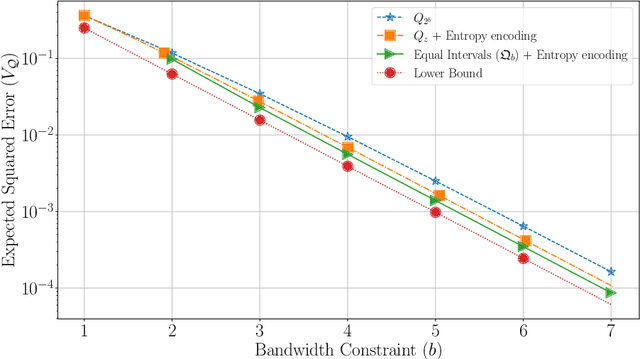
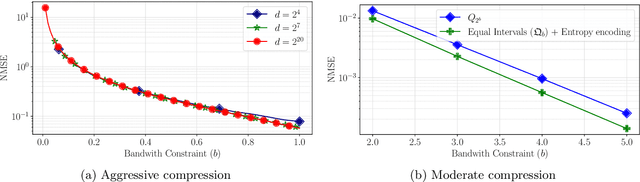
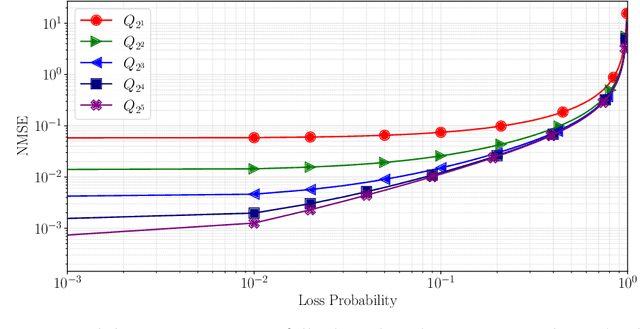
Federated learning commonly relies on algorithms such as distributed (mini-batch) SGD, where multiple clients compute their gradients and send them to a central coordinator for averaging and updating the model. To optimize the transmission time and the scalability of the training process, clients often use lossy compression to reduce the message sizes. DRIVE is a recent state of the art algorithm that compresses gradients using one bit per coordinate (with some lower-order overhead). In this technical report, we generalize DRIVE to support any bandwidth constraint as well as extend it to support heterogeneous client resources and make it robust to packet loss.
DRIVE: One-bit Distributed Mean Estimation
Jun 02, 2021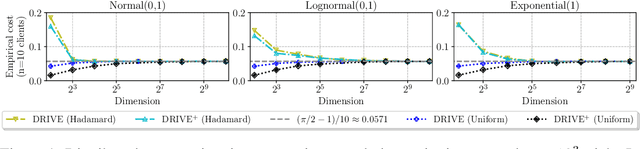
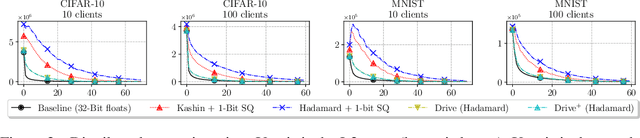
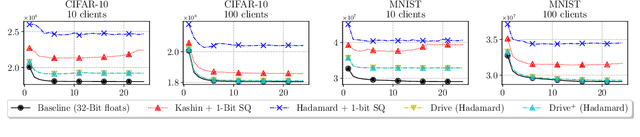
We consider the problem where $n$ clients transmit $d$-dimensional real-valued vectors using $d(1+o(1))$ bits each, in a manner that allows the receiver to approximately reconstruct their mean. Such compression problems naturally arise in distributed and federated learning. We provide novel mathematical results and derive computationally efficient algorithms that are more accurate than previous compression techniques. We evaluate our methods on a collection of distributed and federated learning tasks, using a variety of datasets, and show a consistent improvement over the state of the art.