 Add to Chrome
 Add to Firefox
 Add to Edge
Sola-Visibility-ISPM: Benchmarking Agentic AI for Identity Security Posture Management Visibility
Jan 11, 2026
Identity Security Posture Management (ISPM) is a core challenge for modern enterprises operating across cloud and SaaS environments. Answering basic ISPM visibility questions, such as understanding identity inventory and configuration hygiene, requires interpreting complex identity data, motivating growing interest in agentic AI systems. Despite this interest, there is currently no standardized way to evaluate how well such systems perform ISPM visibility tasks on real enterprise data. We introduce the Sola Visibility ISPM Benchmark, the first benchmark designed to evaluate agentic AI systems on foundational ISPM visibility tasks using a live, production-grade identity environment spanning AWS, Okta, and Google Workspace. The benchmark focuses on identity inventory and hygiene questions and is accompanied by the Sola AI Agent, a tool-using agent that translates natural-language queries into executable data exploration steps and produces verifiable, evidence-backed answers. Across 77 benchmark questions, the agent achieves strong overall performance, with an expert accuracy of 0.84 and a strict success rate of 0.77. Performance is highest on AWS hygiene tasks, where expert accuracy reaches 0.94, while results on Google Workspace and Okta hygiene tasks are more moderate, yet competitive. Overall, this work provides a practical and reproducible benchmark for evaluating agentic AI systems in identity security and establishes a foundation for future ISPM benchmarks covering more advanced identity analysis and governance tasks.

Prompted Contextual Vectors for Spear-Phishing Detection
Feb 14, 2024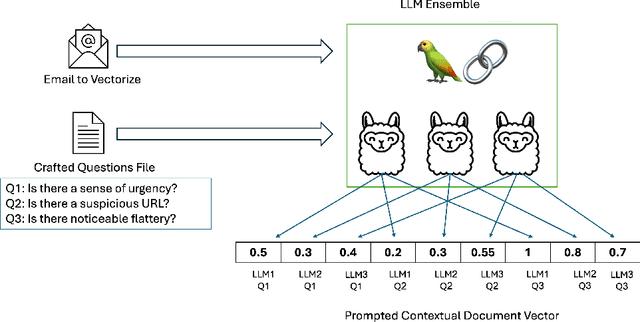
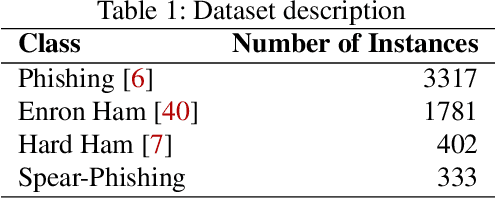

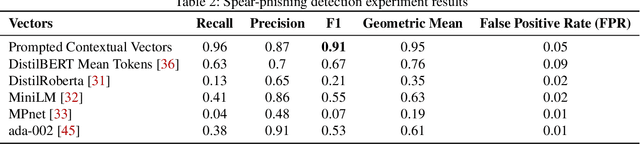
Spear-phishing attacks present a significant security challenge, with large language models (LLMs) escalating the threat by generating convincing emails and facilitating target reconnaissance. To address this, we propose a detection approach based on a novel document vectorization method that utilizes an ensemble of LLMs to create representation vectors. By prompting LLMs to reason and respond to human-crafted questions, we quantify the presence of common persuasion principles in the email's content, producing prompted contextual document vectors for a downstream supervised machine learning model. We evaluate our method using a unique dataset generated by a proprietary system that automates target reconnaissance and spear-phishing email creation. Our method achieves a 91% F1 score in identifying LLM-generated spear-phishing emails, with the training set comprising only traditional phishing and benign emails. Key contributions include an innovative document vectorization method utilizing LLM reasoning, a publicly available dataset of high-quality spear-phishing emails, and the demonstrated effectiveness of our method in detecting such emails. This methodology can be utilized for various document classification tasks, particularly in adversarial problem domains.