 Add to Chrome
 Add to Firefox
 Add to Edge
Spectral Scaling Laws of Muon
Jun 02, 2026
Orthonormalized update rules have rapidly become a leading choice of optimizer for training large language models, with recent open-source state-of-the-art models adopting Muon. To keep these updates tractable, Muon performs the orthonormalization with the Newton--Schulz (NS) iteration. Since NS is only approximate, directions with small singular values fail to be orthonormalized. In Muon, NS is applied to the momentum matrix at every step, yet little is known about how the singular value spectrum of these momentum matrices behaves during training, or how that behavior changes with model size. We present the first systematic study of this question. Tracking singular value quantiles of the momentum buffer across layers in models ranging from 77M to 2.8B parameters, we observe a consistent picture: after a short burn-in, the quantiles stabilize at a value determined by the layer type and model size. These stabilization values follow remarkably clean power laws in model size, with layer-dependent exponents. Layers up to mid-late depth scale very mildly with model size $M$ (around $M^{-0.25}$), so the standard 5-step NS configuration used at academic scale will continue to orthonormalize them at much larger scales. Some of the late layers, however, scale much more aggressively (up to $M^{-0.96}$) and will fall into the NS failure regime at frontier scale unless one uses more NS iterations or better-tuned coefficients. NS iterations are computationally expensive at scale; our laws give practitioners a principled, layer-aware recipe for choosing the minimum NS configuration that still orthonormalizes the directions that matter -- avoiding unnecessary computation without sacrificing update quality.

Collaborative and Efficient Fine-tuning: Leveraging Task Similarity
Feb 06, 2026Adaptability has been regarded as a central feature in the foundation models, enabling them to effectively acclimate to unseen downstream tasks. Parameter-efficient fine-tuning methods such as celebrated LoRA facilitate efficient adaptation of large foundation models using labeled, high-quality and generally scarce task data. To mitigate data scarcity in fine-tuning of foundation models, we propose to leverage task similarity across multiple downstream users. Intuitively, users with similar tasks must be able to assist each other in boosting the effective fine-tuning data size. We propose Collaborative Low-Rank Adaptation, or CoLoRA, which exploits task similarity to collaboratively and efficiently fine-tune personalized foundation models. The main idea in CoLoRA is to train one shared adapter capturing underlying task similarities across all tasks, and personalized adapters tailored to user-specific tasks. We theoretically study CoLoRA on heterogeneous linear regression and provide provable guarantees for ground truth recovery. We also conduct several natural language experiments with varying task similarity, which further demonstrate that when trained together with similar tasks, individual performances are significantly boosted.
General framework for online-to-nonconvex conversion: Schedule-free SGD is also effective for nonconvex optimization
Nov 11, 2024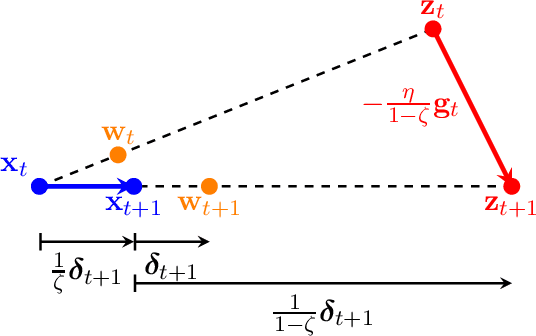
This work investigates the effectiveness of schedule-free methods, developed by A. Defazio et al. (NeurIPS 2024), in nonconvex optimization settings, inspired by their remarkable empirical success in training neural networks. Specifically, we show that schedule-free SGD achieves optimal iteration complexity for nonsmooth, nonconvex optimization problems. Our proof begins with the development of a general framework for online-to-nonconvex conversion, which converts a given online learning algorithm into an optimization algorithm for nonconvex losses. Our general framework not only recovers existing conversions but also leads to two novel conversion schemes. Notably, one of these new conversions corresponds directly to schedule-free SGD, allowing us to establish its optimality. Additionally, our analysis provides valuable insights into the parameter choices for schedule-free SGD, addressing a theoretical gap that the convex theory cannot explain.