 Add to Chrome
 Add to Firefox
 Add to Edge
CoCoT-EEG: Contrastive-Pretrained Multiscale Convolutional Transformer for EEG Decoding
Jul 10, 2026
Self-supervised pretrained foundation models (FM) have shown early promise for non-invasive electroencephalogram (EEG) decoding applications. Many recent large-scale models converged on the approach of tokenizing raw EEG followed by masked reconstruction pretraining. However, this recipe has been shown to be suboptimal for data, like EEG, with high noise amplitude and information confined to limited dimensions such as narrow frequency bands. Building on this insight, we develop a novel contrastive-pretrained EEG model with multiscale temporal convolution input layers and Transformer encoder blocks (CoCoT). CoCoT matches or beats state-of-the-art reconstruction-pretrained EEG models on extensive benchmark decoding tasks with heterogeneous electrode configurations. Furthermore, CoCoT trained from scratch outperforms previous single-task decoding models and even rivals pretrained models, showcasing the architecture's flexibility and data efficiency. Through systematic ablations, including model architecture and pretraining objective, we demonstrate the viability of contrastive learning for building EEG FMs while suggesting key architectural design considerations, prompting further investigations in alternative large-scale pretraining strategies.

The Variance Brain Foundation Models Forgot: Third-Order Statistics Predict Cognition Where Billion-Parameter Models Fail
May 29, 2026Brain foundation models (BFMs) are self-supervised Transformers pretrained on fMRI data. We posit that these models should capture each subject's cognitive performance from their fMRI signal. Yet across three state-of-the-art BFMs and every readout we test, they predict cognition worse than a linear regression from the $\sim$80K parameters of the functional connectivity matrix (FC). The gap widens with scale: BrainLM's 650M model predicts cognition worse than its 111M. We attribute this to a \textbf{variance allocation problem}: BFM pretraining captures the variance components that dominate fMRI but not the higher-order structure that predicts cognition. Our per-cumulant analysis of the reconstructed signal shows that the second-order covariance is partially preserved, while the third-order co-skewness tensor is largely destroyed. To recover what BFMs lose, we design a linear pipeline that projects the fMRI signal into the subspace that best preserves its co-skewness and computes FC there. This \textbf{exceeds raw FC and every pretrained BFM} on every dataset and parcellation we test, outperforming prior state-of-the-art under controlled evaluation \textbf{with no pretraining and no GPU}. We \textbf{recover the raw-FC ceiling on BrainLM's forward pass} by finetuning with a loss targeted at this same subspace. This shows that the bottleneck is the pretraining objective, not the architecture or the model size.
A new inference approach for training shallow and deep generalized linear models of noisy interacting neurons
Jun 16, 2020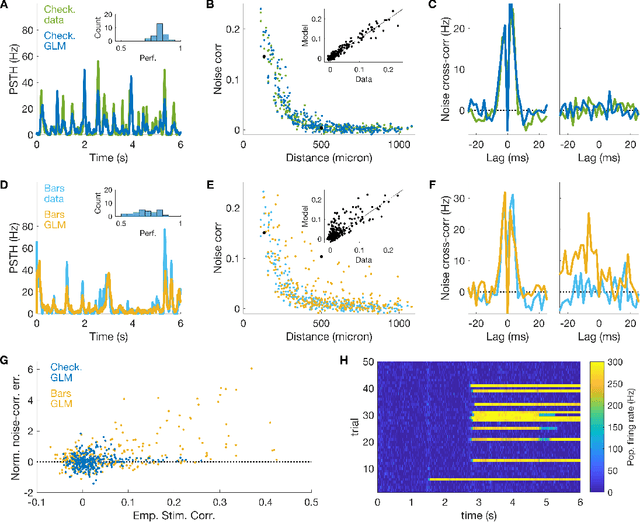
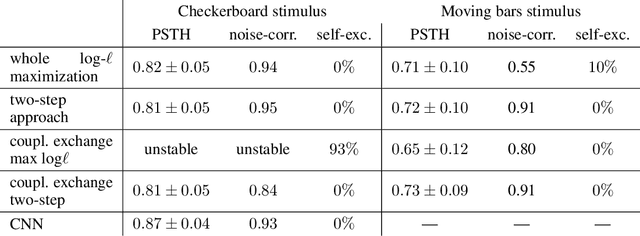
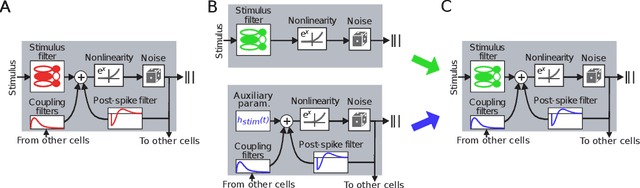
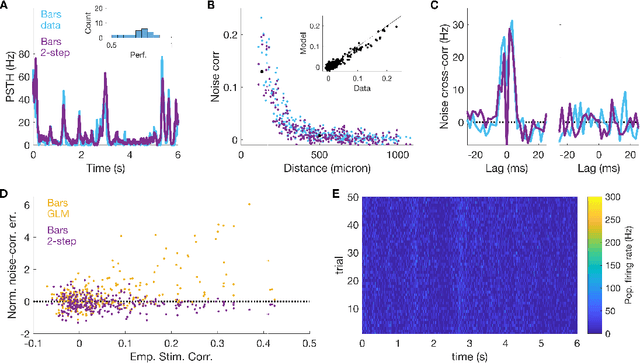
Generalized linear models are one of the most efficient paradigms for predicting the correlated stochastic activity of neuronal networks in response to external stimuli, with applications in many brain areas. However, when dealing with complex stimuli, their parameters often do not generalize across different stimulus statistics, leading to degraded performance and blowup instabilities. Here, we develop a two-step inference strategy that allows us to train robust generalized linear models of interacting neurons, by explicitly separating the effects of stimulus correlations and noise correlations in each training step. Applying this approach to the responses of retinal ganglion cells to complex visual stimuli, we show that, compared to classical methods, the models trained in this way exhibit improved performance, are more stable, yield robust interaction networks, and generalize well across complex visual statistics. The method can be extended to deep convolutional neural networks, leading to models with high predictive accuracy for both the neuron firing rates and their correlations.