 Add to Chrome
 Add to Firefox
 Add to Edge
Inferring hidden forcing in a biological oscillator using Kolmogorov-Arnold networks
Jun 07, 2026
Inferring the forces that drive a dynamical system from partial observations is a fundamental challenge across physics, particularly when distinct underlying mechanisms produce similar observable dynamics. Here we show that the effective muscular forcing underlying avian respiratory dynamics can be reconstructed from measurements of air-sac pressure alone. Using an interpretable learning framework based on Kolmogorov-Arnold networks, we infer the governing equations of the system directly from data and uncover a nontrivial structure in the underlying forcing that is not apparent from the pressure signal, which instead suggests a relaxation-like oscillation. The reconstructed dynamics predict a two-phase activation pattern within each respiratory cycle, which we independently validate through electromyographic recordings of expiratory muscles. These results demonstrate that data-driven reconstruction of dynamical laws can reveal hidden physical structure and provide access to unobserved driving variables, establishing a general route to infer latent forces in partially observed dynamical systems.

On the application of Visibility Graphs in the Spectral Domain for Speaker Recognition
Feb 19, 2025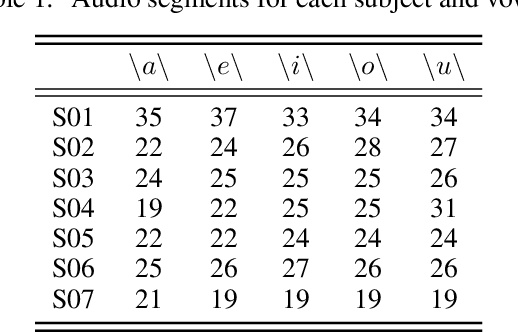
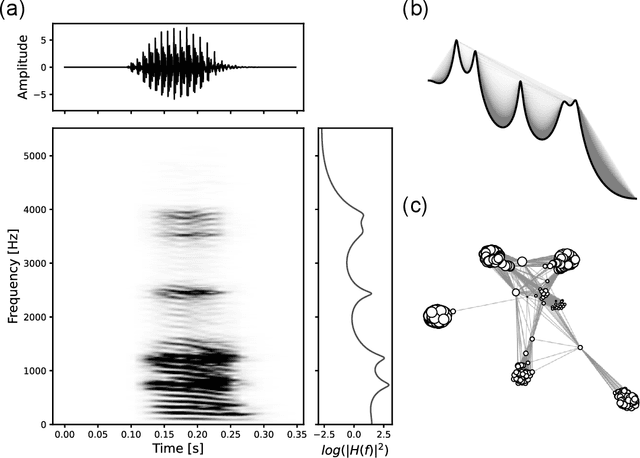
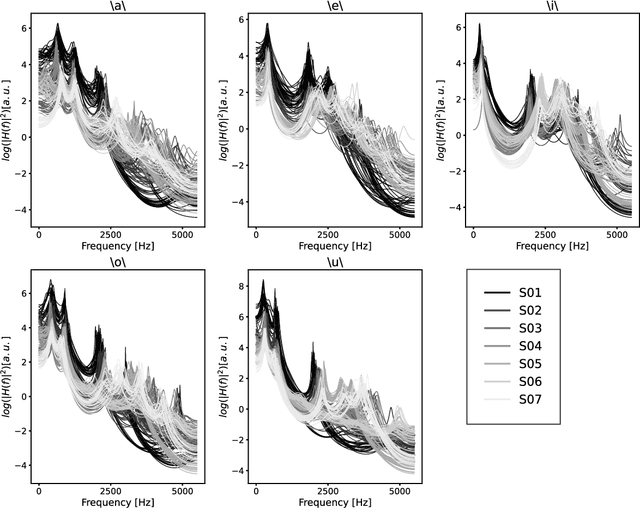
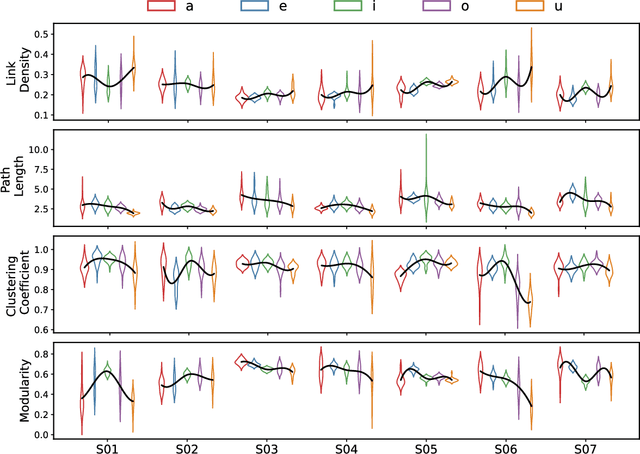
In this study, we explore the potential of visibility graphs in the spectral domain for speaker recognition. Adult participants were instructed to record vocalizations of the five Spanish vowels. For each vocalization, we computed the frequency spectrum considering the source-filter model of speech production, where formants are shaped by the vocal tract acting as a passive filter with resonant frequencies. Spectral profiles exhibited consistent intra-speaker characteristics, reflecting individual vocal tract anatomies, while showing variation between speakers. We then constructed visibility graphs from these spectral profiles and extracted various graph-theoretic metrics to capture their topological features. These metrics were assembled into feature vectors representing the five vowels for each speaker. Using an ensemble of decision trees trained on these features, we achieved high accuracy in speaker identification. Our analysis identified key topological features that were critical in distinguishing between speakers. This study demonstrates the effectiveness of visibility graphs for spectral analysis and their potential in speaker recognition. We also discuss the robustness of this approach, offering insights into its applicability for real-world speaker recognition systems. This research contributes to expanding the feature extraction toolbox for speaker recognition by leveraging the topological properties of speech signals in the spectral domain.
Siamese networks for Poincaré embeddings and the reconstruction of evolutionary trees
Oct 09, 2024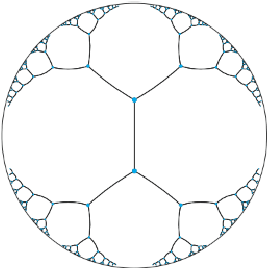

We present a method for reconstructing evolutionary trees from high-dimensional data, with a specific application to bird song spectrograms. We address the challenge of inferring phylogenetic relationships from phenotypic traits, like vocalizations, without predefined acoustic properties. Our approach combines two main components: Poincar\'e embeddings for dimensionality reduction and distance computation, and the neighbor joining algorithm for tree reconstruction. Unlike previous work, we employ Siamese networks to learn embeddings from only leaf node samples of the latent tree. We demonstrate our method's effectiveness on both synthetic data and spectrograms from six species of finches.