 Add to Chrome
 Add to Firefox
 Add to Edge
Fast and Robust On-Device Speaker Diarization: Relative Minimum Cluster Size for Stride-Accelerated Pipelines
Jun 07, 2026
Speech applications such as meeting transcription and voice agents would benefit from on-device speaker diarization, but practical adoption is limited by inference cost. We study how far a Pyannote 3.1-based pipeline can be accelerated on consumer hardware (an RTX 5070 Ti GPU and an Apple M4 laptop) while preserving diarization error rate (DER). A simple recipe: coarser segmentation stride and per-chunk embedding, yields multi-fold speedups and is DER-neutral on AMI, but degrades sharply on in-the-wild data: on VoxConverse, DER rises from 0.075 to 0.113. We trace the failure to speaker under-counting in the clustering stage, caused by a fixed minimum cluster size interacting with the reduced number of embeddings per speaker. We propose a relative minimum cluster size, mcs = round(f * n) with f = 0.01, which adapts to the embedding budget per recording. A single value of f recovers VoxConverse DER to 0.079 (about 89% of the lost accuracy) while keeping AMI flat, and the accelerated pipeline reaches up to 12.2x speedup on AMI (MPS) over our CAM++ baseline.

Hibikino-Musashi@Home 2018 Team Description Paper
Nov 09, 2022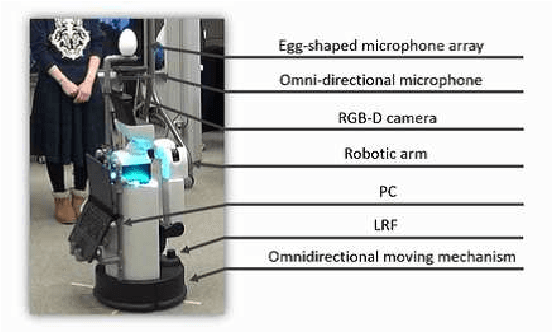

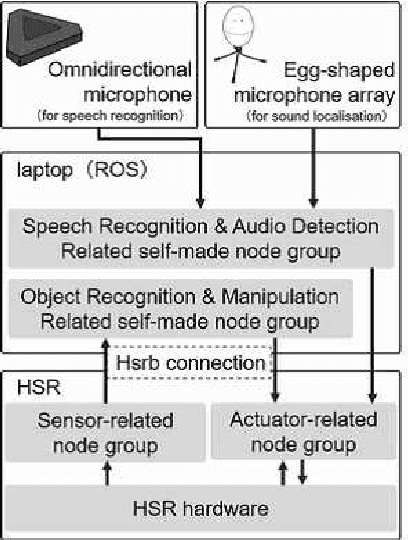

Our team, Hibikino-Musashi@Home (the shortened name is HMA), was founded in 2010. It is based in the Kitakyushu Science and Research Park, Japan. We have participated in the RoboCup@Home Japan open competition open platform league every year since 2010. Moreover, we participated in the RoboCup 2017 Nagoya as open platform league and domestic standard platform league teams. Currently, the Hibikino-Musashi@Home team has 20 members from seven different laboratories based in the Kyushu Institute of Technology. In this paper, we introduce the activities of our team and the technologies.