 Add to Chrome
 Add to Firefox
 Add to Edge
How Much Do Reviews Really Contribute? A Study on Text-Enriched Matrix Factorization for Recommendations
Jun 15, 2026
Incorporating textual reviews into a Recommender System has become a prominent strategy for enriching collaborative signals with semantic information. However, the actual contribution of review-derived representations remains an open question, particularly when strong collaborative baselines are employed. In this work, we systematically investigate the impact of textual information on Matrix Factorization by introducing and comparing three enrichment strategies over a common collaborative backbone. First, we propose a learnable gating mechanism that adaptively balances collaborative and textual signals during training. This mechanism is applied to two distinct review representations: (i) aggregated topic profiles extracted from user and item histories, and (ii) full text embedding representations derived from reviews. Additionally, we explore a cross-attention mechanism that identifies and emphasizes the most informative dimensions of the textual representation before fusion with collaborative factors. We evaluate six variants: pure, enriched with topic profiles and text via gating; enriched with topics and text via gating; and enhanced with cross-attention over textual features. Experiments across multiple review-based datasets reveal that although adaptive fusion mechanisms improve representation flexibility, the marginal contribution of textual signals remains limited compared to the collaborative backbone. These findings suggest that, under typical rating-prediction settings, collaborative information continues to dominate performance, raising important considerations for the effective integration of semantic review signals into recommendation models.

Introducing a Framework and a Decision Protocol to Calibrate Recommender Systems
Apr 07, 2022
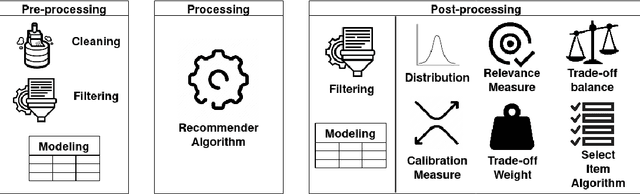
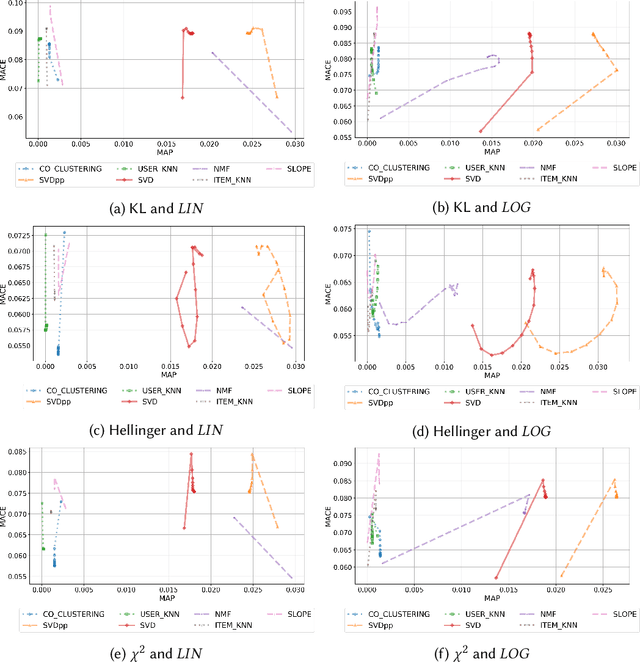
Recommender Systems use the user's profile to generate a recommendation list with unknown items to a target user. Although the primary goal of traditional recommendation systems is to deliver the most relevant items, such an effort unintentionally can cause collateral effects including low diversity and unbalanced genres or categories, benefiting particular groups of categories. This paper proposes an approach to create recommendation lists with a calibrated balance of genres, avoiding disproportion between the user's profile interests and the recommendation list. The calibrated recommendations consider concomitantly the relevance and the divergence between the genres distributions extracted from the user's preference and the recommendation list. The main claim is that calibration can contribute positively to generate fairer recommendations. In particular, we propose a new trade-off equation, which considers the users' bias to provide a recommendation list that seeks for the users' tendencies. Moreover, we propose a conceptual framework and a decision protocol to generate more than one thousand combinations of calibrated systems in order to find the best combination. We compare our approach against state-of-the-art approaches using multiple domain datasets, which are analyzed by rank and calibration metrics. The results indicate that the trade-off, which considers the users' bias, produces positive effects on the precision and to the fairness, thus generating recommendation lists that respect the genre distribution and, through the decision protocol, we also found the best system for each dataset.