 Add to Chrome
 Add to Firefox
 Add to Edge
Automated near-term quantum algorithm discovery for molecular ground states
Mar 27, 2026
Designing quantum algorithms is a complex and counterintuitive task, making it an ideal candidate for AI-driven algorithm discovery. To this end, we employ the Hive, an AI platform for program synthesis, which utilises large language models to drive a highly distributed evolutionary process for discovering new algorithms. We focus on the ground state problem in quantum chemistry, and discover efficient quantum heuristic algorithms that solve it for molecules LiH, H2O, and F2 while exhibiting significant reductions in quantum resources relative to state-of-the-art near-term quantum algorithms. Further, we perform an interpretability study on the discovered algorithms and identify the key functions responsible for the efficiency gains. Finally, we benchmark the Hive-discovered circuits on the Quantinuum System Model H2 quantum computer and identify minimum system requirements for chemical precision. We envision that this novel approach to quantum algorithm discovery applies to other domains beyond chemistry, as well as to designing quantum algorithms for fault-tolerant quantum computers.

sQUlearn $\unicode{x2013}$ A Python Library for Quantum Machine Learning
Nov 15, 2023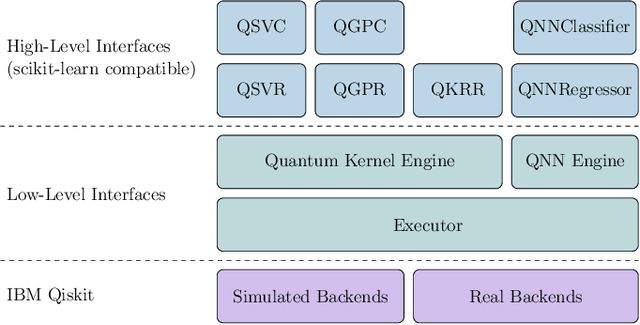
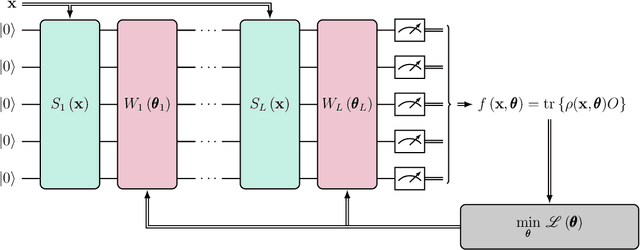
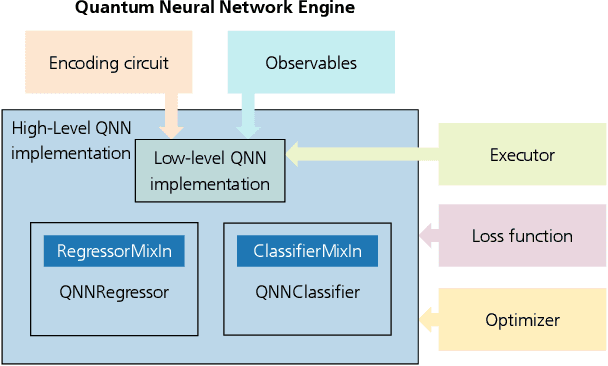
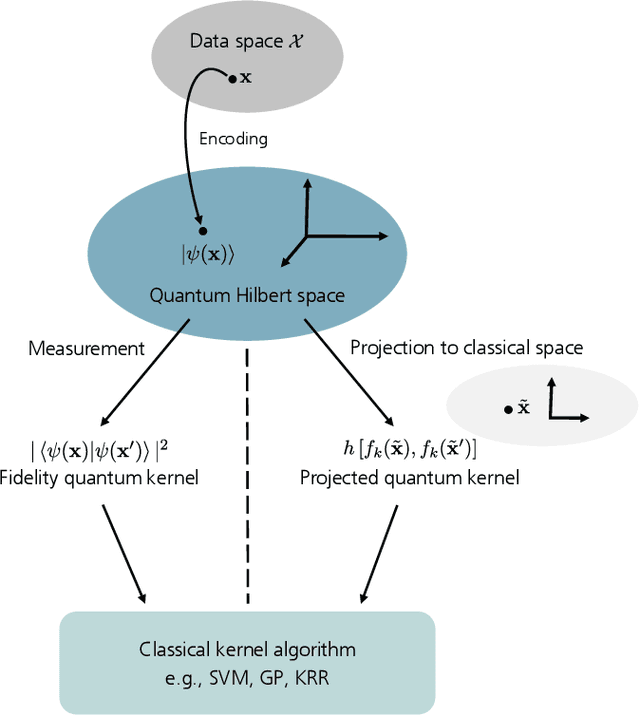
sQUlearn introduces a user-friendly, NISQ-ready Python library for quantum machine learning (QML), designed for seamless integration with classical machine learning tools like scikit-learn. The library's dual-layer architecture serves both QML researchers and practitioners, enabling efficient prototyping, experimentation, and pipelining. sQUlearn provides a comprehensive toolset that includes both quantum kernel methods and quantum neural networks, along with features like customizable data encoding strategies, automated execution handling, and specialized kernel regularization techniques. By focusing on NISQ-compatibility and end-to-end automation, sQUlearn aims to bridge the gap between current quantum computing capabilities and practical machine learning applications.
Quantum Gaussian Process Regression for Bayesian Optimization
Apr 25, 2023Gaussian process regression is a well-established Bayesian machine learning method. We propose a new approach to Gaussian process regression using quantum kernels based on parameterized quantum circuits. By employing a hardware-efficient feature map and careful regularization of the Gram matrix, we demonstrate that the variance information of the resulting quantum Gaussian process can be preserved. We also show that quantum Gaussian processes can be used as a surrogate model for Bayesian optimization, a task that critically relies on the variance of the surrogate model. To demonstrate the performance of this quantum Bayesian optimization algorithm, we apply it to the hyperparameter optimization of a machine learning model which performs regression on a real-world dataset. We benchmark the quantum Bayesian optimization against its classical counterpart and show that quantum version can match its performance.