 Add to Chrome
 Add to Firefox
 Add to Edge
A unified Benchmark for Multi-Frame Image Restoration under Severe Refractive Warping
May 06, 2026
Video sequence capturing through refractive dynamic media, such as a turbulent air or water surface, often suffer from severe geometric distortions and temporal instability. While recent advances address mild atmospheric turbulence, no existing benchmarks systematically evaluate restoration methods under strong and highly nonuniform refractive conditions. We present a comprehensive benchmark for geometric distortion removal in video, covering a range from turbulence-like mild warping to strong discontinuous refractive deformations. The benchmark includes both laboratory-captured real data and synthetic sequences generated for static scenes via physics-based light refraction modeling across four distortion levels and multiple surface wave types. We evaluate a spectrum of methods from simple baselines and classical registration algorithms to advanced learning-based approaches including DATUM and our proposed diffusion based V-cache for high and extreme distortions regimes. Evaluation uses both pixel-level (PSNR, SSIM), and perceptual (LPIPS, DINO, CLIP) metrics providing the first large scale analysis of geometric distortion removal. Our benchmark establishes a new foundation for developing and evaluating algorithms capable of reconstructing video from highly distorted optical environments. Our code and datasets are available at https://github.com/iafoss/refractive-mfir-benchmark.

HD snapshot diffractive spectral imaging and inferencing
Jun 25, 2024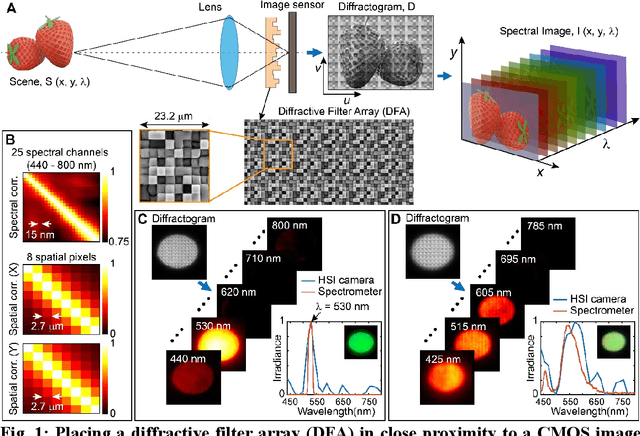
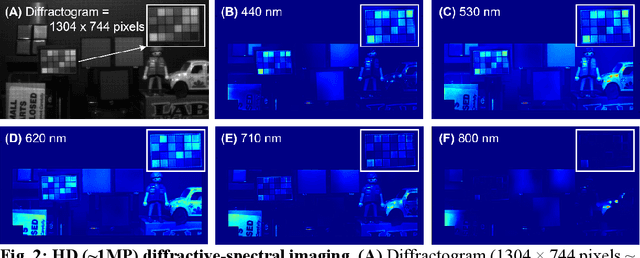
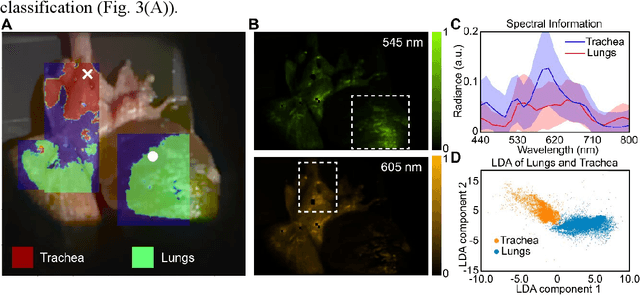
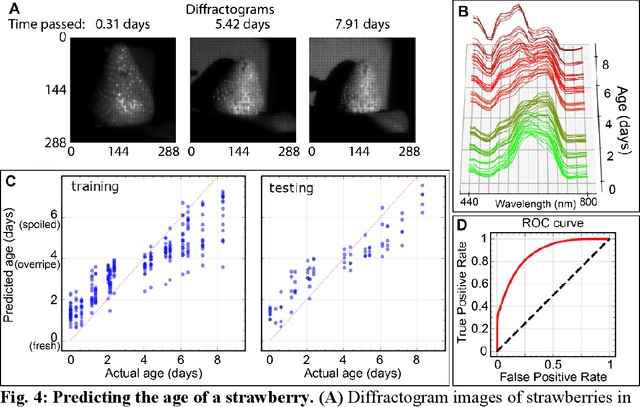
We present a novel high-definition (HD) snapshot diffractive spectral imaging system utilizing a diffractive filter array (DFA) to capture a single image that encodes both spatial and spectral information. This single diffractogram can be computationally reconstructed into a spectral image cube, providing a high-resolution representation of the scene across 25 spectral channels in the 440-800 nm range at 1304x744 spatial pixels (~1 MP). This unique approach offers numerous advantages including snapshot capture, a form of optical compression, flexible offline reconstruction, the ability to select the spectral basis after capture, and high light throughput due to the absence of lossy filters. We demonstrate a 30-50 nm spectral resolution and compared our reconstructed spectra against ground truth obtained by conventional spectrometers. Proof-of-concept experiments in diverse applications including biological tissue classification, food quality assessment, and simulated stellar photometry validate our system's capability to perform robust and accurate inference. These results establish the DFA-based imaging system as a versatile and powerful tool for advancing scientific and industrial imaging applications.