 Add to Chrome
 Add to Firefox
 Add to Edge
Artifacts as Memory Beyond the Agent Boundary
Apr 09, 2026
The situated view of cognition holds that intelligent behavior depends not only on internal memory, but on an agent's active use of environmental resources. Here, we begin formalizing this intuition within Reinforcement Learning (RL). We introduce a mathematical framing for how the environment can functionally serve as an agent's memory, and prove that certain observations, which we call artifacts, can reduce the information needed to represent history. We corroborate our theory with experiments showing that when agents observe spatial paths, the amount of memory required to learn a performant policy is reduced. Interestingly, this effect arises unintentionally, and implicitly through the agent's sensory stream. We discuss the implications of our findings, and show they satisfy qualitative properties previously used to ground accounts of external memory. Moving forward, we anticipate further work on this subject could reveal principled ways to exploit the environment as a substitute for explicit internal memory.

The Grand Illusion: The Myth of Software Portability and Implications for ML Progress
Sep 12, 2023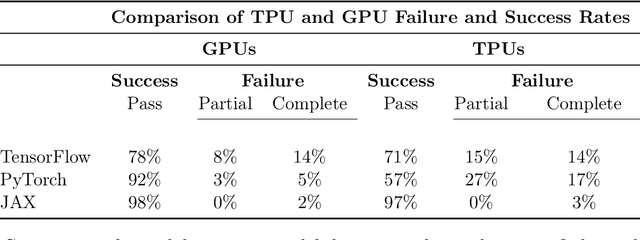
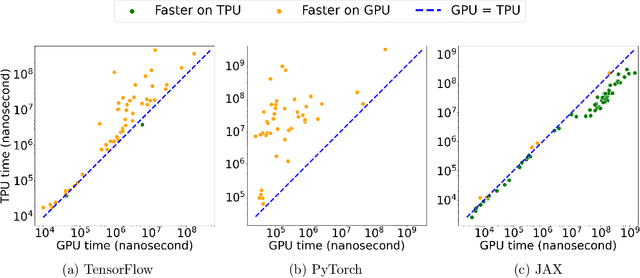
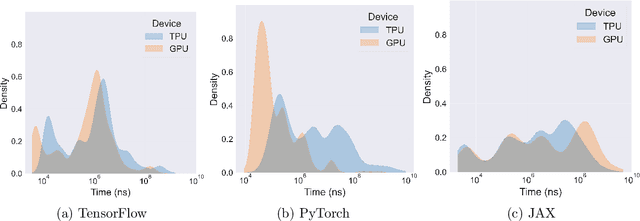
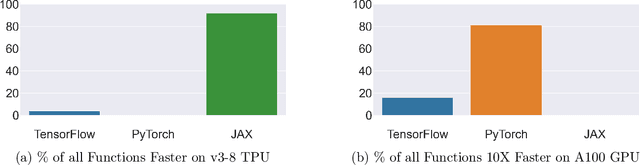
Pushing the boundaries of machine learning often requires exploring different hardware and software combinations. However, the freedom to experiment across different tooling stacks can be at odds with the drive for efficiency, which has produced increasingly specialized AI hardware and incentivized consolidation around a narrow set of ML frameworks. Exploratory research can be restricted if software and hardware are co-evolving, making it even harder to stray away from mainstream ideas that work well with popular tooling stacks. While this friction increasingly impacts the rate of innovation in machine learning, to our knowledge the lack of portability in tooling has not been quantified. In this work, we ask: How portable are popular ML software frameworks? We conduct a large-scale study of the portability of mainstream ML frameworks across different hardware types. Our findings paint an uncomfortable picture -- frameworks can lose more than 40% of their key functions when ported to other hardware. Worse, even when functions are portable, the slowdown in their performance can be extreme and render performance untenable. Collectively, our results reveal how costly straying from a narrow set of hardware-software combinations can be - and suggest that specialization of hardware impedes innovation in machine learning research.