 Add to Chrome
 Add to Firefox
 Add to Edge
Is my model perplexed for the right reason? Contrasting LLMs' Benchmark Behavior with Token-Level Perplexity
Mar 31, 2026
Standard evaluations of Large language models (LLMs) focus on task performance, offering limited insight into whether correct behavior reflects appropriate underlying mechanisms and risking confirmation bias. We introduce a simple, principled interpretability framework based on token-level perplexity to test whether models rely on linguistically relevant cues. By comparing perplexity distributions over minimal sentence pairs differing in one or a few `pivotal' tokens, our method enables precise, hypothesis-driven analysis without relying on unstable feature-attribution techniques. Experiments on controlled linguistic benchmarks with several open-weight LLMs show that, while linguistically important tokens influence model behavior, they never fully explain perplexity shifts, revealing that models rely on heuristics other than the expected linguistic ones.

Do Pre-Trained Language Models Detect and Understand Semantic Underspecification? Ask the DUST!
Feb 19, 2024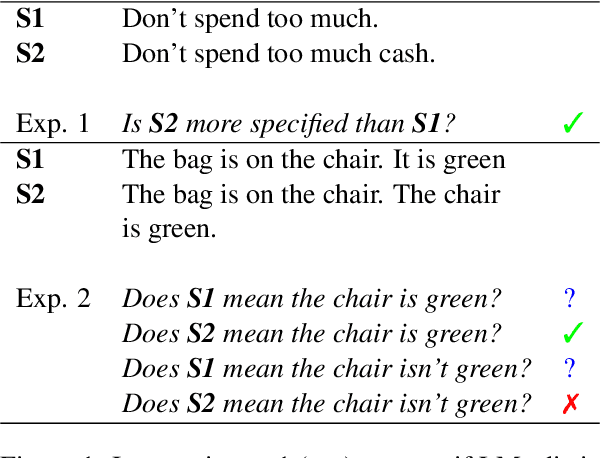
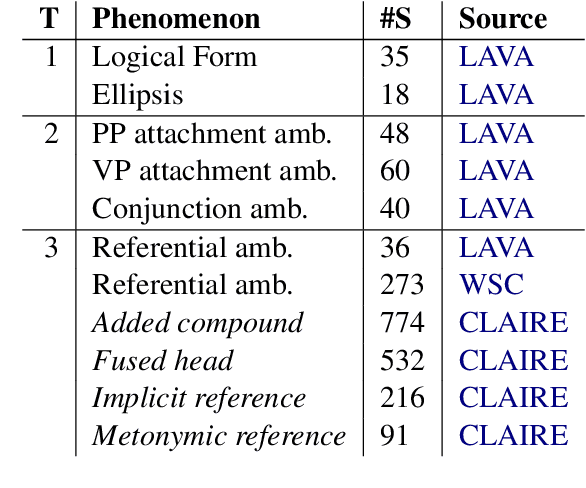
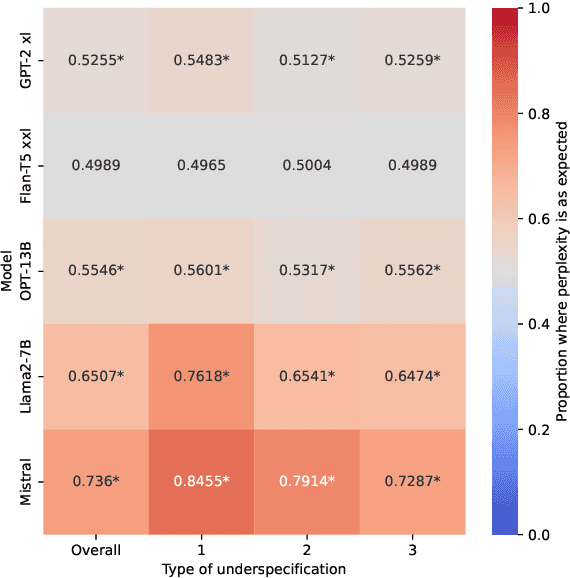
In everyday language use, speakers frequently utter and interpret sentences that are semantically underspecified, namely, whose content is insufficient to fully convey their message or interpret them univocally. For example, to interpret the underspecified sentence "Don't spend too much", which leaves implicit what (not) to spend, additional linguistic context or outside knowledge is needed. In this work, we propose a novel Dataset of semantically Underspecified Sentences grouped by Type (DUST) and use it to study whether pre-trained language models (LMs) correctly identify and interpret underspecified sentences. We find that newer LMs are reasonably able to identify underspecified sentences when explicitly prompted. However, interpreting them correctly is much harder for any LMs. Our experiments show that when interpreting underspecified sentences, LMs exhibit little uncertainty, contrary to what theoretical accounts of underspecification would predict. Overall, our study reveals limitations in current models' processing of sentence semantics and highlights the importance of using naturalistic data and communicative scenarios when evaluating LMs' language capabilities.