 Add to Chrome
 Add to Firefox
 Add to Edge
Conditional Diffusion Sampling
May 05, 2026
Sampling from unnormalized multimodal distributions with limited density evaluations remains a fundamental challenge in machine learning and natural sciences. Successful approaches construct a bridge between a tractable reference and the target distribution. Parallel Tempering (PT) serves as the gold standard, while recent diffusion-based approaches offer a continuous alternative at the cost of neural training. In this work, we introduce Conditional Diffusion Sampling (CDS), a framework that combines these two paradigms. To this end, we derive Conditional Interpolants, a class of stochastic processes whose transport dynamics are governed by an exact, closed-form stochastic differential equation (SDE), requiring no neural approximation. Although these dynamics require sampling from a non-trivial initialization distribution, we show both theoretically and empirically that the cost of this initialization diminishes for sufficiently short diffusion times. CDS leverages this by a two-stage procedure: (1) PT is used to efficiently sample the initial distribution, and then (2) samples are transported via the transport SDE. This combination couples the robust global exploration of PT with efficient local transport. Experiments suggest that CDS has the potential to achieve a superior trade-off between sample quality and density evaluation cost compared to state-of-the-art samplers.

torchmil: A PyTorch-based library for deep Multiple Instance Learning
Sep 09, 2025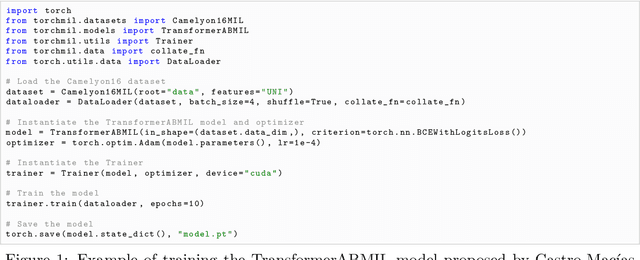
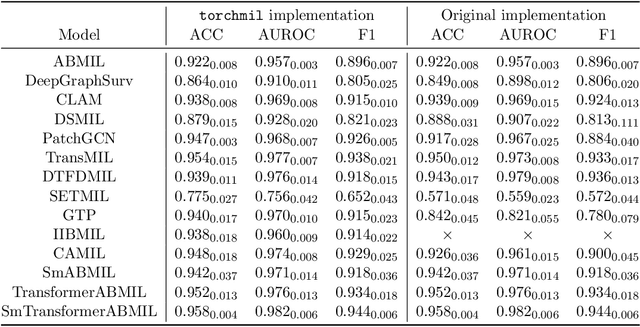
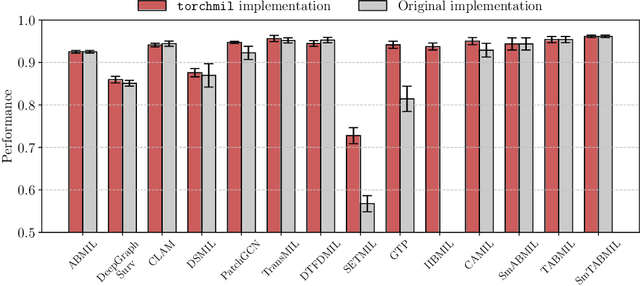
Multiple Instance Learning (MIL) is a powerful framework for weakly supervised learning, particularly useful when fine-grained annotations are unavailable. Despite growing interest in deep MIL methods, the field lacks standardized tools for model development, evaluation, and comparison, which hinders reproducibility and accessibility. To address this, we present torchmil, an open-source Python library built on PyTorch. torchmil offers a unified, modular, and extensible framework, featuring basic building blocks for MIL models, a standardized data format, and a curated collection of benchmark datasets and models. The library includes comprehensive documentation and tutorials to support both practitioners and researchers. torchmil aims to accelerate progress in MIL and lower the entry barrier for new users. Available at https://torchmil.readthedocs.io.
Sm: enhanced localization in Multiple Instance Learning for medical imaging classification
Oct 04, 2024Multiple Instance Learning (MIL) is widely used in medical imaging classification to reduce the labeling effort. While only bag labels are available for training, one typically seeks predictions at both bag and instance levels (classification and localization tasks, respectively). Early MIL methods treated the instances in a bag independently. Recent methods account for global and local dependencies among instances. Although they have yielded excellent results in classification, their performance in terms of localization is comparatively limited. We argue that these models have been designed to target the classification task, while implications at the instance level have not been deeply investigated. Motivated by a simple observation -- that neighboring instances are likely to have the same label -- we propose a novel, principled, and flexible mechanism to model local dependencies. It can be used alone or combined with any mechanism to model global dependencies (e.g., transformers). A thorough empirical validation shows that our module leads to state-of-the-art performance in localization while being competitive or superior in classification. Our code is at https://github.com/Franblueee/SmMIL.
Smooth Attention for Deep Multiple Instance Learning: Application to CT Intracranial Hemorrhage Detection
Jul 18, 2023
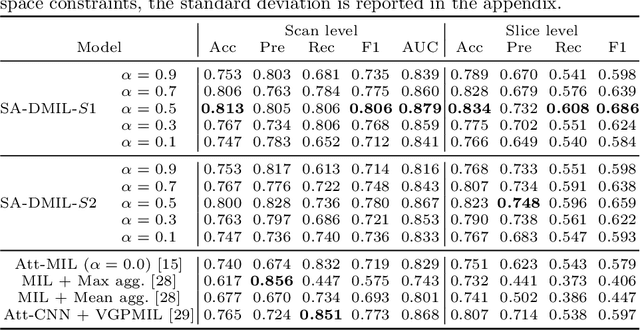


Multiple Instance Learning (MIL) has been widely applied to medical imaging diagnosis, where bag labels are known and instance labels inside bags are unknown. Traditional MIL assumes that instances in each bag are independent samples from a given distribution. However, instances are often spatially or sequentially ordered, and one would expect similar diagnostic importance for neighboring instances. To address this, in this study, we propose a smooth attention deep MIL (SA-DMIL) model. Smoothness is achieved by the introduction of first and second order constraints on the latent function encoding the attention paid to each instance in a bag. The method is applied to the detection of intracranial hemorrhage (ICH) on head CT scans. The results show that this novel SA-DMIL: (a) achieves better performance than the non-smooth attention MIL at both scan (bag) and slice (instance) levels; (b) learns spatial dependencies between slices; and (c) outperforms current state-of-the-art MIL methods on the same ICH test set.