 Add to Chrome
 Add to Firefox
 Add to Edge
Mind the Gap: Promises and Pitfalls of Hierarchical Planning in LeWorldModel
Jul 14, 2026
We investigate whether temporal hierarchy can improve LeWorldModel on long-horizon goal-conditioned control. We introduce Hi-LeWM, an extension that freezes the pretrained low-level LeWM and adds high-level planning over latent subgoals. We evaluate Hi-LeWM on PushT and Cube across increasing goal offsets. Hierarchy does not automatically improve performance: at short horizons, the best configuration uses a one-step high-level horizon, while longer horizons reveal a mismatch between the learned high-level action space and the inference-time search distribution. Experiments with true future latent subgoals show that the frozen low-level controller can execute well-aligned intermediate targets, indicating that high-level subgoal generation is the main bottleneck. Unconstrained search can select latent macro-actions that appear favorable under the learned model but produce poor control targets. Constraining search around macro-actions encoded from training trajectories, with appropriate subgoal execution timing, recovers useful hierarchical regimes, improving over flat LeWM by +11.3 percentage points at medium-range horizons and +14.7 percentage points at the longest PushT horizon. Overall, temporal abstraction can benefit compact frozen LeWM, but only when high-level search remains compatible with the low-level controller

Do Video Foundation Models Understand Intuitive Physics? A Layerwise Probing Analysis
Jun 08, 2026We study whether pretrained video foundation models encode intuitive-physics information in their frozen representations, and how this information varies across model families, layers, and probe types. Using frozen-feature probing on IntPhys2 and Minimal Video Pairs (MVP), we compare predictive joint-embedding models (V-JEPA), masked reconstruction models (VideoMAE), and a diffusion-based video generator (LTX-Video). V-JEPA achieves the strongest overall results across benchmarks, especially with probes that model temporal dynamics, while VideoMAE remains competitive and LTX-Video recovers weaker but non-trivial signal. Layerwise analyses show that physics-relevant information is weakest in early layers and becomes most accessible at intermediate-to-late depth, and temporal controls show that disrupting frame order substantially reduces performance, especially on MVP. Together, these results suggest that intuitive-physics knowledge emerges reliably in pretrained video representations, but its accessibility depends strongly on pretraining paradigm, representational depth, and readout mechanism.
A Machine Learning Pipeline for Multiple Sclerosis Biomarker Discovery: Comparing explainable AI and Traditional Statistical Approaches
Sep 26, 2025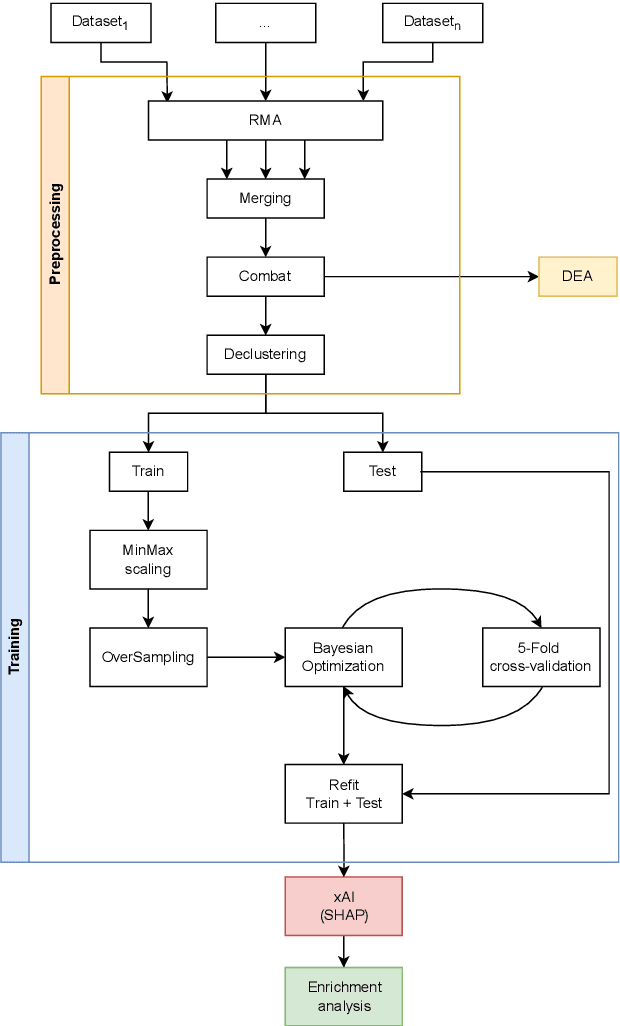
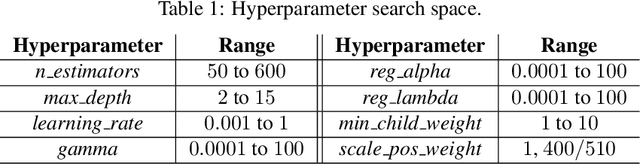
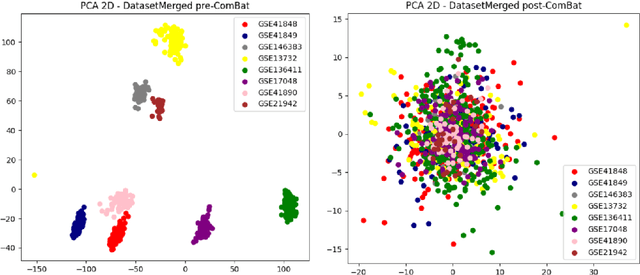
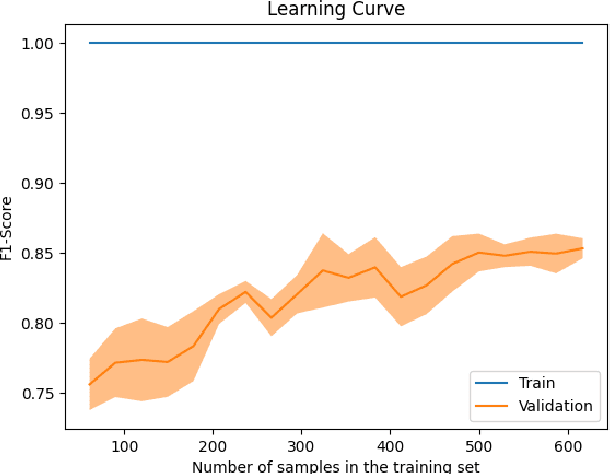
We present a machine learning pipeline for biomarker discovery in Multiple Sclerosis (MS), integrating eight publicly available microarray datasets from Peripheral Blood Mononuclear Cells (PBMC). After robust preprocessing we trained an XGBoost classifier optimized via Bayesian search. SHapley Additive exPlanations (SHAP) were used to identify key features for model prediction, indicating thus possible biomarkers. These were compared with genes identified through classical Differential Expression Analysis (DEA). Our comparison revealed both overlapping and unique biomarkers between SHAP and DEA, suggesting complementary strengths. Enrichment analysis confirmed the biological relevance of SHAP-selected genes, linking them to pathways such as sphingolipid signaling, Th1/Th2/Th17 cell differentiation, and Epstein-Barr virus infection all known to be associated with MS. This study highlights the value of combining explainable AI (xAI) with traditional statistical methods to gain deeper insights into disease mechanism.