 Add to Chrome
 Add to Firefox
 Add to Edge
Assessing Predictive Models for Fairness Based on Movement Patterns
May 22, 2026
Assessing the spatial fairness of predictive models involves establishing whether they are statistically penalizing (favoring) individuals associated with certain geographical locations. Literature on this topic makes the fundamental assumption that each individual is assigned to a single geographical location (e.g., place of residence). However, fairness with respect to the set of locations where one has been, i.e., their movement patterns over different regions, also matters when fairness is considered. Consequently, we argue that it is necessary to generalize the notion of spatial fairness to also include movement patterns, leading to the novel problem of assessing predictive models for fairness relative to the movements of individuals. To deal with this problem, we propose an approach that first associates the movements of individuals to certain geographic regions, considering multiple spatial partitions with different resolutions and alignments, and then employs a suitable spatial scan statistic to assess whether a predictive model is fair based on movement patterns. In the experimental evaluation, we study the performance of our approach over thousands of synthetic unfair datasets, showing that it is effective at detecting this new type of unfairness and at retrieving the set of objects treated unfairly, while localization performance exhibits a consistent multi-resolution trade-off.

Power- and Fragmentation-aware Online Scheduling for GPU Datacenters
Dec 23, 2024
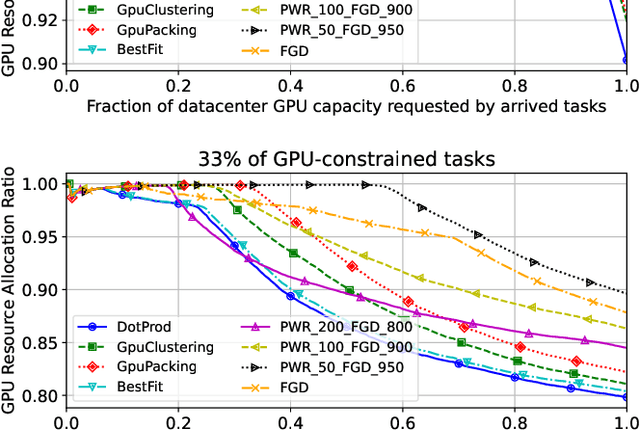


The rise of Artificial Intelligence and Large Language Models is driving increased GPU usage in data centers for complex training and inference tasks, impacting operational costs, energy demands, and the environmental footprint of large-scale computing infrastructures. This work addresses the online scheduling problem in GPU datacenters, which involves scheduling tasks without knowledge of their future arrivals. We focus on two objectives: minimizing GPU fragmentation and reducing power consumption. GPU fragmentation occurs when partial GPU allocations hinder the efficient use of remaining resources, especially as the datacenter nears full capacity. A recent scheduling policy, Fragmentation Gradient Descent (FGD), leverages a fragmentation metric to address this issue. Reducing power consumption is also crucial due to the significant power demands of GPUs. To this end, we propose PWR, a novel scheduling policy to minimize power usage by selecting power-efficient GPU and CPU combinations. This involves a simplified model for measuring power consumption integrated into a Kubernetes score plugin. Through an extensive experimental evaluation in a simulated cluster, we show how PWR, when combined with FGD, achieves a balanced trade-off between reducing power consumption and minimizing GPU fragmentation.
Urban Region Embeddings from Service-Specific Mobile Traffic Data
Nov 20, 2024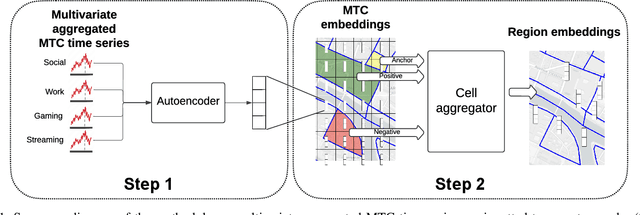
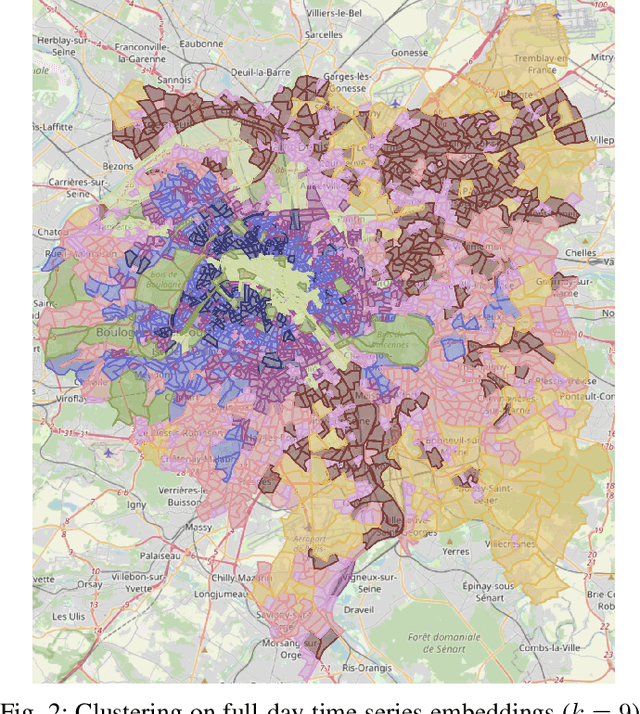
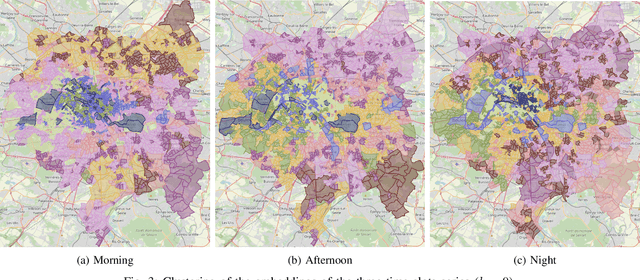
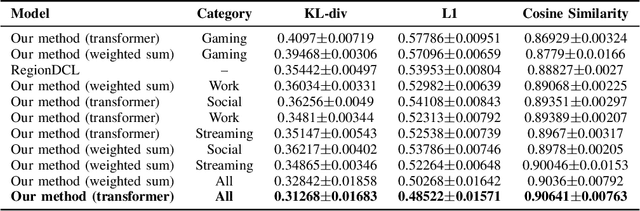
With the advent of advanced 4G/5G mobile networks, mobile phone data collected by operators now includes detailed, service-specific traffic information with high spatio-temporal resolution. In this paper, we leverage this type of data to explore its potential for generating high-quality representations of urban regions. To achieve this, we present a methodology for creating urban region embeddings from service-specific mobile traffic data, employing a temporal convolutional network-based autoencoder, transformers, and learnable weighted sum models to capture key urban features. In the extensive experimental evaluation conducted using a real-world dataset, we demonstrate that the embeddings generated by our methodology effectively capture urban characteristics. Specifically, our embeddings are compared against those of a state-of-the-art competitor across two downstream tasks. Additionally, through clustering techniques, we investigate how well the embeddings produced by our methodology capture the temporal dynamics and characteristics of the underlying urban regions. Overall, this work highlights the potential of service-specific mobile traffic data for urban research and emphasizes the importance of making such data accessible to support public innovation.