 Add to Chrome
 Add to Firefox
 Add to Edge
Accelerating Dynamic Graph Clustering on GPU Architectures with cuGraph
Aug 06, 2026
This work addresses community detection in temporal networks through GPU-accelerated extensions of spectral clustering and modularity-based algorithms originally designed for static graphs. Built on the NVIDIA RAPIDS ecosystem, the framework enables the characterization and tracking of communities in snapshot-based dynamic graphs, either by Leiden greedy optimization with multi-GPU support via Dask-based workload distribution, or eigendecomposition of a symmetric Bethe-Hessian operator. Our multislice modularity backend achieves up to roughly three orders of magnitude speedup over the CPU reference under an equal-work budget, depending on graph density and snapshot count, while preserving compatibility with existing graph analytics pipelines. We demonstrate its applicability on real-world and synthetic datasets, facilitating exploratory analysis of structural network properties over time. Such capabilities are relevant across several application domains, such as epidemic spreading, financial systems, cybersecurity, and trajectory and mobility analysis. We release our implementation as free and open-source software, including Python bindings through the NetworkX-Temporal library for ease of use and zero-code acceleration with existing codebases.

Learning and Clustering on Temporal Graphs: Principles, Primitives, and Pooling
Aug 04, 2026This work focuses on the problem of learning on temporal graphs, with particular emphasis on the task of clustering: obtaining coarse-grained representations by aggregating information from nodes, edges, and temporal dynamics - a task related to pooling in machine learning on graphs, or community detection in network science. Although graph neural networks reach state-of-the-art performance across many downstream graph tasks, their advantage over established descriptive and inferential clustering algorithms is far less settled, especially under demands of efficiency and recovery accuracy. We frame this tension through three linked perspectives: principles, connecting graph learning and community detection through shared spectral foundations and detectability thresholds in stochastic block model regimes; primitives, making spectral clustering and multislice modularity optimization tractable through GPU-accelerated temporal backends; and pooling, viewing principled community detection as a theory-grounded coarse-graining operator for temporal graphs. Our results indicate that algorithmic methods remain the appropriate tool where attributes are absent or weak - scalability rather than accuracy being the binding obstacle - while neural models are most compelling when structural, temporal, and attribute signals align. By making temporal clustering scalable, GPU-accelerated primitives suggest a route toward theory-grounded pooling, while raising a central question: when does community-based coarse-graining preserve the dynamics needed for downstream learning tasks?
Trade-offs in Decentralized Agentic AI Discovery Across the Compute Continuum
May 12, 2026Agentic systems deployed across the compute continuum need discovery mechanisms that remain effective across cloud, edge, and intermittently connected domains. In some emerging agentic architectures, decentralized discovery is already an active design direction, placing DHT-based lookup on the path toward agent directories. This paper studies the trade-offs among major structured-overlay families for agent discovery, comparing Chord, Pastry, and Kademlia as candidate indexing substrates within a shared control-plane framework. Using a benchmark subset centered on a 4096-node stationary comparison and a representative 4096-node churn benchmark, the paper characterizes how discovery reliability, startup behavior, and control-plane overhead vary across these overlays. The goal is to clarify the operating points they expose for agent discovery across edge-to-cloud environments.
Usable Agent Discovery for Decentralized AI Systems
Apr 25, 2026Large-scale agentic systems run on distributed infrastructures where many software agents share physical hosts and are discovered via peer-to-peer mechanisms. Discovery must handle node-level churn from failures and host departures and agent-level churn from demand-driven activation, deactivation, and state changes. Their interaction reshapes classic trade-offs between structured and unstructured overlays. We study decentralized agent discovery under this two-level churn, assuming nodes host multiple agents, overlays are structured or gossip-based, and agents switch between warm and cold states. Using Kademlia as a structured and Cyclon+Vicinity as a gossip baseline, we compare stable, node-churn-only, agent-cooling-only, and combined regimes to see when routing efficiency, resilience, and service readiness align or favor different designs. Structured overlays are more robust and efficient in stable and node-churn regimes, while gossip-based overlays remain competitive and can be faster when readiness dominates.
Power- and Fragmentation-aware Online Scheduling for GPU Datacenters
Dec 23, 2024
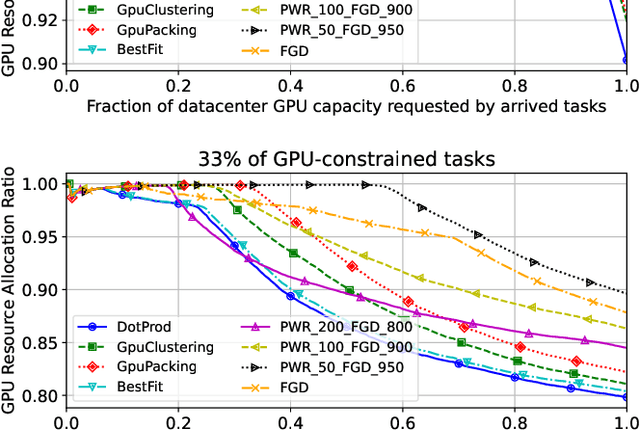


The rise of Artificial Intelligence and Large Language Models is driving increased GPU usage in data centers for complex training and inference tasks, impacting operational costs, energy demands, and the environmental footprint of large-scale computing infrastructures. This work addresses the online scheduling problem in GPU datacenters, which involves scheduling tasks without knowledge of their future arrivals. We focus on two objectives: minimizing GPU fragmentation and reducing power consumption. GPU fragmentation occurs when partial GPU allocations hinder the efficient use of remaining resources, especially as the datacenter nears full capacity. A recent scheduling policy, Fragmentation Gradient Descent (FGD), leverages a fragmentation metric to address this issue. Reducing power consumption is also crucial due to the significant power demands of GPUs. To this end, we propose PWR, a novel scheduling policy to minimize power usage by selecting power-efficient GPU and CPU combinations. This involves a simplified model for measuring power consumption integrated into a Kubernetes score plugin. Through an extensive experimental evaluation in a simulated cluster, we show how PWR, when combined with FGD, achieves a balanced trade-off between reducing power consumption and minimizing GPU fragmentation.
TEACHING -- Trustworthy autonomous cyber-physical applications through human-centred intelligence
Jul 14, 2021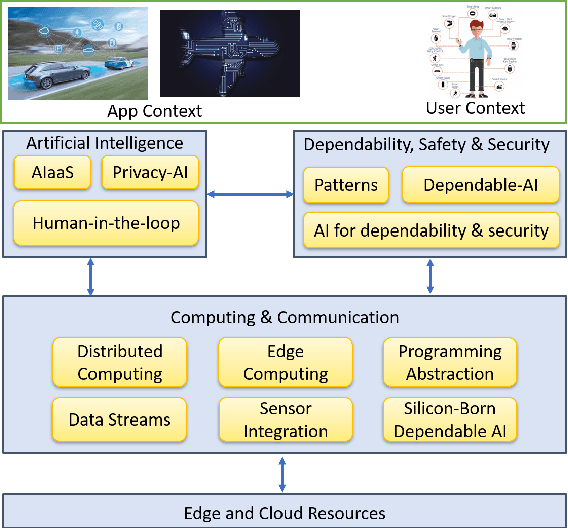
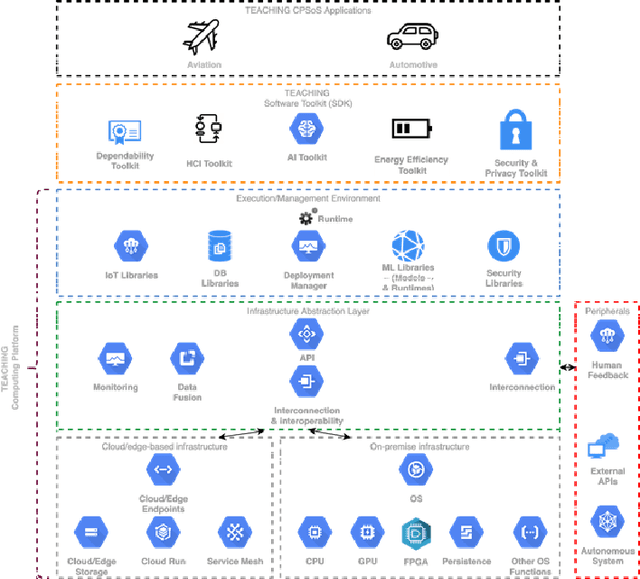
This paper discusses the perspective of the H2020 TEACHING project on the next generation of autonomous applications running in a distributed and highly heterogeneous environment comprising both virtual and physical resources spanning the edge-cloud continuum. TEACHING puts forward a human-centred vision leveraging the physiological, emotional, and cognitive state of the users as a driver for the adaptation and optimization of the autonomous applications. It does so by building a distributed, embedded and federated learning system complemented by methods and tools to enforce its dependability, security and privacy preservation. The paper discusses the main concepts of the TEACHING approach and singles out the main AI-related research challenges associated with it. Further, we provide a discussion of the design choices for the TEACHING system to tackle the aforementioned challenges