 Add to Chrome
 Add to Firefox
 Add to Edge
How to Take a Memorable Picture? Empowering Users with Actionable Feedback
Feb 25, 2026
Image memorability, i.e., how likely an image is to be remembered, has traditionally been studied in computer vision either as a passive prediction task, with models regressing a scalar score, or with generative methods altering the visual input to boost the image likelihood of being remembered. Yet, none of these paradigms supports users at capture time, when the crucial question is how to improve a photo memorability. We introduce the task of Memorability Feedback (MemFeed), where an automated model should provide actionable, human-interpretable guidance to users with the goal to enhance an image future recall. We also present MemCoach, the first approach designed to provide concrete suggestions in natural language for memorability improvement (e.g., "emphasize facial expression," "bring the subject forward"). Our method, based on Multimodal Large Language Models (MLLMs), is training-free and employs a teacher-student steering strategy, aligning the model internal activations toward more memorable patterns learned from a teacher model progressing along least-to-most memorable samples. To enable systematic evaluation on this novel task, we further introduce MemBench, a new benchmark featuring sequence-aligned photoshoots with annotated memorability scores. Our experiments, considering multiple MLLMs, demonstrate the effectiveness of MemCoach, showing consistently improved performance over several zero-shot models. The results indicate that memorability can not only be predicted but also taught and instructed, shifting the focus from mere prediction to actionable feedback for human creators.

Conditioned Prompt-Optimization for Continual Deepfake Detection
Jul 31, 2024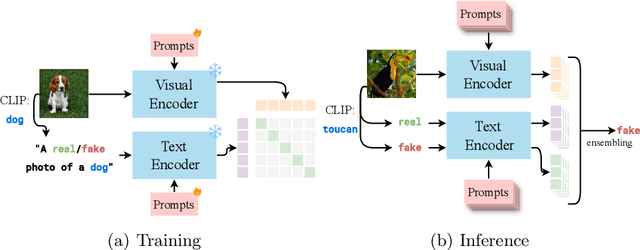
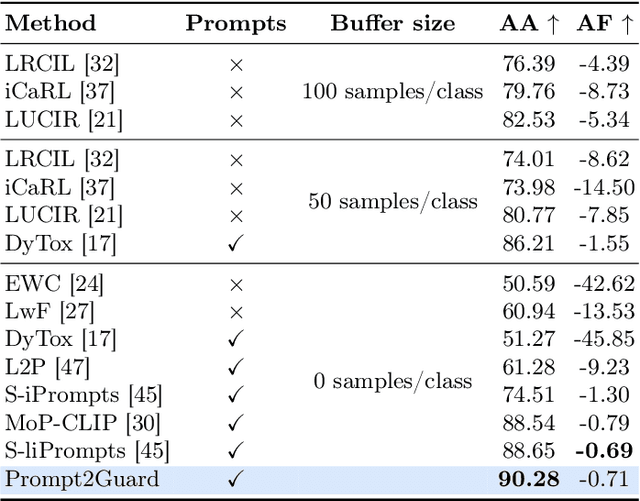
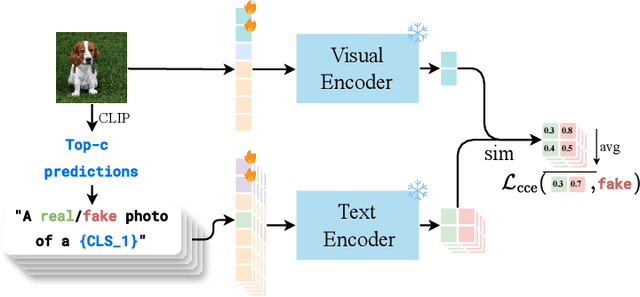

The rapid advancement of generative models has significantly enhanced the realism and customization of digital content creation. The increasing power of these tools, coupled with their ease of access, fuels the creation of photorealistic fake content, termed deepfakes, that raises substantial concerns about their potential misuse. In response, there has been notable progress in developing detection mechanisms to identify content produced by these advanced systems. However, existing methods often struggle to adapt to the continuously evolving landscape of deepfake generation. This paper introduces Prompt2Guard, a novel solution for exemplar-free continual deepfake detection of images, that leverages Vision-Language Models (VLMs) and domain-specific multimodal prompts. Compared to previous VLM-based approaches that are either bounded by prompt selection accuracy or necessitate multiple forward passes, we leverage a prediction ensembling technique with read-only prompts. Read-only prompts do not interact with VLMs internal representation, mitigating the need for multiple forward passes. Thus, we enhance efficiency and accuracy in detecting generated content. Additionally, our method exploits a text-prompt conditioning tailored to deepfake detection, which we demonstrate is beneficial in our setting. We evaluate Prompt2Guard on CDDB-Hard, a continual deepfake detection benchmark composed of five deepfake detection datasets spanning multiple domains and generators, achieving a new state-of-the-art. Additionally, our results underscore the effectiveness of our approach in addressing the challenges posed by continual deepfake detection, paving the way for more robust and adaptable solutions in deepfake detection.