 Add to Chrome
 Add to Firefox
 Add to Edge
Lambdas at the Far Edge: a Tale of Flying Lambdas and Lambdas on Wheels
Mar 04, 2026
Aggregate Programming (AP) is a paradigm for programming the collective behaviour of sets of distributed devices, possibly situated at the network far edge, by relying on asynchronous proximity-based interactions. The eXchange Calculus (XC), a recently proposed foundational model for AP, is essentially a typed lambda calculus extended with an operator (the exchange operator) providing an implicit communication mechanism between neighbour devices. This paper provides a gentle introduction to XC and to its implementation as a C++ library, called FCPP. The FCPP library and toolchain has been mainly developed at the Department of Computer Science of the University of Turin, where Stefano Berardi spent most of his academic career conducting outstanding research about logical foundation of computer science and transmitting his passion for research to students and young researchers, often exploiting typed lambda calculi. An FCCP program is essentially a typed lambda term, and FCPP has been used to write code that has been deployed on devices at the far edge of the network, including rovers and (soon) Uncrewed Aerial Vehicles (UAVs); hence the title of the paper.
* In Proceedings LTT 2026, arXiv:2603.02912

Unavailable Transit Feed Specification: Making it Available with Recurrent Neural Networks
Feb 20, 2021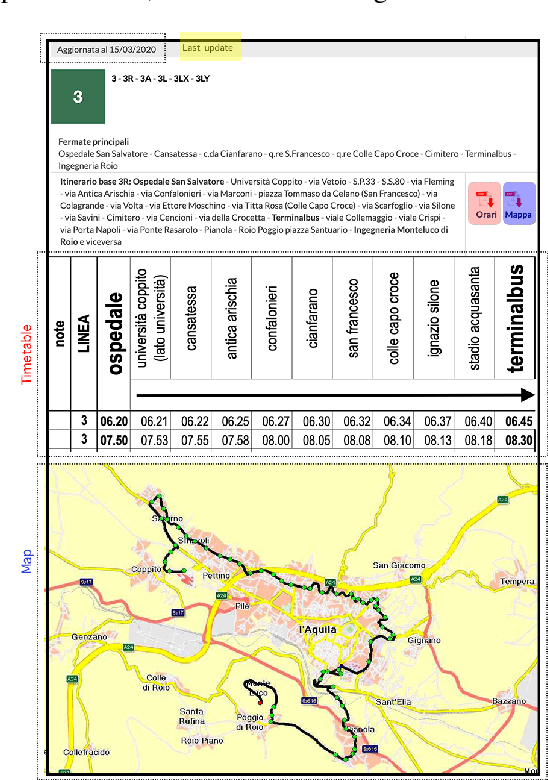
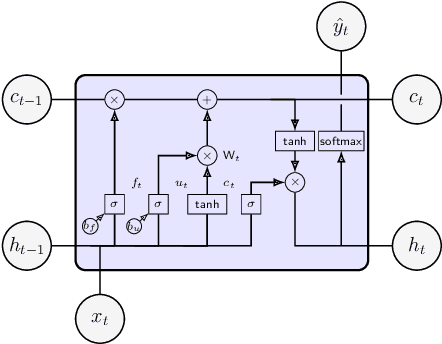
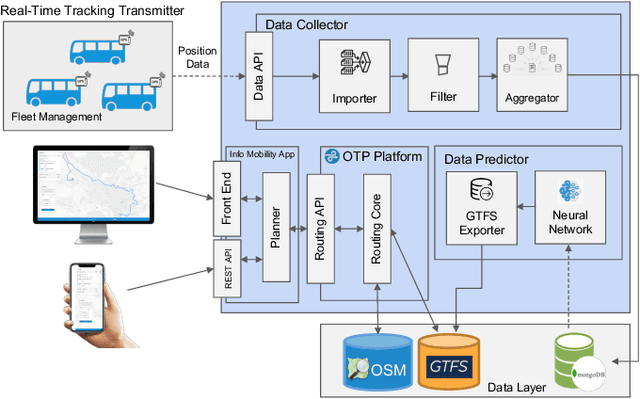
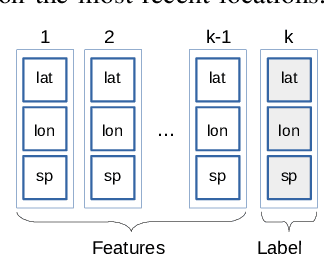
Studies on public transportation in Europe suggest that European inhabitants use buses in ca. 56% of all public transport travels. One of the critical factors affecting such a percentage and more, in general, the demand for public transport services, with an increasing reluctance to use them, is their quality. End-users can perceive quality from various perspectives, including the availability of information, i.e., the access to details about the transit and the provided services. The approach proposed in this paper, using innovative methodologies resorting on data mining and machine learning techniques, aims to make available the unavailable data about public transport. In particular, by mining GPS traces, we manage to reconstruct the complete transit graph of public transport. The approach has been successfully validated on a real dataset collected from the local bus system of the city of L'Aquila (Italy). The experimental results demonstrate that the proposed approach and implemented framework are both effective and efficient, thus being ready for deployment.