 Add to Chrome
 Add to Firefox
 Add to Edge
Localized Anomaly Detection via Differentiable D-vine Copulas
Jul 27, 2026
Vine copulas provide a flexible framework for modeling complex multivariate distributions through a hierarchical decomposition into bivariate pair-copulas. Fitting a D-vine requires selecting a copula family and parameter configuration for each pair-copula from a set of candidates encoding different dependence patterns. As the number of variables and candidate families increases, the number of possible configurations grows combinatorially. Existing fitting procedures address this challenge through sequential greedy decisions, committing to a single locally optimal family at each step and potentially discarding configurations that would yield a better global fit. To overcome this limitation, we propose a novel estimation framework that combines gradient-based maximum likelihood estimation, enabled by our fully differentiable implementation, with a beam-search strategy that maintains multiple competing D-vine configurations throughout the fitting process. This allows a broader exploration of the configuration space while remaining computationally tractable. Building on the fitted D-vine, we introduce a localized anomaly detection framework that exploits the hierarchical decomposition to produce both global anomaly scores and edge-level explanations. Statistical guarantees are provided through Mondrian conformal prediction, while the pair-copula structure enables the localization of anomalies to specific variable relationships. We evaluate the proposed framework on both benchmark and real-world datasets, demonstrating its effectiveness for interpretable anomaly detection with uncertainty quantification.

CoCAI: Copula-based Conformal Anomaly Identification for Multivariate Time-Series
Jul 23, 2025We propose a novel framework that harnesses the power of generative artificial intelligence and copula-based modeling to address two critical challenges in multivariate time-series analysis: delivering accurate predictions and enabling robust anomaly detection. Our method, Copula-based Conformal Anomaly Identification for Multivariate Time-Series (CoCAI), leverages a diffusion-based model to capture complex dependencies within the data, enabling high quality forecasting. The model's outputs are further calibrated using a conformal prediction technique, yielding predictive regions which are statistically valid, i.e., cover the true target values with a desired confidence level. Starting from these calibrated forecasts, robust outlier detection is performed by combining dimensionality reduction techniques with copula-based modeling, providing a statistically grounded anomaly score. CoCAI benefits from an offline calibration phase that allows for minimal overhead during deployment and delivers actionable results rooted in established theoretical foundations. Empirical tests conducted on real operational data derived from water distribution and sewerage systems confirm CoCAI's effectiveness in accurately forecasting target sequences of data and in identifying anomalous segments within them.
Diffusion-based Time Series Forecasting for Sewerage Systems
Jun 10, 2025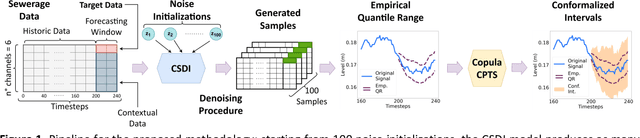
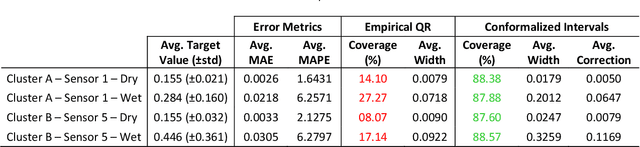
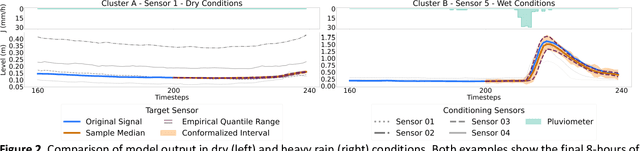
We introduce a novel deep learning approach that harnesses the power of generative artificial intelligence to enhance the accuracy of contextual forecasting in sewerage systems. By developing a diffusion-based model that processes multivariate time series data, our system excels at capturing complex correlations across diverse environmental signals, enabling robust predictions even during extreme weather events. To strengthen the model's reliability, we further calibrate its predictions with a conformal inference technique, tailored for probabilistic time series data, ensuring that the resulting prediction intervals are statistically reliable and cover the true target values with a desired confidence level. Our empirical tests on real sewerage system data confirm the model's exceptional capability to deliver reliable contextual predictions, maintaining accuracy even under severe weather conditions.