 Add to Chrome
 Add to Firefox
 Add to Edge
Style-Based Neural Architectures for Real-Time Weather Classification
Apr 20, 2026
In this paper, we present three neural network architectures designed for real-time classification of weather conditions (sunny, rain, snow, fog) from images. These models, inspired by recent advances in style transfer, aim to capture the stylistic elements present in images. One model, called "Multi-PatchGAN", is based on PatchGANs used in well-known architectures such as Pix2Pix and CycleGAN, but here adapted with multiple patch sizes for detection tasks. The second model, "Truncated ResNet50", is a simplified version of ResNet50 retaining only its first nine layers. This truncation, determined by an evolutionary algorithm, facilitates the extraction of high-frequency features essential for capturing subtle stylistic details. Finally, we propose "Truncated ResNet50 with Gram Matrix and Attention", which computes Gram matrices for each layer during training and automatically weights them via an attention mechanism, thus optimizing the extraction of the most relevant stylistic expressions for classification. These last two models outperform the state of the art and demonstrate remarkable generalization capability on several public databases. Although developed for weather detection, these architectures are also suitable for other appearance-based classification tasks, such as animal species recognition, texture classification, disease detection in medical imaging, or industrial defect identification.
* 9 pages, 21 figures

Heuristic Style Transfer for Real-Time, Efficient Weather Attribute Detection
Apr 15, 2026We present lightweight and efficient architectures to detect weather conditions from RGB images, predicting the weather type (sunny, rain, snow, fog) and 11 complementary attributes such as intensity, visibility, and ground condition, for a total of 53 classes across the tasks. This work examines to what extent weather conditions manifest as variations in visual style. We investigate style-inspired techniques, including Gram matrices, a truncated ResNet-50 targeting lower and intermediate layers, and PatchGAN-style architectures, within a multi-task framework with attention mechanisms. Two families are introduced: RTM (ResNet50-Truncated-MultiTasks) and PMG (PatchGAN-MultiTasks-Gram), together with their variants. Our contributions include automation of Gram-matrix computation, integration of PatchGAN into supervised multi-task learning, and local style capture through local Gram for improved spatial coherence. We also release a dataset of 503,875 images annotated with 12 weather attributes under a Creative Commons Attribution (CC-BY) license. The models achieve F1 scores above 96 percent on our internal test set and above 78 percent in zero-shot evaluation on several external datasets, confirming their generalization ability. The PMG architecture, with fewer than 5 million parameters, runs in real time with a small memory footprint, making it suitable for embedded systems. The modular design of the models also allows style-related or weather-related tasks to be added or removed as needed.
Leveraging blur information for plenoptic camera calibration
Nov 09, 2021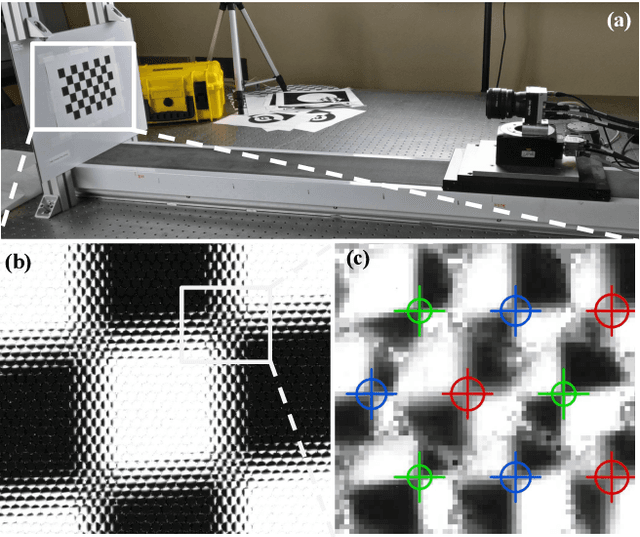
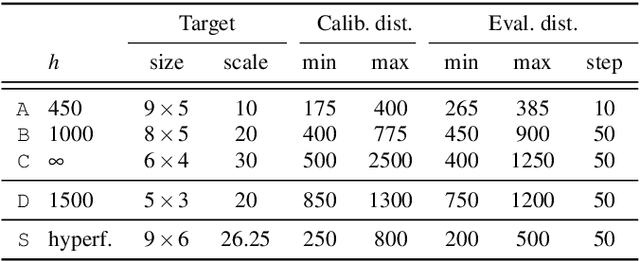
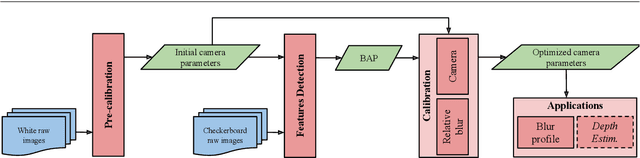
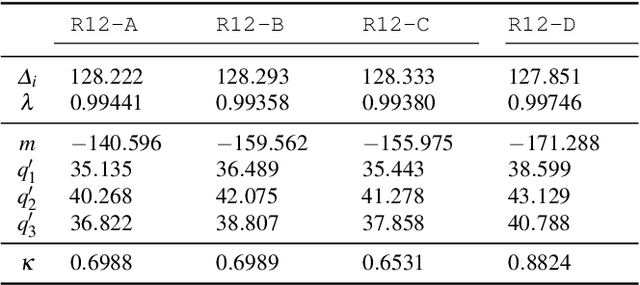
This paper presents a novel calibration algorithm for plenoptic cameras, especially the multi-focus configuration, where several types of micro-lenses are used, using raw images only. Current calibration methods rely on simplified projection models, use features from reconstructed images, or require separated calibrations for each type of micro-lens. In the multi-focus configuration, the same part of a scene will demonstrate different amounts of blur according to the micro-lens focal length. Usually, only micro-images with the smallest amount of blur are used. In order to exploit all available data, we propose to explicitly model the defocus blur in a new camera model with the help of our newly introduced Blur Aware Plenoptic (BAP) feature. First, it is used in a pre-calibration step that retrieves initial camera parameters, and second, to express a new cost function to be minimized in our single optimization process. Third, it is exploited to calibrate the relative blur between micro-images. It links the geometric blur, i.e., the blur circle, to the physical blur, i.e., the point spread function. Finally, we use the resulting blur profile to characterize the camera's depth of field. Quantitative evaluations in controlled environment on real-world data demonstrate the effectiveness of our calibrations.
Blur Aware Calibration of Multi-Focus Plenoptic Camera
Apr 16, 2020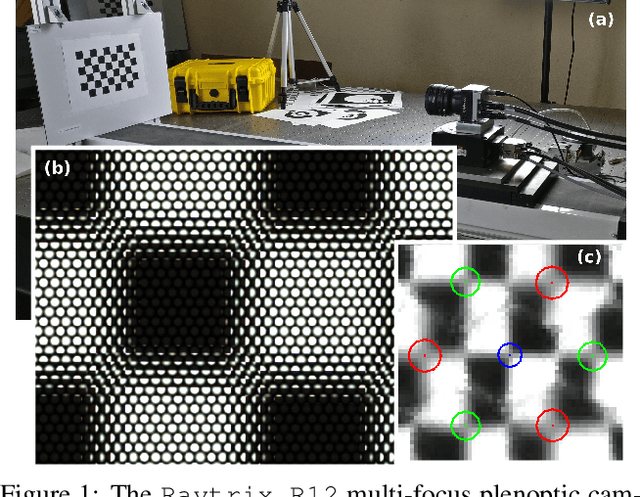
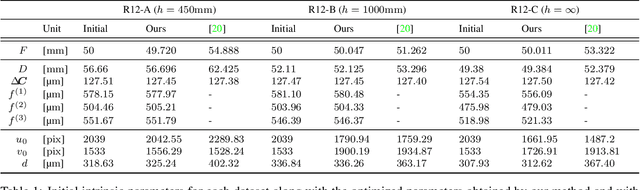
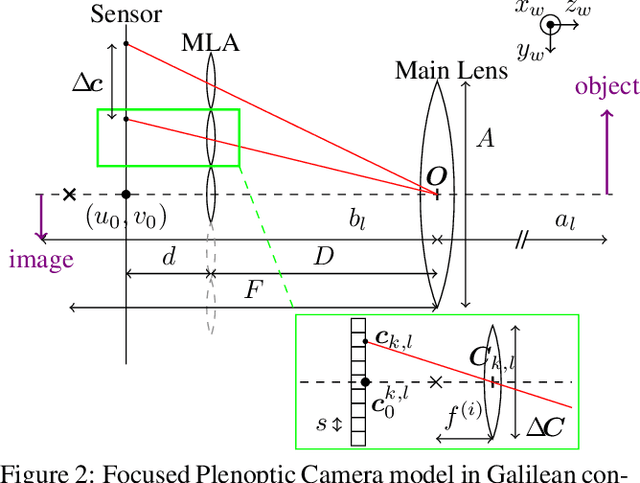
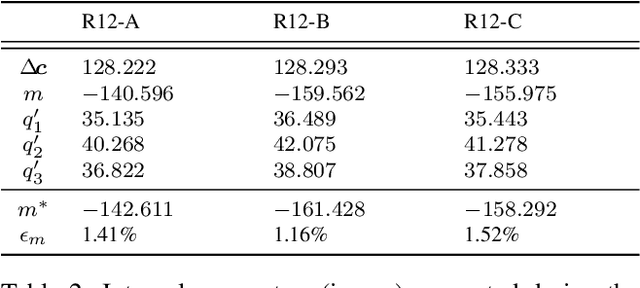
This paper presents a novel calibration algorithm for Multi-Focus Plenoptic Cameras (MFPCs) using raw images only. The design of such cameras is usually complex and relies on precise placement of optic elements. Several calibration procedures have been proposed to retrieve the camera parameters but relying on simplified models, reconstructed images to extract features, or multiple calibrations when several types of micro-lens are used. Considering blur information, we propose a new Blur Aware Plenoptic (BAP) feature. It is first exploited in a pre-calibration step that retrieves initial camera parameters, and secondly to express a new cost function for our single optimization process. The effectiveness of our calibration method is validated by quantitative and qualitative experiments.