 Add to Chrome
 Add to Firefox
 Add to Edge
LEO: Graph Attention Network based Hybrid Multi Sensor Extended Object Fusion and Tracking for Autonomous Driving Applications
Apr 02, 2026
Accurate shape and trajectory estimation of dynamic objects is essential for reliable automated driving. Classical Bayesian extended-object models offer theoretical robustness and efficiency but depend on completeness of a-priori and update-likelihood functions, while deep learning methods bring adaptability at the cost of dense annotations and high compute. We bridge these strengths with LEO (Learned Extension of Objects), a spatio-temporal Graph Attention Network that fuses multi-modal production-grade sensor tracks to learn adaptive fusion weights, ensure temporal consistency, and represent multi-scale shapes. Using a task-specific parallelogram ground-truth formulation, LEO models complex geometries (e.g. articulated trucks and trailers) and generalizes across sensor types, configurations, object classes, and regions, remaining robust for challenging and long-range targets. Evaluations on the Mercedes-Benz DRIVE PILOT SAE L3 dataset demonstrate real-time computational efficiency suitable for production systems; additional validation on public datasets such as View of Delft (VoD) further confirms cross-dataset generalization.

Adaptive Learned State Estimation based on KalmanNet
Apr 02, 2026Hybrid state estimators that combine model-based Kalman filtering with learned components have shown promise on simulated data, yet their performance on real-world automotive data remains insufficient. In this work we present Adaptive Multi-modal KalmanNet (AM-KNet), an advancement of KalmanNet tailored to the multi-sensor autonomous driving setting. AM-KNet introduces sensor-specific measurement modules that enable the network to learn the distinct noise characteristics of radar, lidar, and camera independently. A hypernetwork with context modulation conditions the filter on target type, motion state, and relative pose, allowing adaptation to diverse traffic scenarios. We further incorporate a covariance estimation branch based on the Josephs form and supervise it through negative log-likelihood losses on both the estimation error and the innovation. A comprehensive, component-wise loss function encodes physical priors on sensor reliability, target class, motion state, and measurement flow consistency. AM-KNet is trained and evaluated on the nuScenes and View-of-Delft datasets. The results demonstrate improved estimation accuracy and tracking stability compared to the base KalmanNet, narrowing the performance gap with classical Bayesian filters on real-world automotive data.
Performance Evaluation of Deep Learning-Based State Estimation: A Comparative Study of KalmanNet
Nov 25, 2024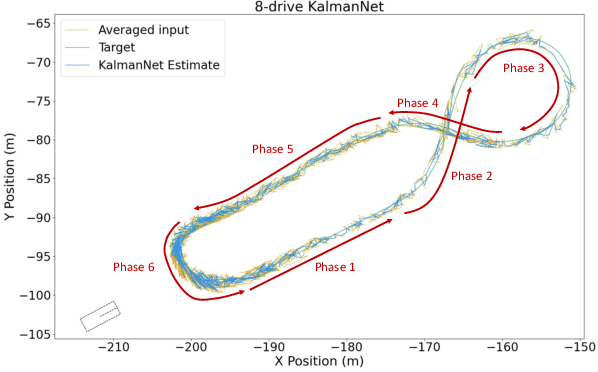
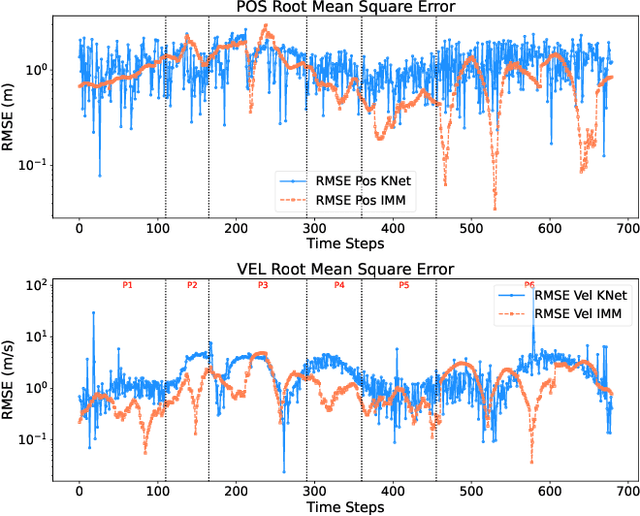
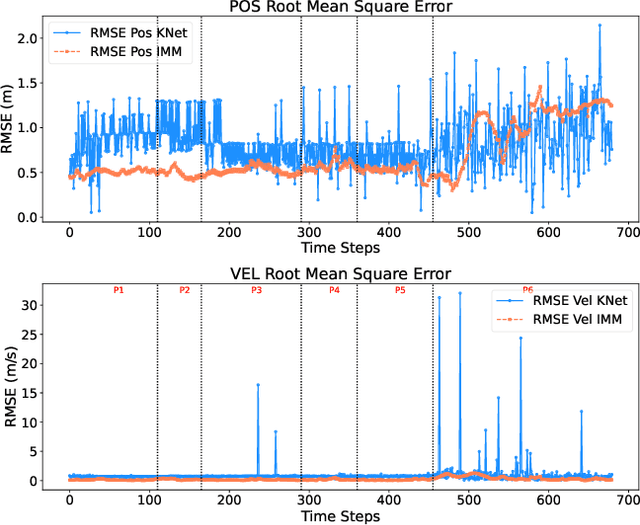
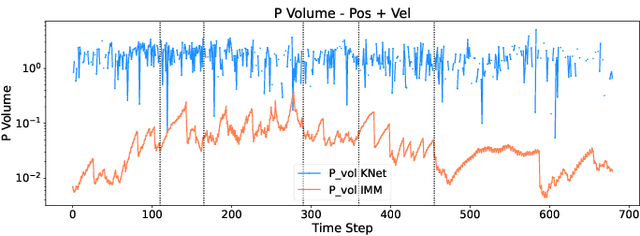
Kalman Filters (KF) are fundamental to real-time state estimation applications, including radar-based tracking systems used in modern driver assistance and safety technologies. In a linear dynamical system with Gaussian noise distributions the KF is the optimal estimator. However, real-world systems often deviate from these assumptions. This deviation combined with the success of deep learning across many disciplines has prompted the exploration of data driven approaches that leverage deep learning for filtering applications. These learned state estimators are often reported to outperform traditional model based systems. In this work, one prevalent model, KalmanNet, was selected and evaluated on automotive radar data to assess its performance under real-world conditions and compare it to an interacting multiple models (IMM) filter. The evaluation is based on raw and normalized errors as well as the state uncertainty. The results demonstrate that KalmanNet is outperformed by the IMM filter and indicate that while data-driven methods such as KalmanNet show promise, their current lack of reliability and robustness makes them unsuited for safety-critical applications.