 Add to Chrome
 Add to Firefox
 Add to Edge
Gromov-Wasserstein Quantization and Clustering: Structure, Rates, and Algorithms
Aug 11, 2026
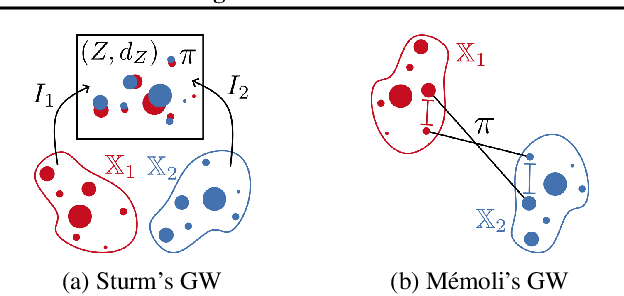
Clustering is a fundamental class of data analysis techniques with the most important representatives being centroid-based methods like $k$-means. Such methods are strongly connected to quantization problems, which aim to approximate general probability measures with discrete ones. For example, $k$-means corresponds to quantization with respect to the Wasserstein distance. While Wasserstein quantization clusters points within a fixed space, this paper studies Gromov-Wasserstein (GW) quantization, which additionally aims at clustering the ambient geometry of the space. We show existence of solutions to the GW quantization problem and give a characterization that justifies an analogue to the $k$-means algorithm (Lloyd's algorithm) to approximate them numerically. We further calculate the quantization rate for usual Euclidean geometries that are used in the GW context, and relate it to standard Wasserstein quantization rates. Finally, numerical experiments show that GW quantization opens up many modeling possibilities beyond normal clustering methods (e.g., for geodesic distances of 3D shapes or structured pruning of neural networks) and that the introduced algorithm leads to useful numerical solutions with approximation quality often in line with theoretically optimal rates.

Joint Metric Space Embedding by Unbalanced OT with Gromov-Wasserstein Marginal Penalization
Feb 11, 2025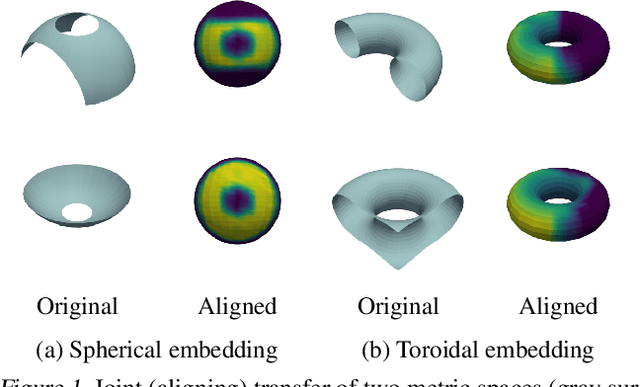
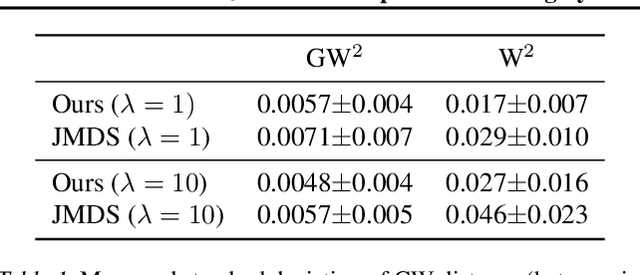
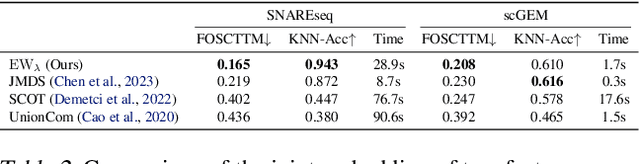
We propose a new approach for unsupervised alignment of heterogeneous datasets, which maps data from two different domains without any known correspondences to a common metric space. Our method is based on an unbalanced optimal transport problem with Gromov-Wasserstein marginal penalization. It can be seen as a counterpart to the recently introduced joint multidimensional scaling method. We prove that there exists a minimizer of our functional and that for penalization parameters going to infinity, the corresponding sequence of minimizers converges to a minimizer of the so-called embedded Wasserstein distance. Our model can be reformulated as a quadratic, multi-marginal, unbalanced optimal transport problem, for which a bi-convex relaxation admits a numerical solver via block-coordinate descent. We provide numerical examples for joint embeddings in Euclidean as well as non-Euclidean spaces.
Transfer Operators from Batches of Unpaired Points via Entropic Transport Kernels
Feb 13, 2024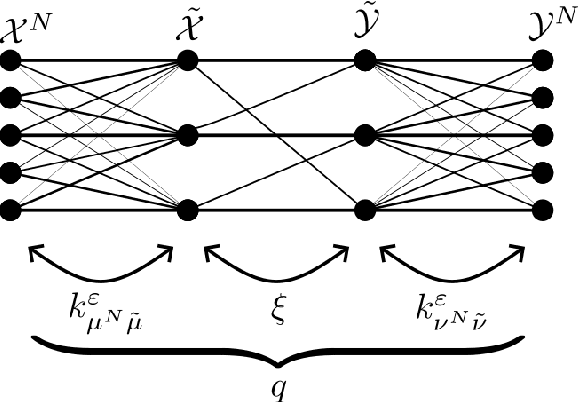
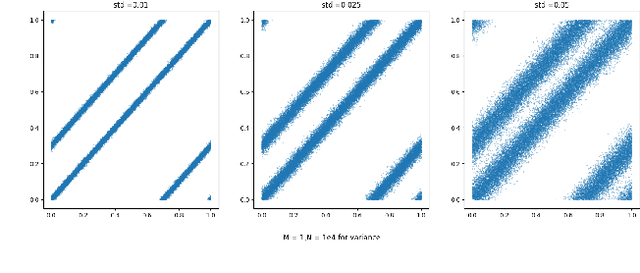
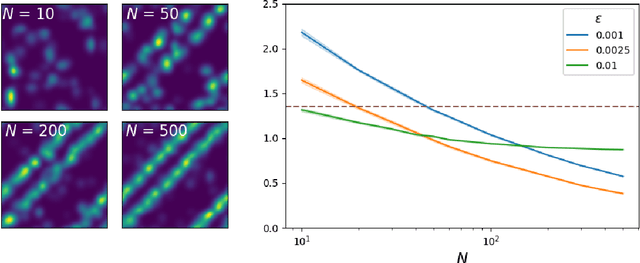
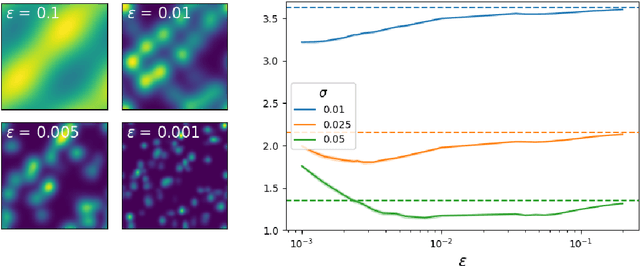
In this paper, we are concerned with estimating the joint probability of random variables $X$ and $Y$, given $N$ independent observation blocks $(\boldsymbol{x}^i,\boldsymbol{y}^i)$, $i=1,\ldots,N$, each of $M$ samples $(\boldsymbol{x}^i,\boldsymbol{y}^i) = \bigl((x^i_j, y^i_{\sigma^i(j)}) \bigr)_{j=1}^M$, where $\sigma^i$ denotes an unknown permutation of i.i.d. sampled pairs $(x^i_j,y_j^i)$, $j=1,\ldots,M$. This means that the internal ordering of the $M$ samples within an observation block is not known. We derive a maximum-likelihood inference functional, propose a computationally tractable approximation and analyze their properties. In particular, we prove a $\Gamma$-convergence result showing that we can recover the true density from empirical approximations as the number $N$ of blocks goes to infinity. Using entropic optimal transport kernels, we model a class of hypothesis spaces of density functions over which the inference functional can be minimized. This hypothesis class is particularly suited for approximate inference of transfer operators from data. We solve the resulting discrete minimization problem by a modification of the EMML algorithm to take addional transition probability constraints into account and prove the convergence of this algorithm. Proof-of-concept examples demonstrate the potential of our method.