 Add to Chrome
 Add to Firefox
 Add to Edge
Dual-Phase Cross-Modal Contrastive Learning for CMR-Guided ECG Representations for Cardiovascular Disease Assessment
Feb 13, 2026
Cardiac magnetic resonance imaging (CMR) offers detailed evaluation of cardiac structure and function, but its limited accessibility restricts use to selected patient populations. In contrast, the electrocardiogram (ECG) is ubiquitous and inexpensive, and provides rich information on cardiac electrical activity and rhythm, yet offers limited insight into underlying cardiac structure and mechanical function. To address this, we introduce a contrastive learning framework that improves the extraction of clinically relevant cardiac phenotypes from ECG by learning from paired ECG-CMR data. Our approach aligns ECG representations with 3D CMR volumes at end-diastole (ED) and end-systole (ES), with a dual-phase contrastive loss to anchor each ECG jointly with both cardiac phases in a shared latent space. Unlike prior methods limited to 2D CMR representations with or without a temporal component, our framework models 3D anatomy at both ED and ES phases as distinct latent representations, enabling flexible disentanglement of structural and functional cardiac properties. Using over 34,000 ECG-CMR pairs from the UK Biobank, we demonstrate improved extraction of image-derived phenotypes from ECG, particularly for functional parameters ($\uparrow$ 9.2\%), while improvements in clinical outcome prediction remained modest ($\uparrow$ 0.7\%). This strategy could enable scalable and cost-effective extraction of image-derived traits from ECG. The code for this research is publicly available.

Synthesis of Late Gadolinium Enhancement Images via Implicit Neural Representations for Cardiac Scar Segmentation
Feb 12, 2026Late gadolinium enhancement (LGE) imaging is the clinical standard for myocardial scar assessment, but limited annotated datasets hinder the development of automated segmentation methods. We propose a novel framework that synthesises both LGE images and their corresponding segmentation masks using implicit neural representations (INRs) combined with denoising diffusion models. Our approach first trains INRs to capture continuous spatial representations of LGE data and associated myocardium and fibrosis masks. These INRs are then compressed into compact latent embeddings, preserving essential anatomical information. A diffusion model operates on this latent space to generate new representations, which are decoded into synthetic LGE images with anatomically consistent segmentation masks. Experiments on 133 cardiac MRI scans suggest that augmenting training data with 200 synthetic volumes contributes to improved fibrosis segmentation performance, with the Dice score showing an increase from 0.509 to 0.524. Our approach provides an annotation-free method to help mitigate data scarcity.The code for this research is publicly available.
Fighting MRI Anisotropy: Learning Multiple Cardiac Shapes From a Single Implicit Neural Representation
Feb 11, 2026The anisotropic nature of short-axis (SAX) cardiovascular magnetic resonance imaging (CMRI) limits cardiac shape analysis. To address this, we propose to leverage near-isotropic, higher resolution computed tomography angiography (CTA) data of the heart. We use this data to train a single neural implicit function to jointly represent cardiac shapes from CMRI at any resolution. We evaluate the method for the reconstruction of right ventricle (RV) and myocardium (MYO), where MYO simultaneously models endocardial and epicardial left-ventricle surfaces. Since high-resolution SAX reference segmentations are unavailable, we evaluate performance by extracting a 4-chamber (4CH) slice of RV and MYO from their reconstructed shapes. When compared with the reference 4CH segmentation masks from CMRI, our method achieved a Dice similarity coefficient of 0.91 $\pm$ 0.07 and 0.75 $\pm$ 0.13, and a Hausdorff distance of 6.21 $\pm$ 3.97 mm and 7.53 $\pm$ 5.13 mm for RV and MYO, respectively. Quantitative and qualitative assessment demonstrate the model's ability to reconstruct accurate, smooth and anatomically plausible shapes, supporting improvements in cardiac shape analysis.
Deep Learning for Automatic Strain Quantification in Arrhythmogenic Right Ventricular Cardiomyopathy
Nov 24, 2023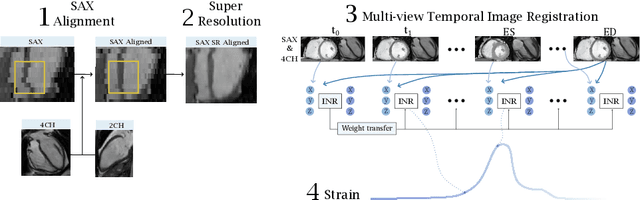
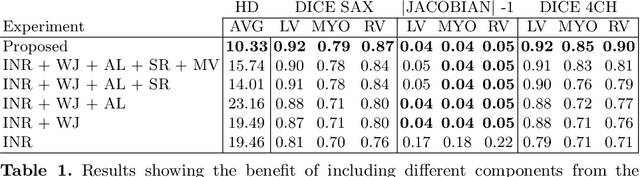

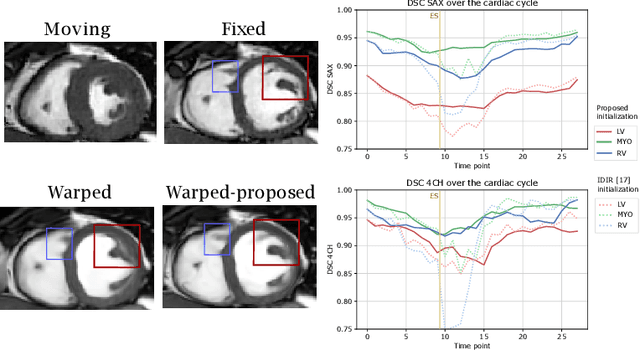
Quantification of cardiac motion with cine Cardiac Magnetic Resonance Imaging (CMRI) is an integral part of arrhythmogenic right ventricular cardiomyopathy (ARVC) diagnosis. Yet, the expert evaluation of motion abnormalities with CMRI is a challenging task. To automatically assess cardiac motion, we register CMRIs from different time points of the cardiac cycle using Implicit Neural Representations (INRs) and perform a biomechanically informed regularization inspired by the myocardial incompressibility assumption. To enhance the registration performance, our method first rectifies the inter-slice misalignment inherent to CMRI by performing a rigid registration guided by the long-axis views, and then increases the through-plane resolution using an unsupervised deep learning super-resolution approach. Finally, we propose to synergically combine information from short-axis and 4-chamber long-axis views, along with an initialization to incorporate information from multiple cardiac time points. Thereafter, to quantify cardiac motion, we calculate global and segmental strain over a cardiac cycle and compute the peak strain. The evaluation of the method is performed on a dataset of cine CMRI scans from 47 ARVC patients and 67 controls. Our results show that inter-slice alignment and generation of super-resolved volumes combined with joint analysis of the two cardiac views, notably improves registration performance. Furthermore, the proposed initialization yields more physiologically plausible registrations. The significant differences in the peak strain, discerned between the ARVC patients and healthy controls suggest that automated motion quantification methods may assist in diagnosis and provide further understanding of disease-specific alterations of cardiac motion.