 Add to Chrome
 Add to Firefox
 Add to Edge
Sharp Low-Degree Thresholds for Planted-vs-Planted Testing
Jun 03, 2026
We establish the first sharp thresholds for low-degree polynomial tests in planted-vs-planted settings, where the goal is to determine with vanishing error which of two structured planted mechanisms generated the observed data. We prove matching low-degree upper and lower bounds for counting communities in the planted submatrix and planted dense subgraph models. The resulting testing threshold coincides, down to the sharp constant, with the known low-degree recovery threshold. In contrast, the task of weak testing, where the goal is to outperform random guessing, does not have a sharp threshold but rather a smooth transition, which we identify. To prove our results, we develop a framework for planted-vs-planted testing that builds on a latent-variable expansion originating in low-degree recovery and employs new methods to identify and prune non-signal contributions.

Is it easier to count communities than find them?
Dec 21, 2022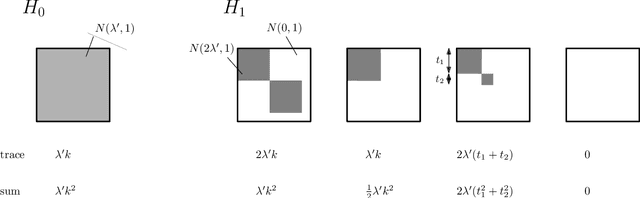
Random graph models with community structure have been studied extensively in the literature. For both the problems of detecting and recovering community structure, an interesting landscape of statistical and computational phase transitions has emerged. A natural unanswered question is: might it be possible to infer properties of the community structure (for instance, the number and sizes of communities) even in situations where actually finding those communities is believed to be computationally hard? We show the answer is no. In particular, we consider certain hypothesis testing problems between models with different community structures, and we show (in the low-degree polynomial framework) that testing between two options is as hard as finding the communities. In addition, our methods give the first computational lower bounds for testing between two different `planted' distributions, whereas previous results have considered testing between a planted distribution and an i.i.d. `null' distribution.