 Add to Chrome
 Add to Firefox
 Add to Edge
Paying to Know: Micro-Transaction Markets for Verified Product Information in Agentic E-Commerce
Jun 23, 2026
Commercial NLP treats the shopping chatbot as a recommender or a conversion tool: its job is to match a user to a catalogue entry and close a sale. We argue that the arrival of agent-native micro-payment rails (e.g., x402, AP2) changes what is scarce. When the buyer is an autonomous agent that can investigate exhaustively, the bottleneck is no longer matching products but acquiring trustworthy, decision-relevant information about them. We envision agentic e-commerce as a micro-transaction market for verified information: buyer agents spend fractions of a cent to progressively unlock seller- and reviewer-supplied data -- service histories, third-party test reports, bills of materials, audited sales and support metrics -- paid for a la carte under a freemium model, with reviewer trust scored reputationally. We sketch the architecture of such a market and argue that it rewards genuine product quality and yields truer competition than ranking-based storefronts. We then translate the vision into concrete NLP problems -- cost-optimal information acquisition, data pricing and negotiation, real-time entity resolution, grounded value exchange, and privacy-preserving persona modelling -- and argue that these, not chat fluency, deserve the field's attention.

AutoSpecNER: A Fine-Grained Named Entity Recognition Dataset for Vehicle Specification Extraction
Jun 23, 2026Vehicle advertisements contain rich specification information, but automotive NER resources remain limited. We introduce AutoSpecNER, an expert-annotated dataset for fine-grained entity recognition in vehicle listings. The dataset includes 659 advertisements from a popular car-selling website, with over 10,000 entities annotated across 15 categories, including MODEL, ENGINE_SPEC, and BATTERY_CAPACITY. Annotation quality was validated through inter-annotator agreement, achieving an average score of 91.5%. We benchmark rule-based extraction, fine-tuned transformer encoders, and large language models. DeBERTa achieves the best performance with a 90% micro-F1 score, outperforming the rule-based baseline (43%) and the strongest large language model (77.8%).
Exploring Zero-Shot ACSA with Unified Meaning Representation in Chain-of-Thought Prompting
Dec 22, 2025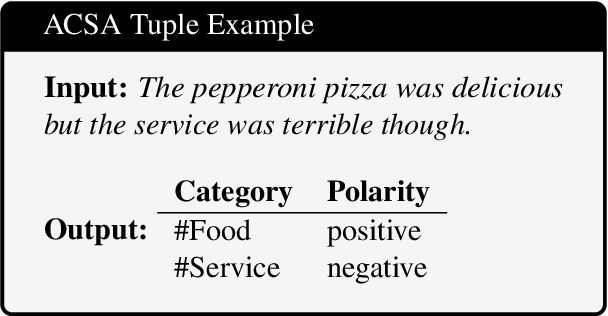
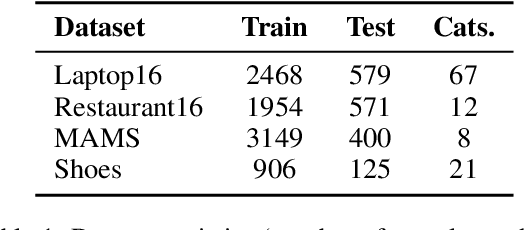

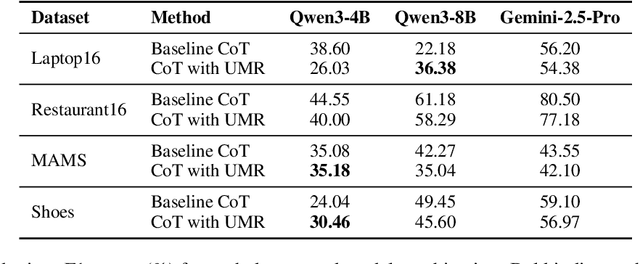
Aspect-Category Sentiment Analysis (ACSA) provides granular insights by identifying specific themes within reviews and their associated sentiment. While supervised learning approaches dominate this field, the scarcity and high cost of annotated data for new domains present significant barriers. We argue that leveraging large language models (LLMs) in a zero-shot setting is a practical alternative where resources for data annotation are limited. In this work, we propose a novel Chain-of-Thought (CoT) prompting technique that utilises an intermediate Unified Meaning Representation (UMR) to structure the reasoning process for the ACSA task. We evaluate this UMR-based approach against a standard CoT baseline across three models (Qwen3-4B, Qwen3-8B, and Gemini-2.5-Pro) and four diverse datasets. Our findings suggest that UMR effectiveness may be model-dependent. Whilst preliminary results indicate comparable performance for mid-sized models such as Qwen3-8B, these observations warrant further investigation, particularly regarding the potential applicability to smaller model architectures. Further research is required to establish the generalisability of these findings across different model scales.
Are You Sure You're Positive? Consolidating Chain-of-Thought Agents with Uncertainty Quantification for Aspect-Category Sentiment Analysis
Aug 24, 2025Aspect-category sentiment analysis provides granular insights by identifying specific themes within product reviews that are associated with particular opinions. Supervised learning approaches dominate the field. However, data is scarce and expensive to annotate for new domains. We argue that leveraging large language models in a zero-shot setting is beneficial where the time and resources required for dataset annotation are limited. Furthermore, annotation bias may lead to strong results using supervised methods but transfer poorly to new domains in contexts that lack annotations and demand reproducibility. In our work, we propose novel techniques that combine multiple chain-of-thought agents by leveraging large language models' token-level uncertainty scores. We experiment with the 3B and 70B+ parameter size variants of Llama and Qwen models, demonstrating how these approaches can fulfil practical needs and opening a discussion on how to gauge accuracy in label-scarce conditions.
* 18 pages, 10 figures, 3 tables, Proceedings of the 1st Workshop for Research on Agent Language Models (REALM 2025)
Shifting NER into High Gear: The Auto-AdvER Approach
Dec 07, 2024This paper presents a case study on the development of Auto-AdvER, a specialised named entity recognition schema and dataset for text in the car advertisement genre. Developed with industry needs in mind, Auto-AdvER is designed to enhance text mining analytics in this domain and contributes a linguistically unique NER dataset. We present a schema consisting of three labels: "Condition", "Historic" and "Sales Options". We outline the guiding principles for annotation, describe the methodology for schema development, and show the results of an annotation study demonstrating inter-annotator agreement of 92% F1-Score. Furthermore, we compare the performance by using encoder-only models: BERT, DeBERTaV3 and decoder-only open and closed source Large Language Models (LLMs): Llama, Qwen, GPT-4 and Gemini. Our results show that the class of LLMs outperforms the smaller encoder-only models. However, the LLMs are costly and far from perfect for this task. We present this work as a stepping stone toward more fine-grained analysis and discuss Auto-AdvER's potential impact on advertisement analytics and customer insights, including applications such as the analysis of market dynamics and data-driven predictive maintenance. Our schema, as well as our associated findings, are suitable for both private and public entities considering named entity recognition in the automotive domain, or other specialist domains.
Towards End-User Development for IoT: A Case Study on Semantic Parsing of Cooking Recipes for Programming Kitchen Devices
Sep 25, 2023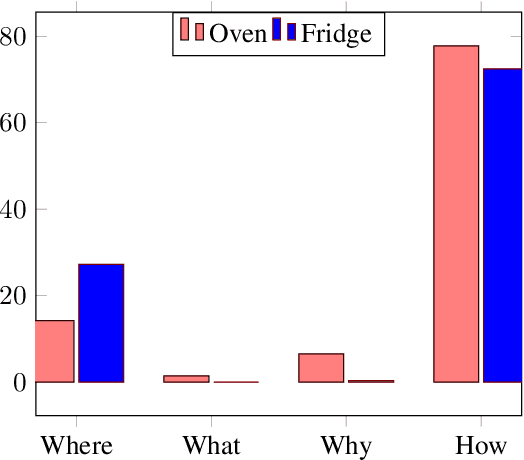
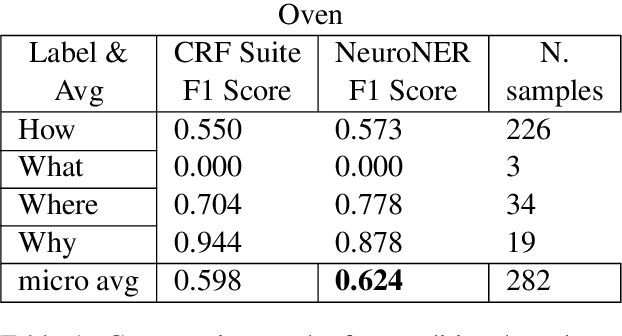
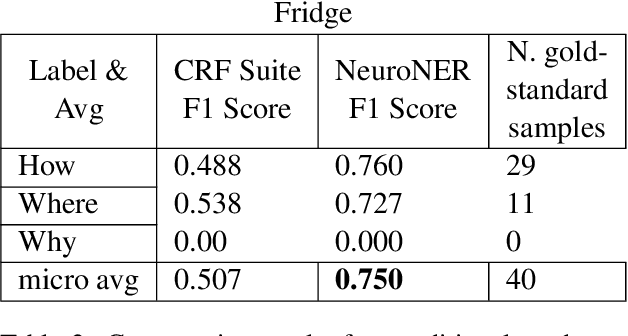
Semantic parsing of user-generated instructional text, in the way of enabling end-users to program the Internet of Things (IoT), is an underexplored area. In this study, we provide a unique annotated corpus which aims to support the transformation of cooking recipe instructions to machine-understandable commands for IoT devices in the kitchen. Each of these commands is a tuple capturing the semantics of an instruction involving a kitchen device in terms of "What", "Where", "Why" and "How". Based on this corpus, we developed machine learning-based sequence labelling methods, namely conditional random fields (CRF) and a neural network model, in order to parse recipe instructions and extract our tuples of interest from them. Our results show that while it is feasible to train semantic parsers based on our annotations, most natural-language instructions are incomplete, and thus transforming them into formal meaning representation, is not straightforward.