 Add to Chrome
 Add to Firefox
 Add to Edge
Learning the Koopman Operator using Attention Free Transformers
Jun 22, 2026
Learning Koopman operators with autoencoders enables linear prediction in a latent space, but long-horizon rollouts often drift off the learned manifold, leading to phase and amplitude errors on systems with switching, continuous spectra, or strong transients. We introduce two complementary components that make Koopman predictors more robust. First, we add an attention-free latent memory (AFT) block that aggregates a short window of past latents to produce a corrected latent before each Koopman update. Unlike multi-head attention, AFT operates in linear time and adds only $\approx$30k parameters ($3d^2 + T^2$, fewer than matched multi-head attention), yet captures the local temporal context needed to suppress error divergence. Second, we propose dynamic re-encoding: lightweight, online change-point triggers (EWMA, CUSUM, and sequential two-sample tests) that detect latent drift and project predictions back onto the autoencoder manifold. Across three benchmark systems -- Duffing oscillator, Repressilator, IRMA -- our model consistently reduces error accumulation compared to a Koopman autoencoder and matched-capacity multi-head attention. We also compare against GRU and Transformer autoencoders, evaluated both from initial conditions and with a 50-step context, and find that Koopman+AFT (with optional re-encoding) attains markedly lower long-horizon error while maintaining lower inference latency. We report improvements over horizons up to 1000 steps, together with ablations over trigger policies. The result is a fast, compact predictor that stays on the learned manifold over long horizons.

ModernBERT + ColBERT: Enhancing biomedical RAG through an advanced re-ranking retriever
Oct 06, 2025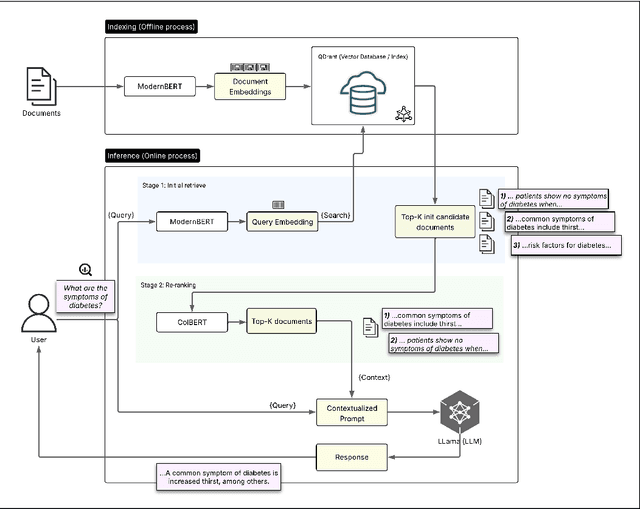
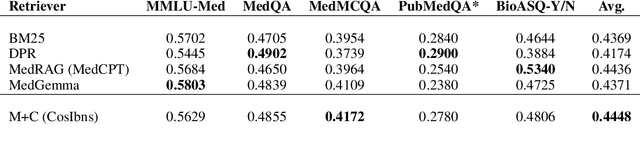
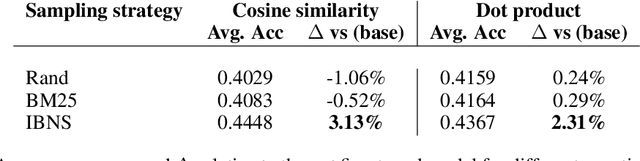
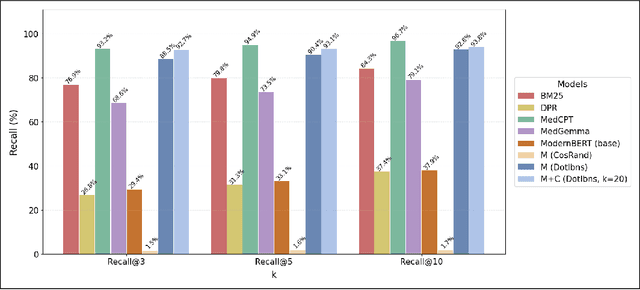
Retrieval-Augmented Generation (RAG) is a powerful technique for enriching Large Language Models (LLMs) with external knowledge, allowing for factually grounded responses, a critical requirement in high-stakes domains such as healthcare. However, the efficacy of RAG systems is fundamentally restricted by the performance of their retrieval module, since irrelevant or semantically misaligned documents directly compromise the accuracy of the final generated response. General-purpose dense retrievers can struggle with the nuanced language of specialised domains, while the high accuracy of in-domain models is often achieved at prohibitive computational costs. In this work, we aim to address this trade-off by developing and evaluating a two-stage retrieval architecture that combines a lightweight ModernBERT bidirectional encoder for efficient initial candidate retrieval with a ColBERTv2 late-interaction model for fine-grained re-ranking. We conduct comprehensive evaluations of our retriever module performance and RAG system performance in the biomedical context, fine-tuning the IR module using 10k question-passage pairs from PubMedQA. Our analysis of the retriever module confirmed the positive impact of the ColBERT re-ranker, which improved Recall@3 by up to 4.2 percentage points compared to its retrieve-only counterpart. When integrated into the biomedical RAG, our IR module leads to a state-of-the-art average accuracy of 0.4448 on the five tasks of the MIRAGE question-answering benchmark, outperforming strong baselines such as MedCPT (0.4436). Our ablation studies reveal that this performance is critically dependent on a joint fine-tuning process that aligns the retriever and re-ranker; otherwise, the re-ranker might degrade the performance.