 Add to Chrome
 Add to Firefox
 Add to Edge
The Tone of Awareness: Topic, Sentiment, and Toxicity Maps During Mental Health Month on TikTok
Jun 11, 2026
Despite raising concerns about the mental health effects associated with the usage of TikTok, little is known about how related content is framed by creators and received by audiences. We collect the content of 28,341 TikTok videos and 80,130 comments from Mental Health Awareness Month (May) in 2023 and 2024 via the TikTok Research API, and study how the tone of awareness varies across topics and years. We characterize "tone" as the emotional and interpersonal framing of mental health discourse, operationalized through sentiment and toxicity measures. We extract topics from video text using BERTopic and log-odds keywords, then quantify topic-conditioned sentiment (XLM-T) and toxicity (Detoxify) separately for video transcriptions and comments. Sentiment captures the affective valence of content, while toxicity reflects the presence of harmful or abusive language. We find a stable set of recurring themes across years, spanning clinical conditions, emotional disclosure, self-care, and campaign-oriented content, with engagement highly skewed toward a small subset of topics. All sentiment and toxicity analyses are computed separately for video content and comments, allowing us to distinguish between content production and audience reception. Sentiment in videos is often negative for emotionally charged topics, while comments tend to shift toward more mixed or positive polarity, especially for suicide prevention. Toxicity is low in median overall, but exhibits longer-tailed outliers in comments than in videos that are more pronounced in comments and concentrated in specific topics (e.g., "Duet", "Suicide Prevention", and "Psychisch"). Overall, our results provide a topic-level decomposition of mental health discourse on TikTok during awareness-month campaigns.

Recency predicts bursts in the evolution of author citations
Nov 27, 2019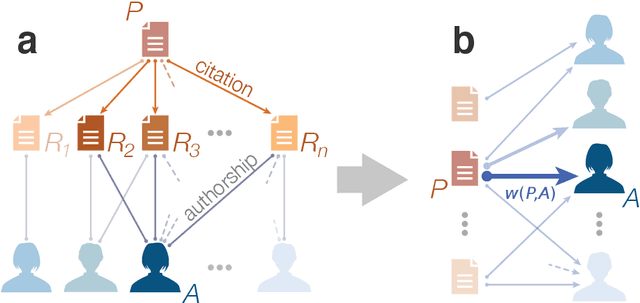
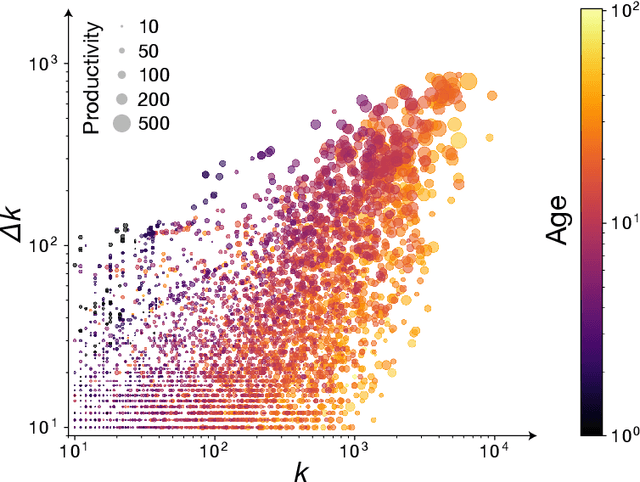
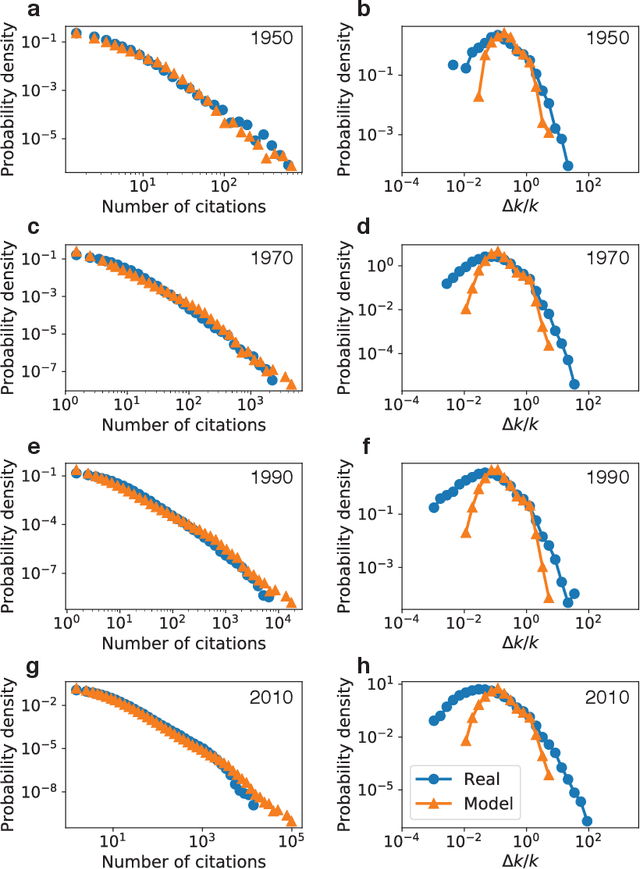
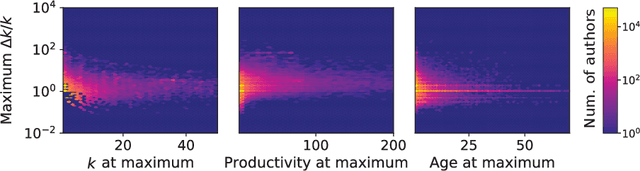
The citations process for scientific papers has been studied extensively. But while the citations accrued by authors are the sum of the citations of their papers, translating the dynamics of citation accumulation from the paper to the author level is not trivial. Here we conduct a systematic study of the evolution of author citations, and in particular their bursty dynamics. We find empirical evidence of a correlation between the number of citations most recently accrued by an author and the number of citations they receive in the future. Using a simple model where the probability for an author to receive new citations depends only on the number of citations collected in the previous 12-24 months, we are able to reproduce both the citation and burst size distributions of authors across multiple decades.