 Add to Chrome
 Add to Firefox
 Add to Edge
The Tone of Awareness: Topic, Sentiment, and Toxicity Maps During Mental Health Month on TikTok
Jun 11, 2026
Despite raising concerns about the mental health effects associated with the usage of TikTok, little is known about how related content is framed by creators and received by audiences. We collect the content of 28,341 TikTok videos and 80,130 comments from Mental Health Awareness Month (May) in 2023 and 2024 via the TikTok Research API, and study how the tone of awareness varies across topics and years. We characterize "tone" as the emotional and interpersonal framing of mental health discourse, operationalized through sentiment and toxicity measures. We extract topics from video text using BERTopic and log-odds keywords, then quantify topic-conditioned sentiment (XLM-T) and toxicity (Detoxify) separately for video transcriptions and comments. Sentiment captures the affective valence of content, while toxicity reflects the presence of harmful or abusive language. We find a stable set of recurring themes across years, spanning clinical conditions, emotional disclosure, self-care, and campaign-oriented content, with engagement highly skewed toward a small subset of topics. All sentiment and toxicity analyses are computed separately for video content and comments, allowing us to distinguish between content production and audience reception. Sentiment in videos is often negative for emotionally charged topics, while comments tend to shift toward more mixed or positive polarity, especially for suicide prevention. Toxicity is low in median overall, but exhibits longer-tailed outliers in comments than in videos that are more pronounced in comments and concentrated in specific topics (e.g., "Duet", "Suicide Prevention", and "Psychisch"). Overall, our results provide a topic-level decomposition of mental health discourse on TikTok during awareness-month campaigns.

Revealing semantic and emotional structure of suicide notes with cognitive network science
Jul 23, 2020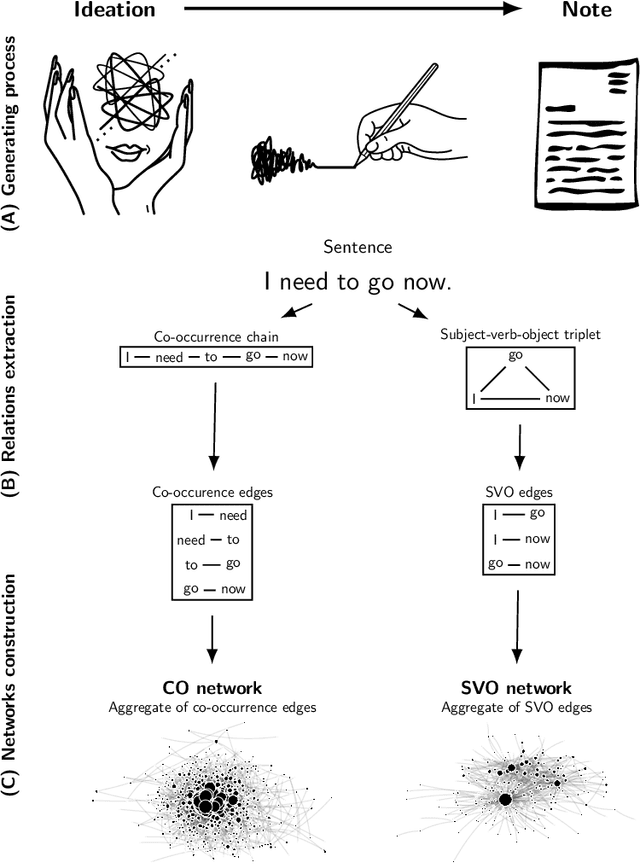
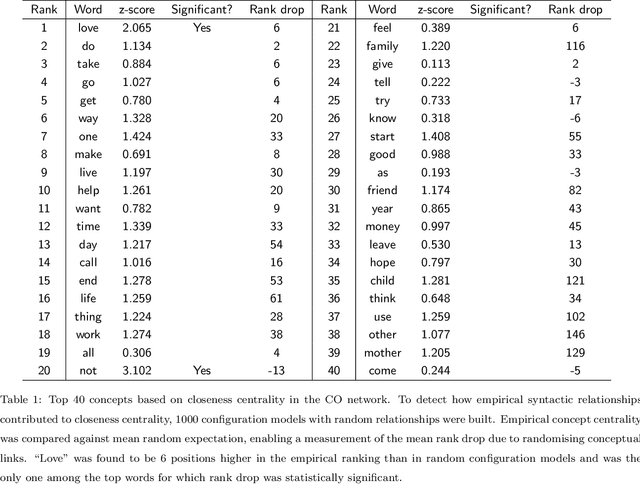
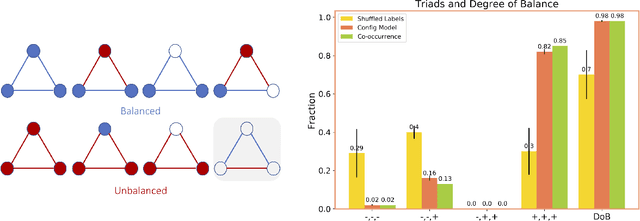
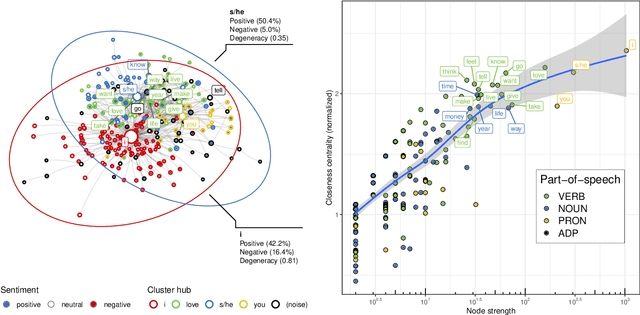
Understanding the cognitive and emotional perceptions of people who commit suicide is one of the most sensitive scientific challenges. There are circumstances where people feel the need to leave something written, an artifact where they express themselves, registering their last words and feelings. These suicide notes are of utmost importance for better understanding the psychology of suicidal ideation. This work gives structure to the linguistic content of suicide notes, revealing interconnections between cognitive and emotional states of people who committed suicide. We build upon cognitive network science, psycholinguistics and semantic frame theory to introduce a network representation of the mindset expressed in suicide notes. Our cognitive network representation enables the quantitative analysis of the language in suicide notes through structural balance theory, semantic prominence and emotional profiling. Our results indicate that the emotional syntax connecting positively- and negatively-valenced terms gives rise to a degree of structural balance that is significantly higher than null models where the affective structure was randomized. We show that suicide notes are affectively compartmentalized such that positive concepts tend to cluster together and dominate the overall network structure. A key positive concept is "love", which integrates information relating the self to others in ways that are semantically prominent across suicide notes. The emotions populating the semantic frame of "love" combine joy and trust with anticipation and sadness, which connects with psychological theories about meaning-making and narrative psychology. Our results open new ways for understanding the structure of genuine suicide notes informing future research for suicide prevention.