 Add to Chrome
 Add to Firefox
 Add to Edge
Deep probabilistic logic programming for diagnostic reasoning from incomplete information: A case study in stroke detection
Aug 09, 2026
In medical applications, raw data is frequently associated with significant privacy concerns, lending particular importance to the encoding of summary statistics from the literature. On the other hand, deep learning has become an invaluable tool for assessing symptoms based on visual or auditory sensor data. DeepProbLog allows for an extensible neuro-symbolic approach that accommodates connectionist components to analyse patient images within a transparent and rigorous probabilistic framework, namely probabilistic logic programming under the distribution semantics. Framed as a case study in stroke detection from multimodal data, this contribution explores the pathway from summary statistics available in the literature to a DeepProbLog-based diagnostic system. It suggests a workflow using established maximum entropy techniques to complete available probabilistic information and the probabilistic logic programming system ProbLog 2 to move from the entropy-maximising causal model to a discriminative neuro-symbolic model expressible within DeepProbLog. The relative performance of models derived from less complete data is analysed alongside the potential of the probabilistic inductive logic programming system ProbFOIL 2 for compressing large discriminative models, and the perspectives and implications of using DeepProbLog for diagnostic reasoning are discussed.

From probability to causality in probabilistic logic programming
Aug 07, 2026Probabilistic logic programming is a formalism of statistical relational artificial intelligence that supports causal queries, including interventions from outside the system. When the structure of a probabilistic logic program is learned from data, however, only probabilistic information is used, and a single probability distribution may be compatible with several causal orders. This leads to ambiguity in interventional reasoning, raising the question of when the causal order is uniquely determined by the distribution. Exploiting the relationship between acyclic probabilistic logic programs and Bayesian networks, we derive conditions under which the probabilistic information encoded in a program determines a unique causal order. We also incorporate constraints arising from relational structure by taking into account prescribed sets of causal symmetries induced by the underlying relational vocabulary. The result is a method for verifying when a learned probabilistic logic program supports well-defined intervention semantics.
Logic Programming Semantics for Causal Processes
Jul 23, 2026Motivated by challenging modelling issues in the life sciences, we investigate the relationship between logic programming semantics and the eventual states of causal processes compatible with those logic programs. More precisely, we show that while stable models of positive logic programs correspond to the eventual states of processes commencing from a neutral state and continuing undisturbed indefinitely, supported models describe the eventual states reachable from arbitrary starting points. This also contributes to the discussion of the appropriate semantics for logic programming as a causal rule language, adding a temporal perspective to recent interpretations of the stable and supported model semantics from an explanatory viewpoint of causality.
* In Proceedings ICLP 2026, arXiv:2607.17707
How Artificial Intelligence Leads to Knowledge Why: An Inquiry Inspired by Aristotle's Posterior Analytics
Apr 03, 2025Bayesian networks and causal models provide frameworks for handling queries about external interventions and counterfactuals, enabling tasks that go beyond what probability distributions alone can address. While these formalisms are often informally described as capturing causal knowledge, there is a lack of a formal theory characterizing the type of knowledge required to predict the effects of external interventions. This work introduces the theoretical framework of causal systems to clarify Aristotle's distinction between knowledge that and knowledge why within artificial intelligence. By interpreting existing artificial intelligence technologies as causal systems, it investigates the corresponding types of knowledge. Furthermore, it argues that predicting the effects of external interventions is feasible only with knowledge why, providing a more precise understanding of the knowledge necessary for such tasks.
Understanding Domain-Size Generalization in Markov Logic Networks
Apr 08, 2024
We study the generalization behavior of Markov Logic Networks (MLNs) across relational structures of different sizes. Multiple works have noticed that MLNs learned on a given domain generalize poorly across domains of different sizes. This behavior emerges from a lack of internal consistency within an MLN when used across different domain sizes. In this paper, we quantify this inconsistency and bound it in terms of the variance of the MLN parameters. The parameter variance also bounds the KL divergence between an MLN's marginal distributions taken from different domain sizes. We use these bounds to show that maximizing the data log-likelihood while simultaneously minimizing the parameter variance corresponds to two natural notions of generalization across domain sizes. Our theoretical results apply to Exponential Random Graphs and other Markov network based relational models. Finally, we observe that solutions known to decrease the variance of the MLN parameters, like regularization and Domain-Size Aware MLNs, increase the internal consistency of the MLNs. We empirically verify our results on four different datasets, with different methods to control parameter variance, showing that controlling parameter variance leads to better generalization.
On the Independencies Hidden in the Structure of a Probabilistic Logic Program
Aug 30, 2023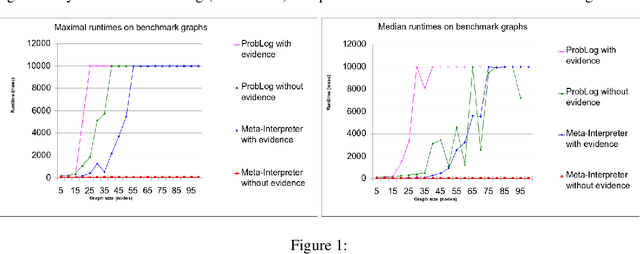
Pearl and Verma developed d-separation as a widely used graphical criterion to reason about the conditional independencies that are implied by the causal structure of a Bayesian network. As acyclic ground probabilistic logic programs correspond to Bayesian networks on their dependency graph, we can compute conditional independencies from d-separation in the latter. In the present paper, we generalize the reasoning above to the non-ground case. First, we abstract the notion of a probabilistic logic program away from external databases and probabilities to obtain so-called program structures. We then present a correct meta-interpreter that decides whether a certain conditional independence statement is implied by a program structure on a given external database. Finally, we give a fragment of program structures for which we obtain a completeness statement of our conditional independence oracle. We close with an experimental evaluation of our approach revealing that our meta-interpreter performs significantly faster than checking the definition of independence using exact inference in ProbLog 2.
* In Proceedings ICLP 2023, arXiv:2308.14898
"Would life be more interesting if I were in AI?" Answering Counterfactuals based on Probabilistic Inductive Logic Programming
Aug 30, 2023Probabilistic logic programs are logic programs where some facts hold with a specified probability. Here, we investigate these programs with a causal framework that allows counterfactual queries. Learning the program structure from observational data is usually done through heuristic search relying on statistical tests. However, these statistical tests lack information about the causal mechanism generating the data, which makes it unfeasible to use the resulting programs for counterfactual reasoning. To address this, we propose a language fragment that allows reconstructing a program from its induced distribution. This further enables us to learn programs supporting counterfactual queries.
* In Proceedings ICLP 2023, arXiv:2308.14898
"What if?" in Probabilistic Logic Programming
May 24, 2023A ProbLog program is a logic program with facts that only hold with a specified probability. In this contribution we extend this ProbLog language by the ability to answer "What if" queries. Intuitively, a ProbLog program defines a distribution by solving a system of equations in terms of mutually independent predefined Boolean random variables. In the theory of causality, Judea Pearl proposes a counterfactual reasoning for such systems of equations. Based on Pearl's calculus, we provide a procedure for processing these counterfactual queries on ProbLog programs, together with a proof of correctness and a full implementation. Using the latter, we provide insights into the influence of different parameters on the scalability of inference. Finally, we also show that our approach is consistent with CP-logic, i.e. with the causal semantics for logic programs with annotated with disjunctions.
The generalised distribution semantics and projective families of distributions
Nov 12, 2022We generalise the distribution semantics underpinning probabilistic logic programming by distilling its essential concept, the separation of a free random component and a deterministic part. This abstracts the core ideas beyond logic programming as such to encompass frameworks from probabilistic databases, probabilistic finite model theory and discrete lifted Bayesian networks. To demonstrate the usefulness of such a general approach, we completely characterise the projective families of distributions representable in the generalised distribution semantics and we demonstrate both that large classes of interesting projective families cannot be represented in a generalised distribution semantics and that already a very limited fragment of logic programming (acyclic determinate logic programs) in the determinsitic part suffices to represent all those projective families that are representable in the generalised distribution semantics at all.
Projectivity revisited
Jul 01, 2022The behaviour of statistical relational representations across differently sized domains has become a focal area of research from both a modelling and a complexity viewpoint. In 2018, Jaeger and Schulte suggested projectivity of a family of distributions as a key property, ensuring that marginal inference is independent of the domain size. However, Jaeger and Schulte assume that the domain is characterised only by its size. This contribution extends the notion of projectivity from families of distributions indexed by domain size to functors taking extensional data from a database. This makes projectivity available for the large range of applications taking structured input. We transfer the known attractive properties of projective families of distributions to the new setting. Furthermore, we prove a correspondence between projectivity and distributions on countably infinite domains, which we use to unify and generalise earlier work on statistical relational representations in infinite domains. Finally, we use the extended notion of projectivity to define a further strengthening, which we call $\sigma$-projectivity, and which allows the use of the same representation in different modes while retaining projectivity.