 Add to Chrome
 Add to Firefox
 Add to Edge
STCAD: Scalable Trajectory Clustering and Anomaly Detection on Terabyte-Scale AIS Data
Aug 10, 2026
We present a scalable framework for unsupervised clustering of maritime trajectories derived from terabyte-scale Automatic Identification System (AIS) archives. Variable-length trajectories are encoded with a custom BERT-based model trained via masked token modeling and clustered using CURE hierarchical clustering, producing physically interpretable trajectory groups without requiring a predefined number of clusters. An intrinsic unsupervised anomaly detection method based on reconstruction loss and clustering noise assignment identifies irregular navigation patterns. The framework is demonstrated on a national-scale AIS dataset comprising billions of messages spanning one year, yielding stable trajectory clusters and a clear separation between nominal and anomalous vessel behavior.

CRHT: A Continuous Regression Hybrid Transformer for Vessel Trajectory Prediction with Online Cluster Sampling
Aug 10, 2026Accurate vessel trajectory prediction is critical for maritime safety and anomaly detection, yet existing models often struggle with geographic bias and navigational realism. We propose the Continuous Regression Hybrid Transformer (CRHT), a deep learning framework designed to forecast vessel motion using Automatic Identification System (AIS) data. To mitigate spatial data imbalance, we introduce an online K-means cluster sampling strategy that ensures diverse exposure to rare maneuvers during training. Our hybrid architecture integrates 1D convolutional layers for local kinematic feature extraction with a multi-head attention mechanism for global temporal context. CRHT demonstrates superior performance in short-term forecasting, achieving the lowest errors at the 1-hour horizon. The results demonstrate that while discrete models provide high navigational stability over long horizons, CRHT offers an optimal balance of precision and maneuver tracking for real-time maritime surveillance.
Noise Reduction to Compute Tissue Mineral Density and Trabecular Bone Volume Fraction from Low Resolution QCT
Nov 04, 2020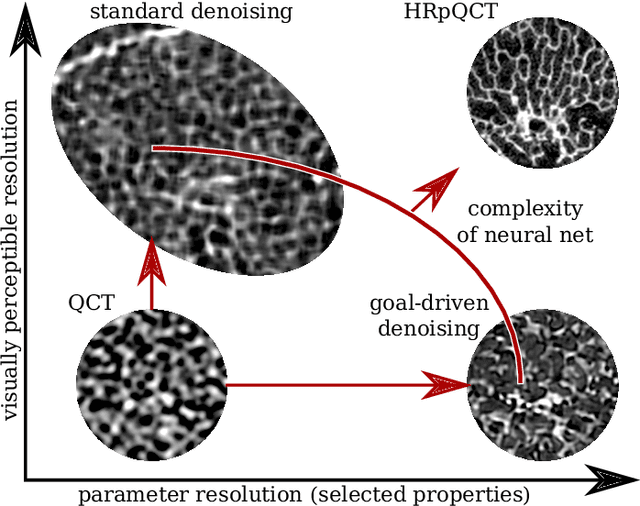
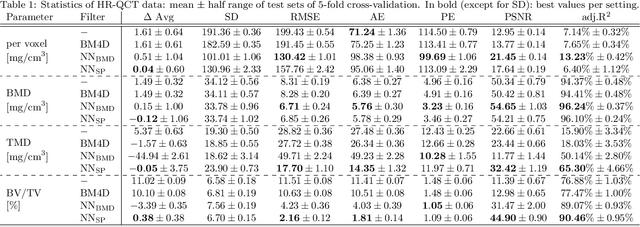
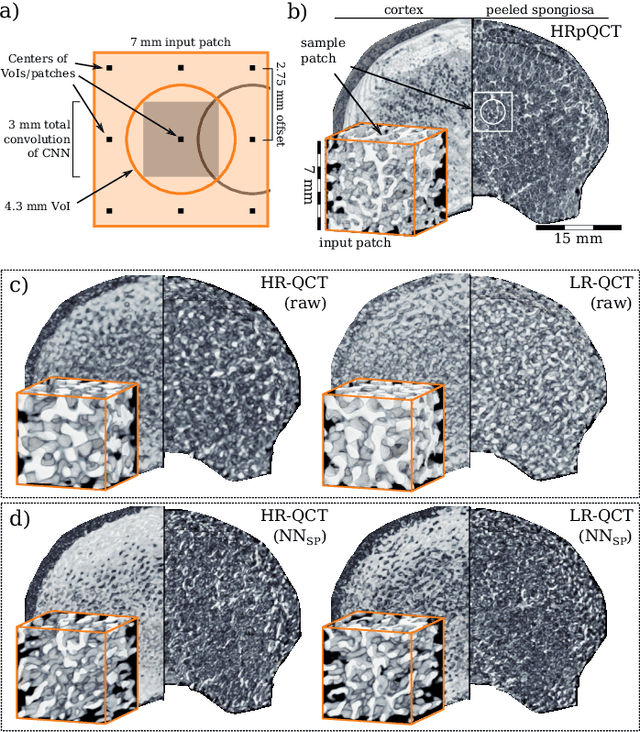
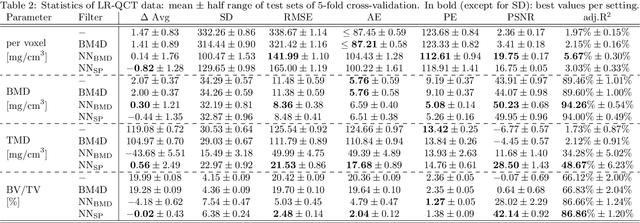
We propose a 3D neural network with specific loss functions for quantitative computed tomography (QCT) noise reduction to compute micro-structural parameters such as tissue mineral density (TMD) and bone volume ratio (BV/TV) with significantly higher accuracy than using no or standard noise reduction filters. The vertebra-phantom study contained high resolution peripheral and clinical CT scans with simulated in vivo CT noise and nine repetitions of three different tube currents (100, 250 and 360 mAs). Five-fold cross validation was performed on 20466 purely spongy pairs of noisy and ground-truth patches. Comparison of training and test errors revealed high robustness against over-fitting. While not showing effects for the assessment of BMD and voxel-wise densities, the filter improved thoroughly the computation of TMD and BV/TV with respect to the unfiltered data. Root-mean-square and accuracy errors of low resolution TMD and BV/TV decreased to less than 17% of the initial values. Furthermore filtered low resolution scans revealed still more TMD- and BV/TV-relevant information than high resolution CT scans, either unfiltered or filtered with two state-of-the-art standard denoising methods. The proposed architecture is threshold and rotational invariant, applicable on a wide range of image resolutions at once, and likely serves for an accurate computation of further micro-structural parameters. Furthermore, it is less prone for over-fitting than neural networks that compute structural parameters directly. In conclusion, the method is potentially important for the diagnosis of osteoporosis and other bone diseases since it allows to assess relevant 3D micro-structural information from standard low exposure CT protocols such as 100 mAs and 120 kVp.
Generative Modelling of 3D in-silico Spongiosa with Controllable Micro-Structural Parameters
Sep 23, 2020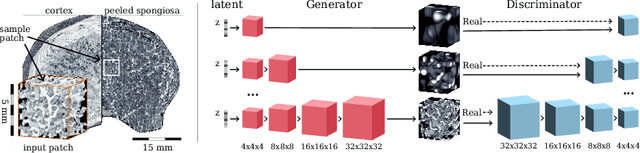
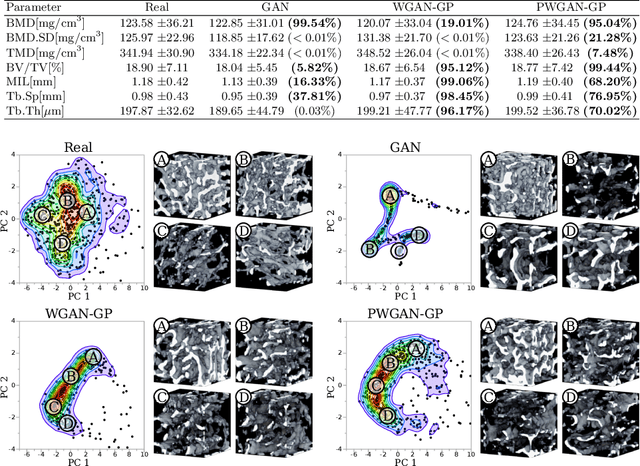
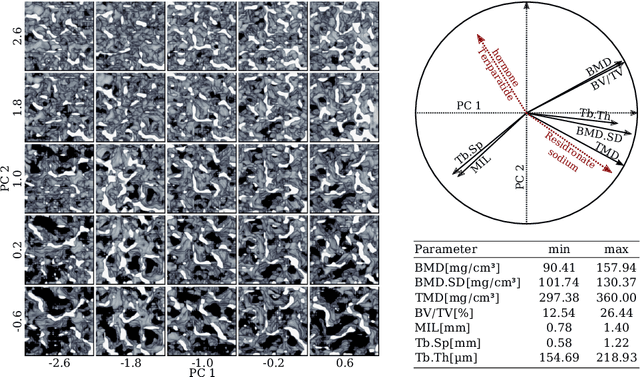
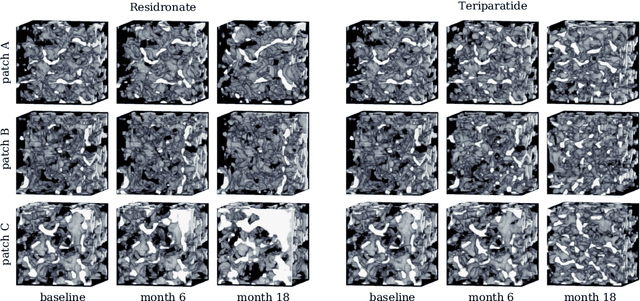
Research in vertebral bone micro-structure generally requires costly procedures to obtain physical scans of real bone with a specific pathology under study, since no methods are available yet to generate realistic bone structures in-silico. Here we propose to apply recent advances in generative adversarial networks (GANs) to develop such a method. We adapted style-transfer techniques, which have been largely used in other contexts, in order to transfer style between image pairs while preserving its informational content. In a first step, we trained a volumetric generative model in a progressive manner using a Wasserstein objective and gradient penalty (PWGAN-GP) to create patches of realistic bone structure in-silico. The training set contained 7660 purely spongeous bone samples from twelve human vertebrae (T12 or L1) with isotropic resolution of 164um and scanned with a high resolution peripheral quantitative CT (Scanco XCT). After training, we generated new samples with tailored micro-structure properties by optimizing a vector z in the learned latent space. To solve this optimization problem, we formulated a differentiable goal function that leads to valid samples while compromising the appearance (content) with target 3D properties (style). Properties of the learned latent space effectively matched the data distribution. Furthermore, we were able to simulate the resulting bone structure after deterioration or treatment effects of osteoporosis therapies based only on expected changes of micro-structural parameters. Our method allows to generate a virtually infinite number of patches of realistic bone micro-structure, and thereby likely serves for the development of bone-biomarkers and to simulate bone therapies in advance.