 Add to Chrome
 Add to Firefox
 Add to Edge
Finding a stationary point of a stochastic convex problem
Jul 08, 2026
We consider the problem of finding stationary points for stochastic convex optimization problems. Rather than surrogates to stationarity, such as a proximity-to-stationarity guarantee or small gradient of the Moreau envelope, we ask for a stronger notion: that the subdifferential of the objective actually contains a small element. This criterion is non-trivial, because subdifferentials of convex functions fail to converge uniformly, even in arbitrarily small neighborhoods of the optimum. Our convergence guarantees rely on dimension theory to decompose the graph of the subdifferential of a convex function, showing how stochastic sampling preserves "pieces" of these graphs, and allowing effective application of proximal-point-like methods.

Achieving Short-Blocklength RCU bound via CRC List Decoding of TCM with Probabilistic Shaping
Nov 16, 2021

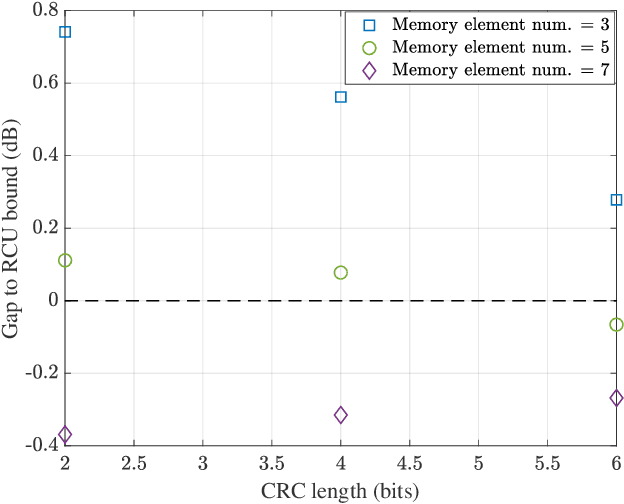
This paper applies probabilistic amplitude shaping (PAS) to a cyclic redundancy check (CRC) aided trellis coded modulation (TCM) to achieve the short-blocklength random coding union (RCU) bound. In the transmitter, the equally likely message bits are first encoded by distribution matcher to generate amplitude symbols with the desired distribution. The binary representations of the distribution matcher outputs are then encoded by a CRC. Finally, the CRC-encoded bits are encoded and modulated by Ungerboeck's TCM scheme, which consists of a $\frac{k_0}{k_0+1}$ systematic tail-biting convolutional code and a mapping function that maps coded bits to channel signals with capacity-achieving distribution. This paper proves that, for the proposed transmitter, the CRC bits have uniform distribution and that the channel signals have symmetric distribution. In the receiver, the serial list Viterbi decoding (S-LVD) is used to estimate the information bits. Simulation results show that, for the proposed CRC-TCM-PAS system with 87 input bits and 65-67 8-AM coded output symbols, the decoding performance under additive white Gaussian noise channel achieves the RCU bound with properly designed CRC and convolutional codes.