 Add to Chrome
 Add to Firefox
 Add to Edge
GMENet: Generative Mixture of Experts Network for Multi-Center Glioma Diagnosis with Incomplete Imaging Sequences
May 22, 2026
Contemporary glioma diagnosis integrates molecular features with histopathology to guide clinical decision-making. However, in clinical settings, divergent imaging protocols result in incomplete MRI sequences, leading to two primary challenges: forcing existing frameworks to discard a large portion of clinical data during training and consequently limiting their clinical applicability. To address these limitations, we propose GMENet, a Generative Mixture of Experts Network for multi-center glioma diagnosis with incomplete imaging sequences. Firstly, we design a Cross-attention-based Gated Generation Module that synthesizes missing sequence features from available sequences via cross-attention and dynamic gating mechanisms, incorporating a cycle-consistency loss to preserve semantic integrity. Secondly, we introduce a Dynamically Weighted Experts Fusion Module that performs mixture-of-experts interaction and confidence-aware fusion over original and synthesized dual-sequence features for multi-task prediction. We evaluate GMENet on a multi-center cohort of 1,241 subjects from four in-house datasets and two public repositories. Experiments show that GMENet expands clinically usable training data by 97\%, relative to complete-sequence-only data. Furthermore, it consistently outperforms state-of-the-art methods trained on complete data, demonstrating improved robustness under cross-center distribution shifts.

A Heterogeneous Graph Neural Network Fusing Functional and Structural Connectivity for MCI Diagnosis
Nov 13, 2024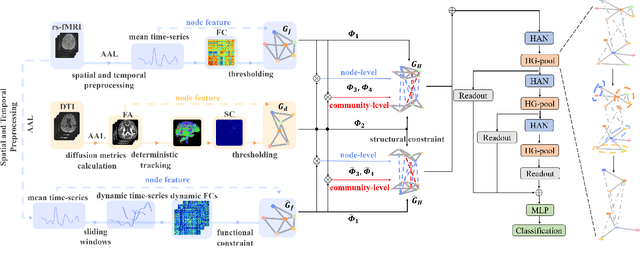
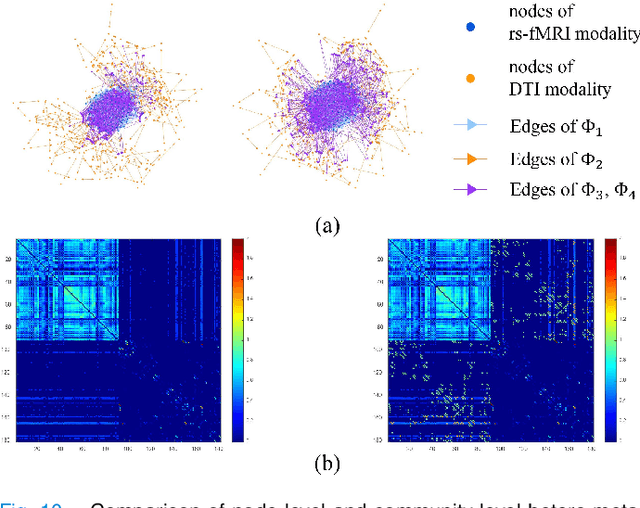
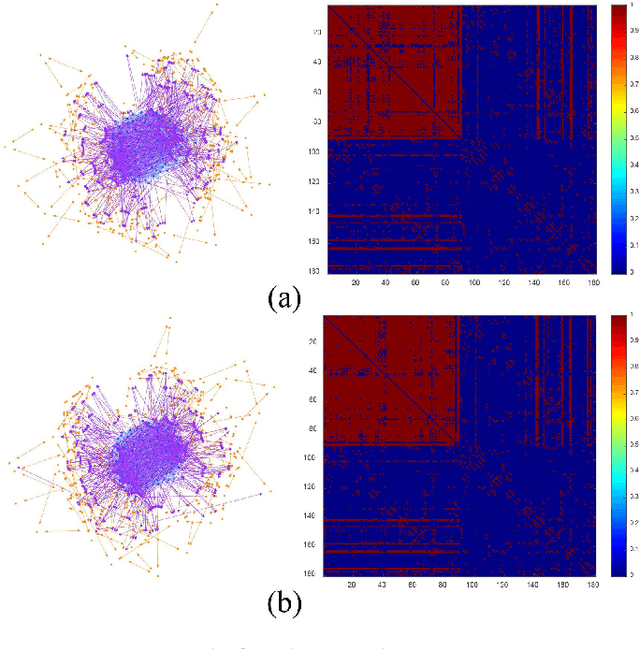
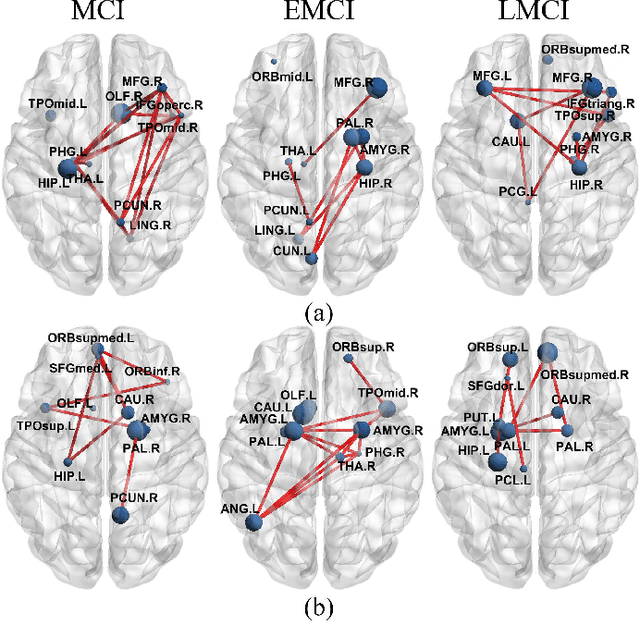
Brain connectivity alternations associated with brain disorders have been widely reported in resting-state functional imaging (rs-fMRI) and diffusion tensor imaging (DTI). While many dual-modal fusion methods based on graph neural networks (GNNs) have been proposed, they generally follow homogenous fusion ways ignoring rich heterogeneity of dual-modal information. To address this issue, we propose a novel method that integrates functional and structural connectivity based on heterogeneous graph neural networks (HGNNs) to better leverage the rich heterogeneity in dual-modal images. We firstly use blood oxygen level dependency and whiter matter structure information provided by rs-fMRI and DTI to establish homo-meta-path, capturing node relationships within the same modality. At the same time, we propose to establish hetero-meta-path based on structure-function coupling and brain community searching to capture relations among cross-modal nodes. Secondly, we further introduce a heterogeneous graph pooling strategy that automatically balances homo- and hetero-meta-path, effectively leveraging heterogeneous information and preventing feature confusion after pooling. Thirdly, based on the flexibility of heterogeneous graphs, we propose a heterogeneous graph data augmentation approach that can conveniently address the sample imbalance issue commonly seen in clinical diagnosis. We evaluate our method on ADNI-3 dataset for mild cognitive impairment (MCI) diagnosis. Experimental results indicate the proposed method is effective and superior to other algorithms, with a mean classification accuracy of 93.3%.