 Add to Chrome
 Add to Firefox
 Add to Edge
On Non-Stationary Dynamic Pricing: Adaptivity and Optimality
Jul 27, 2026
We study the contextual dynamic pricing problem under non-stationarity, where a firm sells products to $T$ sequentially arriving consumers that behave according to an unknown demand model that can change over time. The demand model is assumed to be a generalized linear model (GLM), allowing for a feature vector in $\mathbb{R}^d$ that encodes products and consumer information. To achieve optimal revenue (i.e., least regret), the firm needs to learn and exploit the unknown GLMs while monitoring for potential changes. We propose a multiscale change-point detection based algorithm that achieves a regret of order $\widetilde{O}(\sqrt{s_TdT}\wedge\{V_T^{1/3}d^{1/3}T^{2/3}+\sqrt{dT}\})$, where $s_T$ is the number of piecewise stationary segments and $V_T$ is a newly defined notion of design-adjusted variation budget of model parameters. Our algorithm is adaptive and does not require knowing $s_T$ or $V_T$. Moreover, to our knowledge, this is the first dynamic pricing algorithm that is adaptive to the nature of changes and achieves the best-of-both-worlds rate, thus closing a long-standing gap in the literature. We remark that, due to the varying contexts, existing works in the adaptive non-stationary bandit literature cannot be applied to achieve optimality for contextual dynamic pricing. The regret is further accompanied with a newly constructed minimax lower bound, confirming the optimality of our algorithm (up to logarithmic factors). Extensive numerical experiments are conducted to illustrate the efficiency and robustness of the proposed algorithm in non-stationary dynamic pricing.

Locally Private Nonparametric Contextual Multi-armed Bandits
Mar 11, 2025Motivated by privacy concerns in sequential decision-making on sensitive data, we address the challenge of nonparametric contextual multi-armed bandits (MAB) under local differential privacy (LDP). We develop a uniform-confidence-bound-type estimator, showing its minimax optimality supported by a matching minimax lower bound. We further consider the case where auxiliary datasets are available, subject also to (possibly heterogeneous) LDP constraints. Under the widely-used covariate shift framework, we propose a jump-start scheme to effectively utilize the auxiliary data, the minimax optimality of which is further established by a matching lower bound. Comprehensive experiments on both synthetic and real-world datasets validate our theoretical results and underscore the effectiveness of the proposed methods.
Contextual Dynamic Pricing: Algorithms, Optimality, and Local Differential Privacy Constraints
Jun 04, 2024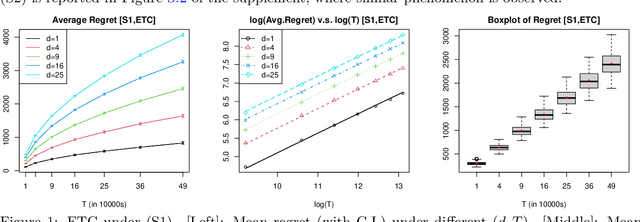
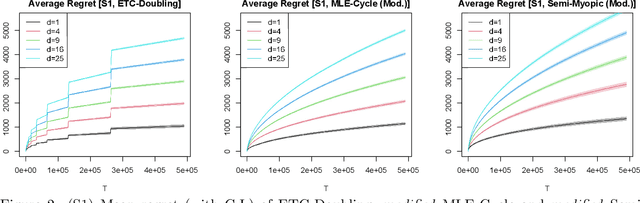
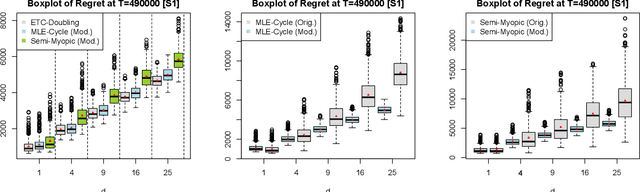
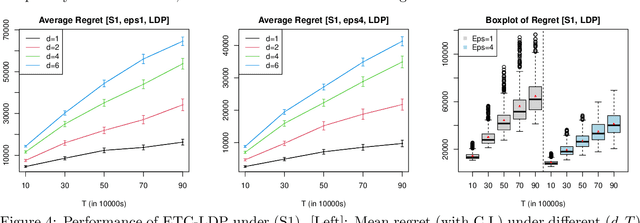
We study the contextual dynamic pricing problem where a firm sells products to $T$ sequentially arriving consumers that behave according to an unknown demand model. The firm aims to maximize its revenue, i.e. minimize its regret over a clairvoyant that knows the model in advance. The demand model is a generalized linear model (GLM), allowing for a stochastic feature vector in $\mathbb R^d$ that encodes product and consumer information. We first show that the optimal regret upper bound is of order $\sqrt{dT}$, up to a logarithmic factor, improving upon existing upper bounds in the literature by a $\sqrt{d}$ factor. This sharper rate is materialised by two algorithms: a confidence bound-type (supCB) algorithm and an explore-then-commit (ETC) algorithm. A key insight of our theoretical result is an intrinsic connection between dynamic pricing and the contextual multi-armed bandit problem with many arms based on a careful discretization. We further study contextual dynamic pricing under the local differential privacy (LDP) constraints. In particular, we propose a stochastic gradient descent based ETC algorithm that achieves an optimal regret upper bound of order $d\sqrt{T}/\epsilon$, up to a logarithmic factor, where $\epsilon>0$ is the privacy parameter. The regret upper bounds with and without LDP constraints are accompanied by newly constructed minimax lower bounds, which further characterize the cost of privacy. Extensive numerical experiments and a real data application on online lending are conducted to illustrate the efficiency and practical value of the proposed algorithms in dynamic pricing.