 Add to Chrome
 Add to Firefox
 Add to Edge
Deep Learning based Cross-Receiver Radio Frequency Fingerprint Identification Under Varying Channels
Mar 09, 2026
Radio frequency fingerprint identification (RFFI) exploits device-specific hardware impairments for transmitter recognition, but its performance is highly vulnerable to receiver variations and changing wireless channels in cross-receiver deployment. To address both challenges, this paper proposes a novel cross-receiver RFFI framework with channel robustness. In the enrollment stage, a channel-robust preprocessing method is developed to construct denoised spectral quotient (DSQ) sequences, and a DSQ-based convolutional neural network (DSQCNN) is trained using data collected from the source receiver. In the cross-receiver deployment stage, a calibration dataset is built from signals captured by both the source and target receivers, and a trainable calibration neural network (TCNN) is designed to learn the nonlinear mapping between them. The cascaded TCNN-DSQCNN framework then enables robust transmitter classification on the target receiver under varying channel conditions. To the best of our knowledge, this is the first work to jointly address channel and receiver portability through combined channel suppression and nonlinear receiver calibration. Simulations with twelve WiFi transmitters and three receivers show that the proposed method achieves reliable cross-receiver classification, reaching over 90\% accuracy at an SNR of 24 dB.

UAV's Rotor Micro-Doppler Feature Extraction Using Integrated Sensing and Communication Signal: Algorithm Design and Testbed Evaluation
Aug 29, 2024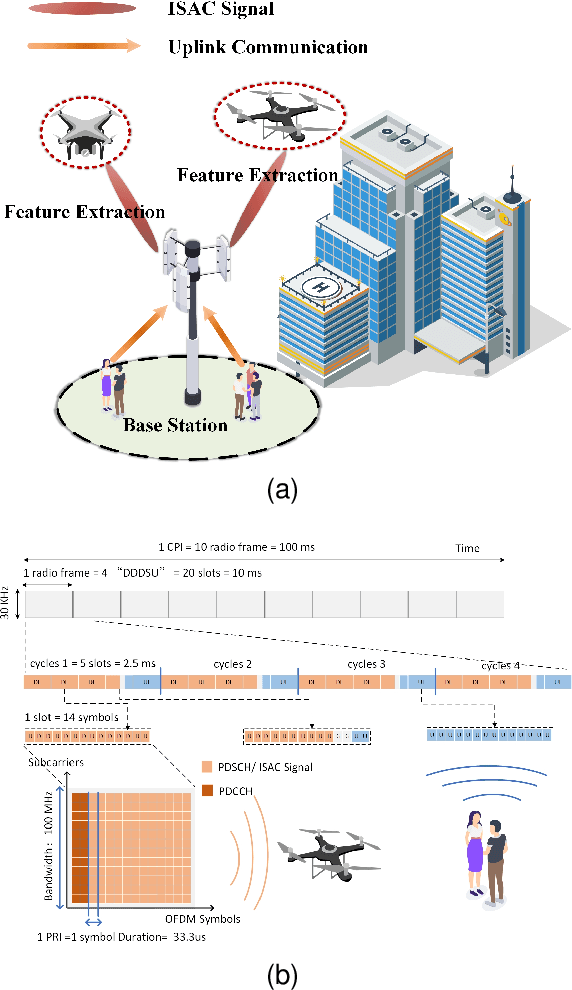
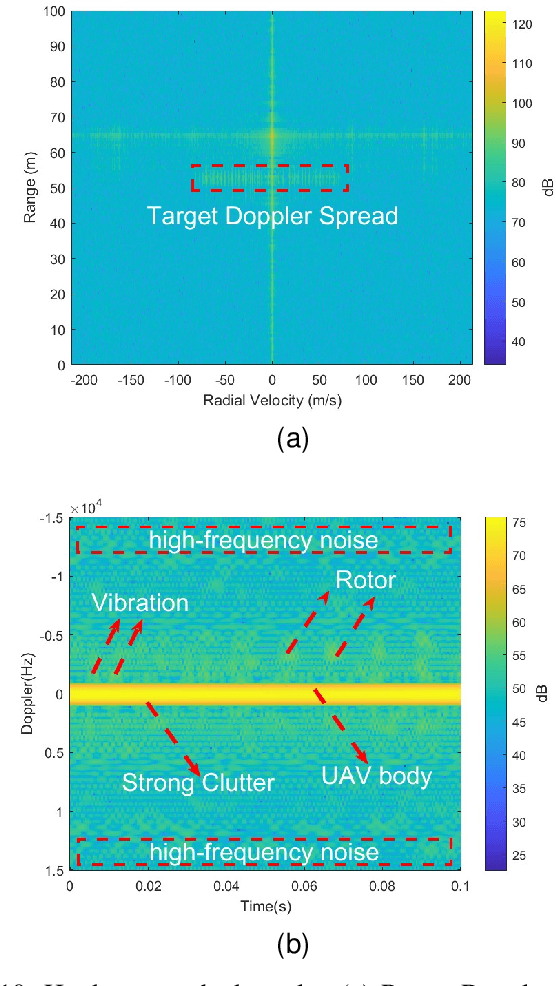
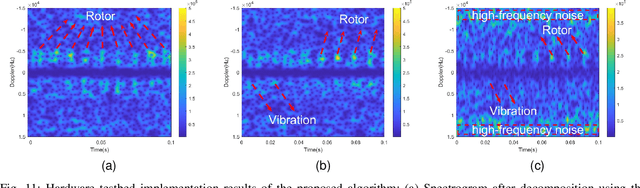
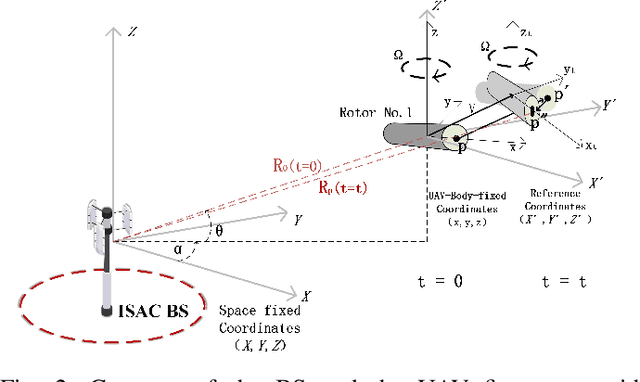
With the rapid application of unmanned aerial vehicles (UAVs) in urban areas, the identification and tracking of hovering UAVs have become critical challenges, significantly impacting the safety of aircraft take-off and landing operations. As a promising technology for 6G mobile systems, integrated sensing and communication (ISAC) can be used to detect high-mobility UAVs with a low deployment cost. The micro-Doppler signals from UAV rotors can be leveraged to address the detection of low-mobility and hovering UAVs using ISAC signals. However, determining whether the frame structure of the ISAC system can be used to identify UAVs, and how to accurately capture the weak rotor micro-Doppler signals of UAVs in complex environments, remain two challenging problems. This paper first proposes a novel frame structure for UAV micro-Doppler extraction and the representation of UAV micro-Doppler signals within the channel state information (CSI). Furthermore, to address complex environments and the interference caused by UAV body vibrations, the rotor micro-Doppler null space pursuit (rmD-NSP) algorithm and the feature extraction algorithm synchroextracting transform (SET) are designed to effectively separate UAV's rotor micro-Doppler signals and enhance their features in the spectrogram. Finally, both simulation and hardware testbed demonstrate that the proposed rmD-NSP algorithm enables the ISAC base station (BS) to accurately and completely extract UAV's rotor micro-Doppler signals. Within a 0.1s observation period, ISAC BS successfully captures eight rotations of the DJI M300 RTK UAV's rotor in urban environments. Compared to the existing AM-FM NSP and NSP signal decomposition algorithms, the integrity of the rotor micro-Doppler features is improved by 60%.