 Add to Chrome
 Add to Firefox
 Add to Edge
DLAM: Distributional Latent Actions with Temporal Constraints
Jul 29, 2026
Vision-language-action (VLA) models remain constrained by scarce action-labeled robot data, whereas action-free videos offer abundant observations of physical change. Latent action models can extract such priors, but reconstruction-trained codes may predict future observations without the structure required for joint generation with robot actions. Existing structured methods add temporal constraints but retain deterministic transition points, so residual errors in locally inferred transitions may propagate and compound under recursive composition. We introduce DLAM, a distributional latent-action model that represents each transition as a diagonal Gaussian. Reconstruction conditioned on the reference frame grounds the mean in observed visual change, while normalized composition and reversal over equal-gap triplets constrain both the mean and dimension-wise variance. Variance composition uses a lightweight shared-correlation coefficient to account for dependence between adjacent transitions that share an intermediate frame, whereas reversal negates the mean and preserves the variance. For downstream policy learning, we freeze the encoder and train a flow-matching policy to jointly generate mean transition sequences and robot actions. On held-out transitions, DLAM learns more temporally consistent latent dynamics than existing latent-action baselines and achieves stronger direct and cumulative reconstruction on held-out videos. Under the same controlled $π_0$ transfer protocol, it also improves policy performance on MetaWorld MT50, LIBERO, and real-world manipulation tasks. Controlled ablations show that normalized mean constraints account for most of the reconstruction gain, while learned variance and correlation-aware composition provide complementary improvements in downstream control.

Coarse-to-Fine: A Hybrid Self-Supervised Method for Non-rigid 3D Shape Matching
Jun 25, 2026Non-rigid 3D shape matching is a fundamental task in computer vision and graphics. In this paper, we propose a hybrid self-supervised method based on a coarse-to-fine strategy, which ensures consistency between the coarse mapping and the refined correspondence produced by our refinement module. The architecture features a dual-branch design, consisting of two symmetric functional map learning streams: one based on the Laplacian basis and the other utilizing the elastic basis. Extensive experiments show that our approach not only maintains computational efficiency, but also achieves state-of-the-art performance across a variety of challenging scenarios, including non-isometric deformations and topological noise. Finally, we rigorously demonstrate that contrastive energies promote feature discrimination. Furthermore, integrating these energies with existing methods yields consistent improvements, validating the overall efficacy of our approach. Our code is available at https://github.com/LuoFeifan77/Coarse-to-Fine-Hybrid-Self-Supervised-Matching.
From Feature Learning to Spectral Basis Learning: A Unifying and Flexible Framework for Efficient and Robust Shape Matching
Mar 25, 2026Shape matching is a fundamental task in computer graphics and vision, with deep functional maps becoming a prominent paradigm. However, existing methods primarily focus on learning informative feature representations by constraining pointwise and functional maps, while neglecting the optimization of the spectral basis-a critical component of the functional map pipeline. This oversight often leads to suboptimal matching results. Furthermore, many current approaches rely on conventional, time-consuming functional map solvers, incurring significant computational overhead. To bridge these gaps, we introduce Advanced Functional Maps, a framework that generalizes standard functional maps by replacing fixed basis functions with learnable ones, supported by rigorous theoretical guarantees. Specifically, the spectral basis is optimized through a set of learned inhibition functions. Building on this, we propose the first unsupervised spectral basis learning method for robust non-rigid 3D shape matching, enabling the joint, end-to-end optimization of feature extraction and basis functions. Our approach incorporates a novel heat diffusion module and an unsupervised loss function, alongside a streamlined architecture that bypasses expensive solvers and auxiliary losses. Extensive experiments demonstrate that our method significantly outperforms state-of-the-art feature-learning approaches, particularly in challenging non-isometric and topological noise scenarios, while maintaining high efficiency. Finally, we reveal that optimizing basis functions is equivalent to spectral convolution, where inhibition functions act as filters. This insight enables enhanced representations inspired by spectral graph networks, opening new avenues for future research. Our code is available at https://github.com/LuoFeifan77/Unsupervised-Spectral-Basis-Learning.
Unsupervised Contrastive Learning for Efficient and Robust Spectral Shape Matching
Mar 19, 2026Estimating correspondences between pairs of non-rigid deformable 3D shapes remains a significant challenge in computer vision and graphics. While deep functional map methods have become the go-to solution for addressing this problem, they primarily focus on optimizing pointwise and functional maps either individually or jointly, rather than directly enhancing feature representations in the embedding space, which often results in inadequate feature quality and suboptimal matching performance. Furthermore, these approaches heavily rely on traditional functional map techniques, such as time-consuming functional map solvers, which incur substantial computational costs. In this work, we introduce, for the first time, a novel unsupervised contrastive learning-based approach for efficient and robust 3D shape matching. We begin by presenting an unsupervised contrastive learning framework that promotes feature learning by maximizing consistency within positive similarity pairs and minimizing it within negative similarity pairs, thereby improving both the consistency and discriminability of the learned features.We then design a significantly simplified functional map learning architecture that eliminates the need for computationally expensive functional map solvers and multiple auxiliary functional map losses, greatly enhancing computational efficiency. By integrating these two components into a unified two-branch pipeline, our method achieves state-of-the-art performance in both accuracy and efficiency. Extensive experiments demonstrate that our approach is not only computationally efficient but also outperforms current state-of-the-art methods across various challenging benchmarks, including near-isometric, non-isometric, and topologically inconsistent scenarios, even surpassing supervised techniques.
Deep MSFOP: Multiple Spectral filter Operators Preservation in Deep Functional Maps for Unsupervised Shape Matching
Feb 06, 2024
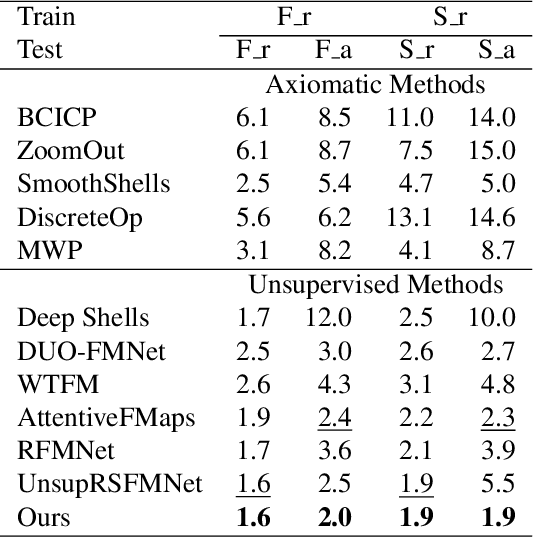
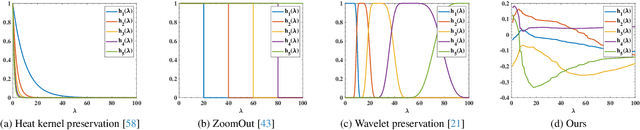
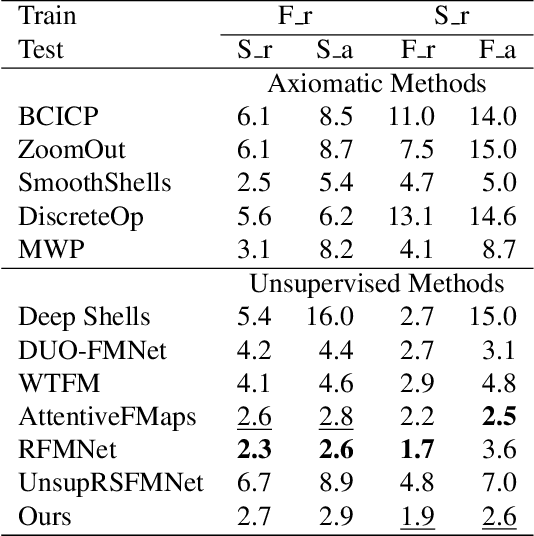
We propose a novel constraint called Multiple Spectral filter Operators Preservation (MSFOR) to compute functional maps and based on it, develop an efficient deep functional map architecture called Deep MSFOP for shape matching. The core idea is that, instead of using the general descriptor preservation constraint, we require our maps to preserve multiple spectral filter operators. This allows us to incorporate more informative geometrical information, contained in different frequency bands of functions, into the functional map computing. This can be confirmed by that some previous techniques like wavelet preservation and LBO commutativity are actually our special cases. Moreover, we also develop a very efficient way to compute the maps with MSFOP constraint, which can be conveniently embedded into the deep learning, especially having learnable filter operators. Utilizing the above results, we finally design our Deep MSFOP pipeline, equipped with a suitable unsupervised loss jointly penalizing the functional map and the underlying pointwise map. Our deep functional map has notable advantages, including that the functional map is more geometrically informative and guaranteed to be proper, and the computing is numerically stable. Extensive experimental results on different datasets demonstrate that our approach outperforms the existing state-of-the-art methods, especially in challenging settings like non-isometric and inconsistent topology datasets.